Tuesday, 28 September 2021

Arthur Bliss: Piano Quintet (1919) Part II

A brief survey of several other contemporary reviews, in chronological order will be followed by a summary of what Arthur Bliss’s “lost” Piano Quintet may have sounded like. 

The unsigned review of the concert in The Times (28 April 1920, p.14) - possibly by H.C. Colles - considered that Bliss’s Quintet was “an exceedingly interesting work, rising to moments of striking beauty in the central movement of the three.”  Furthermore, it impressed the critic by displaying a “real originality of melodic design and a high sense of the colour contrast producible from strings and piano in combination.” Alas, not “all of these possibilities of colour seemed to be realized in this rather rough performance.”

A critique in the Westminster Gazette (28 May 1920) suggested that Arthur Bliss’s Quintet “was quite worth hearing.” The premiere performance in Paris was alluded to and deemed appropriate as the work was “redolent of French influence through and through.”  Regrettably he writes that “this is indeed the only fault which has to be found with so many of these clever young English composers of the present day. One feels that they could never have been written as they stand if Debussy, Ravel, and the other French modernists had never existed; and this is a thing which one ought not to be able to say of English music.”  The reviewer completes his rant by asking, “What...is the good of casting off the oft-deplored influence of Handel, Mendelssohn, Brahms, and the rest, [if] it is only to substitute that of Debussy, Ravel and other Frenchmen in its place? Certainly, we shall never achieve the regeneration of English music in this way.”  Presumably he was an Elgar, Parry and Stanford enthusiast.

Robin Legge for The Telegraph (29 April 1920, p.15) as “curious” the performance of Stravinsky’s Ragtime, but that which was “quite sane” was the Bliss Quintet. This new work was played “fairly well, but only fairly” by the Philharmonic Quartet. Legge felt that the “Quintet seems to have a little of a Scots twang about it.” Bliss has written music that is “frankly melodious, often very rhapsodical, more often incohesive, in that the joints are far too visible.” On top of this, he has “apportioned a rather dull share” of the score to the piano. That said, the enthusiastic audience “cheered him lustily on his way as a composer, and he was called and recalled many times.”

Ernest Newman (Sunday Times, 2 May 1920, p.6) states that the quintet was “on first hearing seemed to me to be a rather cold-blooded piece of pure headwork…”  Percy A Scholes, writing in The Observer (2 May 1920, p.11) felt that Bliss’s Piano Quintet “has a very quiet refined slow movement -   sort of intimate conversation à cinq. The work as a whole is much in the French style, and strikes me as a promising experiment, rather than achievement.”

Finally, The Athenaeum (7 May 1920, p.614) reported that “Mr Bliss has learned something it is clear, from Debussy, Elgar, Ravel, Stravinsky and Vaughan Williams, and some day he will weld the results of his various musical experiences into a style of his own.” On the positive side, was the “individual and compelling…wonderful energy and exuberance.” The Quintet was “reminiscent, but it has no cliches, no padding, no empty rhetoric; it is always vital and expressive, often genuinely noble and beautiful” Finally, it avoids “those characteristic English vices, pompousness and sentimentality, and it is full of delightful and original colour-effects. Its only grave faults are its untidiness of style and its looseness of structure.”

The critics are almost unanimous in pointing out the French influence on Bliss’s Quintet. Debussy and Ravel rather than Vaughan Williams or Edward Elgar are exemplars for this work. This was especially evident in the luminous colour effects of the scoring. Secondly, there seems some concern about the rather “loose” formal structure of the work. And finally, the overall mood of the piece would seem to have been rhapsodic underpinned by strong melodies.

Saturday, 25 September 2021

Arthur Bliss: Quintet for two violins, viola, cello and piano (1919) Part I

What do we know about Arthur Bliss’s Quintet for two violins, viola, cello and piano? The answer is not a lot. 

The work was composed in London during 1919, and was “Dedicated to the City of Bath, and three friends met therein: Sir Hugh Miller, Lady Stuart of Wortley and Leo. F. Schuster.” It was never published, and the manuscript is lost. The first performance was given in Paris on 26 November 1919 at La Salle Gaveau and was played by the Philharmonic Quartet with the composer at the piano.  The British premiere was heard at the Aeolian Hall on 27 April 1920, by the same performers. At thi same concert Stravinsky’s Ragtime for 11 instruments was heard for the first time.

At the start of 1919, (15 February) Arthur Bliss was discharged from the army. He had been a combatant since enlisting in the Court Officer’s Training Corps, on 31 August 1914.

Four widely varying works were completed during 1919. None of them has become part of Bliss’s legacy. The incidental music for the Nigel Playfair production of Shakespeare’s As You Like It has also suffered from the loss of the holograph. It was never published. The quality of the music can only be surmised from the contemporary reviews. The somewhat surreal, but remarkable tonal study, Rhapsody for solo voice and chamber ensemble has survived. But it is hardly secure in the repertoire. Finally, Bliss’s arrangement of Purcell’s music, as a Set of Act Tunes and Dances, has clung on, and has had at least a single recording made by the composer conducting the Sinfonia of London.

The Musical Times (January 1920, p.63) noted that the Philharmonic String Quartet gave two concerts at the Salle Gaveau in Paris. The first, on 22 November 1919 included Eugène Goossen’s Quartet, op.14, Josef Holbrooke’s Three Songs with strings and accompaniment, with John Goss as vocalist. This was followed by Frank Bridge’s Three Idyls and Holbrooke’s Symphonic Quintet, op.44 with the soloist at the piano.  The second concert included Edward Elgar’s Quartet, op.83, Cyril Scott’s Quartet No.1?], and the Bliss Quintet for piano and strings.  The performance was noted in Musical America (27 December 1919) where the critic remarked on the “exclusively British compositions.” He noted “a very interesting Piano Quintet by Arthur Bliss, which although still in [manuscript] will doubtless be widely played.” This was well wide of the mark.  I was unable to locate a review in the contemporary French press.

The concert held at the Aeolian Hall on 27 April 1920 began with a performance of Mozart’s Divertimento in D major, K.131. This was followed by the “Chinaman’s Song” from Henry Purcell’s The Fairy Queen. It was sung by Gerald Cooper and featured a trumpet obligato played by a Mr. H. Barr. Other vocal numbers included Benjamin Dale’s Two Songs from Shakespeare, op. 9 (1919), “O mistress mine” and “Come away death” from As You Like it. Cooper also included Thomas Morley’s original version of the former song. The remainder of the concert was devoted to the London premiere of Bliss’s Piano Quintet and the world premiere of Igor Stravinsky’s Ragtime for 11 instrumentalists.  

Some reviews of Arthur Bliss’s lost Quintet will follow in a subsequent post.

Sunday, 19 September 2021

Some Jottings on Alexander Goehr’s Nonomiya for piano, op. 27 (1969)

Whilst exploring John McCabe’s Sonata for clarinet, cello and piano which was commissioned for the 1969 Macclesfield Arts Festival, I came across the other work specifically composed for this event. The catalogue of Alexander Goehr’s music compiled by Schott in 2013, states that Nonomiya, op. 27 for piano was commissioned by Brocklehurst-Whiston Amalgamated. This was a large silk mill, based at Hurdsfield, near Macclesfield.  Interestingly, Gerard Larner writings in the Manchester Guardian (13 May 1969) states that the work was commissioned by the former textile machinery giant, Ernest Scragg and Sons. I will assume that the catalogue is correct. 

Nonomiya is the title of a Noh play. This art form is a Japanese theatrical tradition combining poetic texts, ritualistic drama, dance, and music with elaborate costumes and simple props. The Noh play originated in the 14th century and flourished during the 17th century. There are more than 200 examples from that period still extant. This genre was influential on W.B. Yeats and Ezra Pound.  Benjamin Britten’s Curlew River is based on the Noh play Sumida-gawa (Sumida River) of Juro Motomasa (1395–1431). Britten saw this play when he was in Japan during 1956.

Goehr’s Nonomiya opens with a declaimed song with a “finely drawn vocal line in the first part, surrounded by somewhat exotic decoration” given by the “principal actor”. (Dawes 1975, p.719).  In the second section, possibly some centuries later he returns as a ghost, and rails against those who have caused his death. The mood of the music takes on that of a dance and then the characters “exeunt.” 

In reality, Goehr has used the Noh play’s traditional bipartite structure as a starting point. Bill Hopkins (Northcott, 1980, p.22) quotes the composer as saying that “the piece does not depict, it enacts.”  A good evaluation. This music is not programmatic and does not attempt to follow the story of this play. In fact, the liner notes (CD PFCD 013) suggest that the main character is a man, rather than a woman. In the original Nonomiya play, the chief protagonist is Lady Rokujō, an extremely jealous personality derived from The Tale of Genji. The overall impact of this play is of a character “soaked in the feeling of deep suffering and pensiveness that comes from living in this world.” This does not describe the predominant mood of Goehr’s work.

It is interesting that although he has not attempted to “create an explicitly Eastern sound-world, its finely wrought 'calligraphic' detail expresses a subtle affinity with Japanese culture.” (Pruslin, Liner note, AUC 1005).

Bill Hopkins (Northcott, 1980, p.22) writes that the “intervallic constants which form the core of the piece’s serial apparatus are presented with aggressive insistence, and – as is appropriate in such a dramatically gestural work - much of the emphasis is switched to rhythmic invention…” This creativity seems to transcend the dodecaphonic structure of the piece. Furthermore, Nonomiya “is deliberately more florid and showier; it has stylized, objective brilliance which throws into relief the ritualised contrasts the work encompasses – between, for example, embellished cantilena style and the stark rhythmic composition of the closing pages.” Finally, Hopkins considers that the piano “ceases to be a mechanical vehicle for musical thought, and becomes a persona, a protagonist in the [Noh] drama…”

Stylistically, Goehr’s Nonomiya looks back to the pianism of Aleksandr Scriabin, the tight concentration of Claude Debussy’s Sonatas and the logical perfection of Anton Webern’s Symphony, op.21 for inspiration.  Yet, these have been subtly deployed rather than parodied.

John Ogdon was the soloist at the piano recital given on 12 May 1969 at the King’s School, Macclesfield. His programme included Beethoven’s “Appassionato” Sonata, Schubert’s “Wanderer” Fantasy and Chopin’s Sonata in B flat minor. Gerald Larner (Manchester Guardian, 13 May 1969) was delighted that the Macclesfield Art Festival’s “interest in English music is happily not restricted to period pieces and pillars of the establishment.” This was evident in Goehr’s new work heard the previous evening. He considers that “it is an interesting piece. It begins unpromisingly with an obsessive insistence on certain chords and intervals, the texture opaque and the melodic interest lost somewhere in the middle, but it gradually clarifies.” Larner suggests that the “middle section is graced by the parlando [in a ‘speaking’ manner] lyricism of the Japanese dramatic declamation and the piano’s climactic percussive figures atmospherically recall the use of the drum in Noh drama.” He concludes by suggesting that further performances “will clarify the first part too.”  Sadly, Alexander Goehr’s Nonomiya has largely fallen by the wayside. Turning to the other works in the recital, Gerald Larner felt that Ogdon was at his “commanding best” during the ‘Appassionata’ Sonata. On the other hand, the “quieter passages” of the Schubert’s Wanderer Fantasy “lacked something in physical strength as well as accuracy.” Finally, Chopin’s Sonata “gained much from Mr. Ogdon’s mature interpretive insight.” The recital was followed by a “generous succession of encores”.

In 1983, Auracle Records released an LP (AUC 1005) featuring the premiere recording of Peter Maxwell Davies’s Piano Sonata. This was coupled with Goehr’s Nonomiya and Capriccio. The pianist was Stephen Pruslin.  Reviewing this album for The Gramophone (December 1983, p.801) Arnold Whittall considered that “Nonomiya is...demanding and impressive in its slow, inexorable build-up to a final, vehement yet formal explosion. Here Pruslin's rhythmic precision and delicacy of touch are abundantly in evidence, though the climax lacks something in sheer dynamic force.” In 1999, Elisabeth Klein issued a recording of Nonomiya on her compilation album, Music of the Night (Classico CLASSCD 270). Another CD was issued in 2012 on the Prima Facie Label (CD PFCD 013) played by Panayiotis Demopoulos. It features music by David Ellis, Anthony Gilbert and the pianist. A remarkable live performance of Nonomiya recorded by Jonathan Powell in 2019 has been uploaded to Sound Cloud.

Bibliography:
Dawes, Frank “Review: Modern Piano” The Musical Times, August 1975, p.719-720)
Northcott, Bayan, ed. The Music of Alexander Goehr, (Schott & Co. London, 1980)
Files of the Manchester Guardian, The Gramophone, CD liner notes etc.

Thursday, 16 September 2021

John Ireland: Trio in D for clarinet, cello and piano (1913)

Before listening to John Ireland’s Trio in D for clarinet, cello and piano, I recommend reading the excellent essay by Stephen Fox at MusicWeb International. I have noted before that this is an excellent piece of musical scholarship, that is not technically off-putting. Further contextualisation of this piece can be gained from the liner notes written by Giles Easterbrook for the Prima Facie recording of the work.  This explains that the Trio’s history is complex, its chronology uncertain and Ireland’s motivation ‘debatable.’  

Distilling all this information provides the following overview of the Trio’s genesis, development and reception. The work appears to have been composed during 1912-1913. It was premiered during a Thomas Dunhill chamber concert in the Steinway Hall on 9 June 1914. The soloists were Charles Draper, who was known as the grandfather of English clarinettists, May Mukle (cello) and the composer playing the piano. After a couple of performances, the composer withdrew the Trio. Subsequently, elements of the piece were introduced into a conventional Piano Trio. Alas, this itself was abandoned. Eventually, some of the music was included in Ireland’s Piano Trio No.3 in E major, composed in 1938. This has established itself in the repertoire.

Stephen Fox, the Canadian clarinettist, clarinet maker and musicologist has reconstructed a ‘satisfying work of some beauty, great vigour and a delightful addition to the repertoire’. The above-mentioned essay by Fox explains how this was achieved.

What does this Trio sound like, and how does it fit into John Ireland’s musical aesthetic? I think that listeners who are au fait with the composer’s music will recognise the present work’s pivotal nature. The influence of Johannes Brahms and Charles Villiers Stanford had been respectfully laid aside to be replaced by something that nods to Maurice Ravel and Claude Debussy. On the other hand, Fox makes a valid point in declaring that this Trio could not have been written by anyone other than a British composer. Certainly, there are some hat tips to folksong, if not any actual quotations.

This is a gorgeous work that provides the listener with a beautiful evocation of the landscape heard through the prism of Ireland’s mind. It is hard to believe that there are only two recorded versions of this masterpiece currently available. It seems to me that this pivotal work should be at the forefront of John Ireland’s chamber music repertoire.

An excellent recording of Ireland’s Trio can be heard on the Prima Facie CD label (PFNSCD 009). It is performed by the Tritium Trio: Jernej Albreht clarinet, Joseph Havlat, piano, Lydia Hillerudh, cello. Other works on this disc include John McCabe’s Sonata for clarinet, cello and piano (1969), Kenneth Leighton’s Fantasy on an American Hymn Tune (1975) and Giles Easterbrook’s Trio (2002).

The Naxos recording of John Ireland’s Trio in D for clarinet, cello and piano, has been uploaded to YouTube. It is presented as three videos: Allegro non Troppo, Scherzo-Vivace and Lento con moto. The artists are Robert Plane, clarinet, Sophia Rahman, piano and Alice Neary, cello.


Monday, 13 September 2021

Philip Wilby: Lowry Sketchbook for brass band (1992)

Whilst investigating John McCabe’s brass band piece, Northern Lights, I discovered Philip Wilby’s remarkable Lowry Sketchbook. This was composed in 1992 for the Britannia Building Society Band (now Foden’s Band). It has become a popular test piece and a highly regarded concert work. 

In 1993 the composer explained that he “wrote this piece when I was ‘composer in residence’ with the Britannia Band, and the pictures I’ve chosen are all on display in the Salford Art Gallery, so it’s my ‘Manchester’ piece.” Since that time, the Lowry Collection has been established at Salford Quays and many of the paintings relocated there.  

No introduction is needed to L.S. (Laurence Stephen) Lowry (1887-1976). He remains one of best known and loved British artists of all time. Much of his life was spent in his native Salford, a city that is often wrongly subsumed into neighbouring Manchester. His trademark “matchstick men” in industrial surroundings overwhelms his other major achievements as a fine and innovative portrait painter. He also produced several amazing seascapes.

Philip Wilby’s Lowry Sketchbook was composed in three movements: City Scape, Family Portraits, and Peel Park: The Bandstand.  The work lasts for about 15 minutes.  Fortunately, the composer has provided programme notes for his Lowry Sketchbook. These have been uploaded to the Internet. He 
writes:

“The first is called City Scape and, in typical Lowry style, contrasts the fragile nature of humanity - individual figures, all different from each other - against the great, throbbing energy of the industrial landscape in which we live.” 

The second [movement] is a tribute to the family, though I have in mind more universal family elements, a cross-generation thing, so it’s a sentimental melody rather old fashioned, but I’m rather fond of it.

The last one is a depiction of Peel Park - a subject Lowry painted several times - The Bandstand as seen from the window of the Art Gallery itself. A huge crowd of Mancunians, or Salfordians, dances to the music of a brass band. What sort of music would it be playing? In my case something arranged from the classics. To say any more would give the game’ away.”

During the first movement, I can imagine railway locomotives shunting wagons at Salford Docks or clattering machinery in one of the Lancashire countless mills. It is also quite scary. Clearly the Salford of Lowry’s imagination was a grim and menacing place to work and live.  It is a frenetic piece.   

The second movement puts a human face on much that is faceless. The magic of Lowry’s artistic style is that each one of the “matchstick” men, women and children have a unique personality. Wilby has chosen to celebrate the family life, which was hard for all concerned. Yet there were compensations. Music-making was important: performances of Messiah were ubiquitous in Lancashire. Brass bands and choral societies vied with sport and the public house for people’s interest, and often overlapped. This music, which is sentimental at times, brings a touch of humour and humanity to what must have often been grinding poverty in Lowry’s day. It is dark hued, but just occasionally a shaft of sunlight breaks thorough the house, factory and railway engine smoke. It is music to bring a tear to the eye.

The finale is rip-roaring. Do the extrovert fanfares and represent high-days and holidays in Peel Park, Salford? Certainly, Lowry painted the band stand in the park on several occasions. It is satisfying to note that Peel Park is still intact in all its glory. The air will certainly be a lot cleaner than it was back in the artist’s day. The composer has indicated that the tune quoted here is based on Bach’s Partita in E. There is an almost Charles Ives-ian effect here of several pieces of music being heard at the same time. This ‘toccata’ ends with a powerful and exciting peroration. 

A good live recording of Philip Wilby’s Lowry Sketchbook has been uploaded to YouTube. The work has been issued on CD. (DOYCD053) played by the Black Dyke Mills Band.

Friday, 10 September 2021

York Bowen (1884-1961) Piano Works on Chandos - Volume 3

I guess the one thing that put York Bowen’s career into perspective for me, was meeting a lady on a train. Conversation about the weather turned to London, the Wigmore Hall and the piano. She told me that the examiner at one of her early ‘grades’ was - York Bowen. My travelling companion probably took her Grade 5 around 1959, two years before his death. The liner notes point out that the composer lived from a time when a person could have been expected not to have seen a motor car, to a date when John Fitzgerald Kennedy announced his intention to land men on the Moon. And there were two World Wars in between. He lived through remarkable years.

It is interesting to note that the earliest piece on this CD, the Three Preludes was composed in 1905 and the latest, the Toccata in 1957. 

It is only relatively recently that enthusiasts of British music have been able to get their heads around Bowen’s music. For many years, during the ’sixties, ’seventies and ’eighties the only record that was generally available was the composer’s recital on Lyrita: it was a good and tantalising introduction. I immediately fell in love with the selection of Preludes, op.102 (pub.1950) – most especially the gorgeous ‘seventh’.

It is not the place to develop a chronological discography of York Bowen, but the highlights have to include several versions of the Viola Concerto, a considerable variety of his chamber music, concertos and orchestral works on the once prolific Dutton Epoch label, the fine ‘Romantic Piano Concertos’ volume from Hyperion, and Symphonies Nos. 1 and 2 on Chandos. Finally, there is Danny Driver’s masterly account of all six Piano Sonatas on Hyperion.  The biggest project was the potentially complete solo piano music by Joop Celis on Chandos. Sadly, the project was abandoned after the fourth volume. A large section of Bowen’s piano music therefore remains to be recorded.

The CD opens with a fine performance of one of the longest of the composer’s piano pieces that is not a Sonata: Ballade No.2 in A minor op.87. This is a fine work, one which allows the listener to ‘get into’ Bowen’s style. The liner-notes suggest that this piece is “somewhat epigrammatic in its melodic writing”. However, the nature of a Ballade is that it takes a simple story and embellishes it with detail. It is exactly this process which the composer uses to such great effect here. It places huge demands on the soloist, both from a technical and from an interpretive perspective.  It was published by Oxford University Press in 1931 and was presumably written around that time.

I enjoyed the delicious Three Songs without Words op.94, which belie their ‘late’ date of 1935. There is nothing of the ‘Second Viennese school’ about these romantically overblown works! I could suggest several sources for his inspiration, but that would be largely irrelevant. Let’s just say that if you like Fauré you will love these dreamy pieces. There is a certain sadness here which resolves into a definite feeling of ‘heartsease’. I believe that these three ‘songs’ – Song of the Stream, Solitude and The Warning – ought to be heard as a group.

I guess that many people will know that York Bowen wrote his Twenty-Four Preludes ‘in all the major and minor keys’ in 1950. I agree with those commentators who regard this work as the composer’s masterpiece – at least within the ambit of the solo piano literature. There are a small number of other Preludes which Bowen wrote at various times in his career.  The present Three Preludes op.81 date from the late 1920s and can be seen as a precursor to his larger opus. Unfortunately, due to ‘the limitations of playing time’ only the second and third of these delightful numbers have been recorded. Now, I have no problems with the length of this CD – just 40 seconds shy of eighty minutes. But it does trouble me that this first Prelude may have been lost for good. I doubt if there will be many subsequent recordings of this music and I imagine that if Chandos did release Volume 5 it would be somewhat of an ‘orphan’ if presented there.  But the fact remains, these two Preludes are worthy of Bowen’s art, especially the ‘heart-on-the-sleeve’ romance of the ‘allegretto grazioso’.

If the listener is of the impression that the Short Sonata, op.35, no.1 (1922) is ‘diminutive’, in some way akin to a ‘sonatina’ suitable for neophytes, they are mistaken. This Sonata is fourteen minutes long, so it is ‘not really that short’.  It is correct to suggest that this work ought to be ‘numbered’ as one of the composer’s list of piano Sonatas – which would then number seven. Listen for the ‘haunting tune’ at the start of the middle movement and note the finale, a ‘presto scherzando’ which is a sheer delight.

The Three Miniatures op.44 are another example of music where the title belies the depth and the technical difficulty. These were ‘wartime’ pieces which were completed in 1916: they seem a million miles away from the horrors of that time. Bowen composed this music shortly after he had been invalided out of the Scots Guards - his wartime service thankfully complete. Robert Matthew-Walker, in the liner notes, suggests that they are in fact ‘studies in rhythm’ rather than just written for the salon. The opening Prelude is thoughtful and makes use of subtle variations and part-writing. Look out especially for the sultry Spanish flavour of the second – an Intermezzo.  The final ‘allegro scherzando’ is quite lovely – but is certainly not easy. There is a magic about these ‘miniatures’ that seem to define much of Bowen’s pianistic style.

The Three Serious Dances, op.51 (1919) are quite a contrast to the Three Miniatures. I guess that the title derives from the generally introspective feel of this music. I agree with Robert Matthew-Walker that there is a constant forward momentum in these three pieces. There is no doubt that they are ‘retro’ – even for 1919. Nevertheless, they are beautiful and exquisite. I was most struck by the ‘languid’ second Dance, which like the others is in no way sentimental or clichéd. The last Dance in F# major, a forceful ‘allegro molto pomposo’, is technically demanding, if not quite pushing the bounds of Listzian virtuosity.

The late Toccata op.155 from 1957 was reconstructed from the autograph score by Stephen Hough. Lasting for some five minutes, it is exactly what one would imagine a toccata to be. Full of highly technical writing, it is well laid out for pianists allowing them at least half a chance of playing this demanding music. The composer gave the first performance at the Wigmore Hall in June 1960 – the year before his death. At that time. he would have been 76 years old. It is surely a tribute to his enduring keyboard technique that this work was a huge success at that recital.

The CD closes with the earliest item on this CD – the Three Pieces op.20 which date from 1905. Despite their obvious Francophile influences – Debussy, Ravel and Saint-Saëns spring to mind - these are convincing works. The 21-year-old composer was probably under a heap of influences at that time: the programme notes mention Grovlez and Fauré as being influential. I must be honest and state that the Arabesque, the Reverie d ‘Amour and the Bells are derivative. Contrariwise Bowen handles his material with skill, honesty and conviction.

This is a great CD. All the music is beautifully played by Joop Celis, who has manifestly become one of Bowen’s champions. The recording is superb and has a clarity that certainly adds considerably to an appreciation of this underrated music. The programme notes by Robert Matthew-Walker add to the listener’s enjoyment.

One last thought, York Bowen is a composer who seriously impresses me. Yet, it is more than this. Along with Cyril Scott, Samuel Barber and Maurice Ravel, I have never yet heard a piece of his music that I have not thoroughly enjoyed or been moved by. That is surely a rare thing. And it is certainly not true of some of the ‘greats’ – at least for me.

Track Listings:
York BOWEN (1884-1961)
Ballade No.2 op.87 (1931)
Three Songs without Words op.94 (1935)
From Three Preludes op.81 (late 1920s)
Short Sonata Op.35 no.1 (1922)
Three Miniatures op.44 (1916
Three Serious Dances op.51 (1919)
Toccata op.155 (1957
Three Pieces op. 20 (1905)
Joop Celis (piano)
Rec. Willem Hijstek Zaal, Maastricht Conservatory, The Netherlands, 21-24 March 2008
CHANDOS CHAN10506

Tuesday, 7 September 2021

Discovering John McCabe’s Northern Lights for brass band (1993)

I guess that I was disappointed when I discovered that John McCabe’s Northern Lights for brass band has nothing to do with the Auroa Borealis. This phenomenon is usually associated with the Arctic Circle (and above). Nevertheless, these “polar lights” can sometimes be seen in the United Kingdom when the atmospherics are right, and light pollution is low. McCabe is well known for his ‘descriptive’ titles. Think of Cloudcatcher Fells, also for brass band, inspired by the composer’s favourite places in the English Lake District. Then there is Maunsell Forts, evoking the abandoned Second World War steel citadels in the Thames Estuary.  So, learning that Northern Lights was a tribute to the memory of Harry Mortimer C.B.E. was a wee bit of a let-down. That said, all brass band enthusiasts will recognize the huge contribution made by Mortimer to the brass band movement, especially in the North of England. 

Northern Lights is scored for the standard band forces plus a good selection of percussion instruments. Like most of McCabe’s contributions to the brass band repertoire, it is quite a long piece at 11 minutes - at least compared to the standard concert fare of selections and arrangements. The composer has explained that the formal structure is a Prelude and Fugue. A “Waltonian” fast introduction is followed by the slow movement, which deploys “two contrasting ideas, a flowing Andantino and a central, slower section in which a descending sequence of simple major/minor chords alternates with cadenza-like solos on flugelhorn and euphonium respectively.” The highlight of this piece must be where a beautiful cornet solo is heard above some slow-moving chords played on four muted tubas and glockenspiel. The Fugue is highly virtuosic and is characterised by rhythmic vitality and rapid changes of metre. The piece builds up to a rip-roaring conclusion, ending with an emphatic G major tonality.  It is interesting that the subject of the fugue was written in 1959 or 1960, when the composer was studying at Manchester University. A third of a century later, he found a good and idiomatic use for it.

John McCabe had given Northern Lights a twofold dedication. Firstly, to the Britannia Building Society Brass Band (now the Foden’s Band) who have made the only currently available recording of the work. And secondly, to the Royal Northern College of Music Band, which was based at the Liverpool-born McCabe’s alma mater (at least one of them).  I was unable to find out precisely when the premiere of Northern Lights was given. The last printed Novello catalogue of McCabe’s work notes the premiere as being on 25 January 1993, given by Royal Northern College of Music Band under Howard Snell, at the college. The musicologist Paul Hindmarsh has suggested to me that this may have been a “run through.” A subsequent performance was heard on 7 March 1993 at the BBC in Manchester, this time played by the Britannia Building Society Brass Band, again conducted by Howard Snell. Northern Lights was broadcast during the eighth programme in the BBC Festival of Brass, on 29 June 1993. The Band also played Wilfred Heaton’s Celestial Prospect, Eric Ball’s Exodus, Edward Gregson’s Dances and Arias and Philip Wilby’s Lowry Sketchbook.

Paul Hindmarsh (Landscapes of the Mind: The Music of John McCabe, (Ashgate, 2007, p.151-2) has noted that Northern Lights has “never really ‘taken off’ in the brass band world.” He speculates that this may have “something to do with its comparatively modest technical demands, compared to his other brass band works. It is perhaps not quite as effectively “voiced” as its earlier companions.” On the other hand, Hindmarsh reminds the reader that “there are five levels or divisions within the brass band structure, and Northern Lights which would greatly enrich the repertoire choices for those selecting test-pieces for the section immediately below the elite Championship division.”

Northern Lights was issued on CD in 1995 (Doyen DOY CD030) as part of a survey of John McCabe’s brass band music. The Britannia Building Society Brass Band is conducted by Howard Snell. Other works on this disc include McCabe’s masterpiece of the genre, Cloudcatcher Fells, the highly textured Images, the shimmering Desert II: Horizon, and the typically extrovert Salamander.  Sadly, the review in The Gramophone (February 1996 p.50) provides no detailed assessment of Northern Lights.

In his review of the CD, Christopher Thomas (MusicWeb International 3 May 2003) picks up on my regret that the work is devoid of topographical allusions. Thomas writes: “Despite the composer's assertion that the piece has nothing to do with the Northern Lights of the Arctic, I could not help but feel them drift into my mind whilst listening.”  I wholeheartedly agree with this sentiment.

Saturday, 4 September 2021

One Hundred Years of British Song Volume 2

I listened to William Alwyn’s A Leave-Taking with mixed feelings. On the one hand, there is much beauty in these settings, yet on the other, they are “unremitting in their sense of loneliness and loss”. There is nothing optimistic here. Even the one seeming exception, Daffodils, which initially, and rather positively, considers the return of Spring, ends up being forlorn. Considerable chromaticism is the order of the day in this song-cycle. There is much dissonance, and the vocal line is often declaimed rather than sung.  Here and there, Alwyn pares down the texture to the barest bones. I love the sound of these songs, but I struggle with the sentiment. The highlight for me is the musical onomatopoeia reflecting the sea in the third number, The Ocean Wood. The poems were taken from the work of John Byrne Leicester Warren, 3rd Baron de Tabley (1835-95). The Baron was an English poet, numismatist, botanist and specialist on bookplates. Reading these often-depressing poems it will not surprise the listener that he was also a recluse! 

I am not going to get involved with the politics of Alan Bush, whether Marxist, Socialist, Stalinist or nodding to Harry Pollitt. And his associate composer of the Prison Cycle, Alan Rawsthorne was hardly right of centre in his political views. The Prison Cycle is neither Left nor Right in its appeal. It concerns any political prisoner who is incarcerated for their beliefs and principles rather than their crimes. The structure of the “cycle” is a little ritornello with the first, third and final songs imagining the prisoner pacing up and down in their tiny cell. In the second, the poet appreciates “familiar objects” around himself: the table, the window bars and even the midges. The fourth sees the poet contemplating a swallow’s nest built on the windowsill – until the callous guards destroy it. This is heart-breaking. The text was written by the socialist author Ernst Toller (1893-39), who was incarcerated by the Germans following his involvement in the Bavarian Workers’ Republic. He finally committed suicide during May 1939. Bush wrote the first, second and last songs, and Rawsthorne the third and fourth. This song-cycle is approachable, despite the harrowing environment. There is a definite claustrophobic feel to this music as befits the context. It is sung in German, with English translation provided in the insert.

Alan Rawsthorne wrote his Two Songs to Poems of John Fletcher (1579-1625) in 1943. Both were criticised for their “intellectualism” at the time of publication. But, 80 years down the road we can listen to this music that is “full of harmonic and rhythmic fantasy” without getting too hung up on changes of time signatures, and modulations, both enharmonic and otherwise. No longer does Rawsthorne’s musical language appear to us to be “advanced”. In fact, the second song, God Lyaeus (God of fertility and wine!) is humorous and looks to the music hall, rather than the recital room for its inspiration.

This disc includes the premiere recording of Elizabeth Maconchy’s enigmatic The Donne Songs. (John Donne, 1572-1631). These settings were published in 1966 but had been composed over a six-year period. The liner notes suggest that they form a triptych, looking at three “Powers” of the Universe. The first, A Hymn to God the Father, calls on God to forgive the poet numerous, but unnamed, sins.  It is followed by the long A Hymn to Christ. This was penned during the Donne’s last trip to Germany. Here Donne prays for his future and asks God to look after those he has left behind. Finally, The Sun Rising majors on erotic love. The poet chastises the rising Sun for interrupting his night of passion with his paramour. He declares “Saucy pedantic wretch, go chide/Late school-boys, and sour prentices”.  But finally, the Sun is invited to be part of their Universe. This is Britten-esque in style: it is full of musical irony and wit and even mock anger.

The liner notes sums up better than I can: “[These] are substantial, ambitious songs, imbued with a genuine sense of drama by an assured composer at the height of her powers.” The text in the booklet (p.20) for the third number is mistitled A Hymn to Christ instead of The Sun Rising.

I have been a fan of Doreen Carwithen/Mary Alywn since first hearing the Chandos CD devoted to her music. (CHAN 9524, 1997). It included the Suffolk Suite, the Concerto for piano and strings and the overtures ODTAA “One Damn thing after Another” and Bishop’s Rock. Since then, there have been several CDs in whole or in part devoted to her music. In fact, I understand that most of her surviving compositions are now available to the listener. The present seven songs are a welcome addition to her catalogue. Dates are not given, but I am guessing that they are not presented chronologically. They are all premiere recordings. The liner notes explain that they represent Carwithen’s entire output for voice and piano. There also exists an undated part-song for children’s voices, The Silver Penny.  

These songs are very much of their time, with little to challenge the listener. The first, a Serenade, provides a straightforward setting of Sir Philp Sydney’s (1554-86) My True Love hath my Heart, and I His. Next up are the timeless Three Songs to Poems by Walter de la Mare (1873-1956): Noon, Echo and Ride by Nights. This latter song moves away from the thoughtful, explorations of the first two and is written in a more popular idiom. Yet there is sufficient stylistic unity here for them to be performed as a group.  The poet Michael Drayton (1563-1631) has suffered neglect in recent years. I remember as a teenager battling my way through his great (and long) topographical poem Poly-oblion (1612). It remains a formative literary experience. Carwithen has set A Summer’s Day (“Clear had the day been from the dawn”). She has introduced a hint of blues or jazz into this perfect description of a beautiful romantic day on the Downs. Katharine Tynan (1859-1931) was an Irish Nationalist poet and author, who produced more than 150 novels and poetry books. Carwithen has set Slow Spring, which describes a certain hesitancy about the season progressing too quickly. It is a perfectly wrought song, that has just the correct amount of hope and melancholy.  The final number, Echo (Who Called?), is perhaps the most remarkable. Once again by Walter de la Mare, this is imaginative, and explores a soundscape far removed from some of her earlier settings. It is a case of leaving the best to last. I do hope that the sheet music for all these songs will be published soon.

It is redundant to declare that this is a superlative CD. Considering the two performers, the technical prowess of Somm Records the excellent liner notes and the imaginative and wide-ranging programme, it could be nothing else. 

Track Listing:
William ALWYN
(1905-1985)
A Leave-Taking (1978)
Alan BUSH (1900-1995) and Alan RAWSTHORNE (1905-71)
Prison Cycle (1939)
Alan RAWSTHORNE
Two Songs to Poems of John Fletcher (1943)
Elizabeth MACONCHY (1907-94)
Three Donne Songs (1966)
Doreen CARWITHEN (1922-2003)
Serenade
Noon
Echo (Seven Sweet Notes)
The Ride-by-Nights
Clear Had the Day Been
Slow Spring
Echo (Who Called?)
James Gilchrist (tenor), Nathan Williamson (piano)
rec. 15-16 July 2020, The Menuhin Hall, Stoke d’Abernon.
SOMM RECORDINGS SOMMCD 0636

Wednesday, 1 September 2021

Leonard Salzedo’s Concerto for Percussion, op.74 (1968)

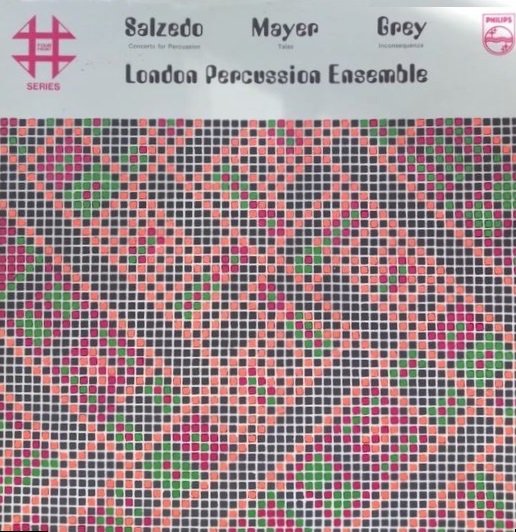
I was in an antique/collectors shop the other day. In a box of classical vinyl LPs, I discovered a copy of Leonard Salzedo’s Concerto for Percussion, op.74. It was priced £20. Salzedo’s piece was one of three works commissioned by Pye Records (4FE 8003) for an album of percussion music released during 1969. The other two works were Talas by the Indian composer John Mayer and Inconsequenza by Geoffrey Grey. They were performed by the London Percussion Ensemble.

The liner notes by Leonard Salzedo (1921-2000) explain the progress of the music. Setting the Concerto in context, the composer recalls that in 1964 he had composed Disneos for percussion. This work was conceived in Spain and has a “distinct Spanish and Latin American flavour.” This concerto called for six players and a vast array of instrument. The work achieved “its effect by the variety of tone colour.”  It remains unrecorded. 

Five years later, the new Concerto was more rhythmical and used only four soloists. There are five contrasting movements. Salzedo explains: The Preludio contrasts a rhythmic figure against a melodic one, while the Scherzo is pure rhythm. (Although the timpani are tuned, the notes are not important.). The Arioso uses only tuned instruments and develops the melodic idea from the first movement. In the Antifona, two snare drums comment over a timpani ostinato which is derived from an old plainsong tune. The Finale is in two sections, the first part using both tuned and percussive instruments, but it is rhythm that dominates in the end, the second part consisting of a gradual accelerando to the climax.”

Paul Conway (MusicWeb International, September 2000) writes that Salzedo’s Concerto for Percussion “had a number of concert performances both in the UK and the USA and was also used for the ballet The Empty Suit first produced by the Batsheva Ballet in Israel in October 1970, and in the following month by the Ballet Rambert in England. This demonstrated how even works never intended to be danced [can] make eminently suitable ballet music, so strong is the dance element in Leonard Salzedo's writing.”  It has subsequently been produced by a university ballet company in Johannesburg and, most recently, in Milwaukee at the University of Wisconsin. The earliest appearance as ballet music was in an experimental production by Scottish Ballet, directed by Norman Morrice.  

The London Percussion Ensemble was formed in 1964, by a few London-based percussion players. Their debut was at that year’s Cheltenham Festival, and was followed by many performances in London and several BBC broadcasts. They seem to disappear from concert listings in the late 1980s. The line up on this present album are James Holland, Terry Emery, David Johnson and Tristan Fry. 

M.H. reviewing the Pye album for The Gramophone (October 1969, p.561) wrote that “…Leonard Salzedo's Concerto is longer yet more lightweight [than the other two works on the LP] …Many people might find its five movements an easy introduction to this kind of music, a gateway to the more complex deployment of percussion elsewhere”.

Sadly, this remarkable Pye album has not been reissued. Fortunately, there is an excellent performance of Salzedo’s Concerto for Percussion uploaded to YouTube.  This is a live performance given on 13 August 2003, in the Sigyn-Hall, Turku, Finland, performed by the Kroustikon Percussion Ensemble, featuring Antti Suoranta, Juha Kangassalo, Tomi Salo and Olli Lehti.

Surely some enterprising CD company could remaster the aging Pye LP. Certainly, Leonard Salzedo’s Concerto for Percussion is a satisfying and interesting example of the genre.

Sunday, 29 August 2021

Twentieth Century Music for Horn and Piano

Unless you are an aficionado of horn music, I recommend exploring this CD a few tracks at a time. I started with the “Bonus Tracks” beginning with Henry Eccles’s (1670-1742) Sonata in G minor. London-born Eccles was a composer and violinist and was a member of the King’s Band. Feeling somewhat neglected, he moved to Paris where he joined another Royal Band. His most infamous work collection was Twelve Solos for the Violin, published in 1720. Unfortunately, this was not entirely his own endeavour. He had lifted several pieces from a certain Guiseppe Valentini. The present “Horn Sonata” was No.11 of this volume. It does seem to have been written by Eccles himself. It was transcribed for horn by the American horn virtuoso, Joseph Eger. The Sonata works well in this arrangement. The four movements are well balanced and full of interest. The slow introduction is followed by three lively dances. 

David Gwilt (b.1932) is a Scottish composer who has worked much of his life in Hong Kong. The present Sonatina for horn and piano dates from 1952. It is very much a piece of its time. The opening Allegro is spiky with a wide-ranging solo part. After some brassy fanfares, the second subject is a bit more reflective. The slow movement is a lovely piece of soul-searching. The mood lightens with the lively and breath-taking rondo. David Gwilt, for some reason, is virtually unrepresented in the current CD catalogues.

The track listing announces Arthur Cooke’s Rondo in B flat. And herein lies a wee drop off. This vibrant piece, dating from 1950, is by Arnold Cooke (1906-2005). It became “an appealing encore piece for instrumentalists”. The present horn soloist, Ifor James, is quoted as saying that “the work captures the qualities of the instrument superbly.”  It is a pleasure to hear this “jaunty” hunt inspired piece of neo-classicism. Interestingly, there was a rather shadowy composer, singer, pianist and conductor called Arthur Cooke. He was born in 1879 and died at a time unknown.

The last of the Bonus Tracks is one of relatively few compositions by Alan Abbott. Much of his career was spent as a music producer and music director, with the BBC, the Turkish State Ballet, the Australian Ballet and more. The Alla Caccia is an engaging little number that hides an unforgettable tune amongst the hunting fanfares inherent in its title. The slow middle section is deliciously romantic and moody.

Turning now to the main events on this CD. Peter Racine Fricker wrote his Horn Sonata, op.24 for the legendary Dennis Brain. It was premiered by the dedicatee and the pianist, Harry Isaacs at the Conway Hall on 20 March 1955. It is typical of the composer at this period. The progress of the music is tightly controlled, and often austere. The opening movement is written in sonata form and has a concise development section. There is a balance here between intensity and expressiveness. The second movement Scherzo is quicksilver, with some remarkable double and triple tonguing. Strangely, the heart of the work is the slow finale. This is a rondo, but certainly not a rollocking one. It is a successful Sonata, with Fricker brilliantly mastering the difficult art of combining the horn and piano.

Carl Nielsen wrote his short Canto Serioso in 1913.  I understand that it was originally an audition piece for aspirants to the Copenhagen Opera Orchestra. The band needed a “low horn player” hence the extensive use of the lower register in this piece. It is a moody, romantically charged miniature.

The main event on this CD are the two Horn Sonatas by the German Paul Hindemith. I admit to not being a huge fan, and I guess I rarely choose to listen to his music. Nevertheless, when I do hear something by him, I invariably enjoy it. The Sonata No.1 in F major was completed during November 1939, shortly after the outbreak of the Second World War. It was only a few weeks later that Hindemith left Switzerland bound for America, and a teaching career at Yale University. The opening movement deploys widely contrasting themes of a stately and lyrical nature. This is underpinned by some aggressive rhythms. There is a sense of militaristic bombast here. The second movement opens with a long solo passage for the piano, before the horn introduces a second theme. It typically presents a mood of calm and melancholy. However, this is brusquely kicked into touch by the flamboyant finale, which opens with “bustling energy”, soon to be followed by a quiet interlude. The remainder of this movement is characterised by “heroic” and colourful “show-off” music. I was surprised at how much I enjoyed this piece. It is clearly a work of its time, balancing menacing thoughts and lyrical reflection at a time of great danger for civilisation.

The other work by Hindemith is the Althorn Sonata in E flat major. This was composed in 1943 whilst he was on holiday in the Berkshires, in Western Massachusetts. There was a problem. Hindemith’s publisher refused to issue the work, as they felt it was written for an antique instrument, only played in musical fanfares and by amateurs. Later, Schotts did publish the Sonata, on condition that it could be played on the contemporary French horn.  There are some novelties in this piece, including a spoken dialogue heard before the final movement, a mysterious Morse Code message in the second and possible references to numerology. The formal construct of the work is a Sonata da chiesa – four movements, a slow introduction, a fugal allegro, a slow cantabile and a rapid finale.

The poem may reflect the composer’s thoughts about his German childhood, when the mail was delivered by horse and carriage, and the postman still blew his post horn to announce his arrival. In Germany today, the symbol of the Post Office (Deutsche Post) is the Althorn.  I enjoyed this enigmatic Sonata. It is well played here, full of interest and with a hint of mystery to add a touch of spice.

Little need be said about the performances here. They are ideal. Details of the horn player Ifor James and the composer/pianist John McCabe can easily be found on the Internet. The liner notes, by Robert Mathew Walker are excellent and provide a readable introduction to the music. It is interesting that he does not mention the esoteric mysteries of the Althorn Sonata. As noted above, the track listing refers to Arthur, rather than Arnold Cooke, an easy mistake to make. The insert is printed on flimsy computer paper, which does detract from the overall packaging of this CD. Eagle eyed readers will have noticed that there are no recording dates or venues included in the track listings above. They are not given in the CD documentation. I asked the record company about this. Seemingly, the apparatus is a “bit sketchy”. It is known that the Hindemith Sonata in F, the Fricker, the Nielsen and the Abbott were recorded sometime during January 1968. Hindemith’s Althorn Sonata was never released. Finally, the Eccles, Gwilt and Cooke were released in 1979 on the Cornucopia record label, which was privately owned by Ifor James.

Heritage Records are to be congratulated on exhuming these excellent recordings from the archives. The re-mastering by Paul Arden-Taylor is superb throughout.

Track Listing:
Paul HINDEMITH
(1895-1963)
Sonata No.1 in F major (1939)
Althorn Sonata in E flat major (1943)
Peter Racine FRICKER (1920-90)
Horn Sonata, op.24 (1955)
Carl NIELSEN (1865-1931)
Canto Serioso (1913?)
Henry ECCLES (1670-1742) (arr. Joseph EGER (1920-2013)
Sonata in G minor (c.1720)
David GWILT (b.1932)
Horn Sonatina (1952)
Arnold COOKE (1906-2005)
Rondo in B flat (1950)
Alan ABBOTT (b.1926)
Alla Caccia (1948) [2:40]
Ifor James (horn), John McCabe (piano)
Rec. Not given (See Below)
HERITAGE HTGCD 164
With thanks to MusicWeb International where this review was first published.

Thursday, 26 August 2021

Reviewing John McCabe’s Sonata for clarinet, cello and piano (1969)

The Macclesfield Arts Festival ran from 5th to 25th May 1969. By all estimations it was a major event. Big names in the musical world were legion: John Ogdon, Colin Horsley, Francis Jackson, Johnny Dankworth and Cleo Laine. Equally impressive was the line-up of ensembles, including, the Dolmetsch Ensemble, Foden’s Motor Works Band, the Royal Liverpool Philharmonic Orchestra, the London Mozart Players, the Geraint Jones Orchestra and the De Peyer Trio. Major performances were given of Elgar’s Gerontius, Handel’s Judas Maccabaeus and Britten’s Noyes Fludde. Aside from the musical events, there were exhibitions of flower arranging and artwork from Julie Clements, Harold Riley and Austin Wright. Festivalgoers were able to visit the radio telescope at Jodrell Bank and stately homes such as Gawsworth Hall, Capesthorne Hall and Clonterbrook House. One final delight were stagecoach trips to Gawsworth Village. 

Two new works were commissioned by the festival authorities: Alexander Goehr’s Nonomiya for solo piano, and John McCabe’s Sonata for clarinet, cello and piano.

McCabe’s Sonata was premiered at the King’s School Hall, Macclesfield on 22 May 1969. The De Peyer Trio, consisting of Gervase de Peyer, clarinet, William Pleeth, cello and Peter Wallfisch, piano, played Beethoven’s Trio in B flat, op.11 and Brahms’s Trio in A minor, op.114 as well as the McCabe Sonata.

In a major review of this concert, Gerald Larner, (Manchester Guardian, 23 May 1969) wrote that the “Sonata is similar in construction to McCabe’s Movements (and not very different in instrumentation), the Sonata invites comparison to that earlier work, and seems less exciting in the circumstance.” [NOTE: Movements was composed in 1964: it is scored for clarinet, violin and cello. The piece is written in seven short sections and, like the Sonata, is formally a palindrome]. Larner continues: “Although both works are cast in the composer’s favourite palindrome form, the matching outer layers round a central section, they are not intended to have the same effect. Whereas the middle section of Movements contains much impassioned clarinet music, this corresponding section of the Sonata is a more deliberate experiment in sonorities, including McCabe’s first adventure under the piano lid with rubber beaters and fingernails. These sound effects are well imagined, and they come off, as do the sympathetic vibrations of the piano (with dampers raised) to the clarinet’s twelve-note invocations at the beginning and its reflection at the end. They do, however, interrupt the continuity of the work So, while the ear remains fascinated, the emotions are not involved to the extent that they are in the Movements, which seems the more inspired and less self-conscious of the two.”  Larner considered that De Peyer Trio played the work “with complete conviction and, certainly with considerable accomplishment.”  That said, the Beethoven was less satisfactory, with “hard sounds issuing from the clarinettist and his acoustic and personal dominance over the others, but mainly because of the generally unsympathetic and less than skilful treatment of the score.”  On the other hand, the Brahms “made up for most of that” and provides a performance in which there “was much refinement of sound and felicity of phrase in an altogether winning interpretation.”

The score of McCabe’s Sonata (Novello) and his Dance Movements for horn, violon and piano (1967) were reviewed in The Musical Times (February 1973, p.160). Niall O’Loughlin writes that: The work is “carefully planned” and displays “bold canonic writing and irregular rhythms.” Structurally, the “opening clarinet melody provides a point of repose from which the work sets out and to which it returns at the end, as well as melodic material for some of the music. [Learning this Sonata] would be well worth the energies of experienced players.”

Another review of the score was included in Notes (September 1973, p.158f). Jerome Rosen thinks that “much of the harmonic language and instrumental usage of John McCabe's Sonata… is reminiscent of Bartok's Contrasts.” This latter work, for the same instrumentation, was composed in 1938. Based on Rumanian and Hungarian folk-tunes. Yet John McCabe “is sufficiently strong as a composer to be able to take this language and technique and somehow make them his own.” Rosen is impressed by McCabe’s uses of his instrumental resources and considers that the “performers are put to the test as individual virtuosos and as ensemble players.” Stylitically, this critic considers that this “music more of gesture and texture than of exposition and development, yet it adds up to a large-scale form that is both impressive and satisfying. McCabe has a nice ear for coloristic effects which he knows how to get with simple means-e.g., struck piano strings, cello harmonics, and chalumeau register clarinet. Moreover, he uses such effects in meaningful ways rather than as stylish gimmicks.”

Some additional remarks were made by Verity Butler in Landscapes of the Mind: The Music of John McCabe, (Ashgate, 2007, p.83f). She notes that the Sonata “calls for an extremely wide range of dynamic contrasts. Even within the opening improvisatory phrase of the piece the clarinet is required to crescendo from pppp to ff and then diminuendo a niente.”  The Sonata is characterised by “contrasts, employing extremes not only of dynamics, but also of tempi and tessitura.”  Finally, the demanding clarinet part requires “immense control…light quick tongue and fluent finger work…and the essential ability to encompass many varied moods into a coherent musical whole.”

To my knowledge, there are currently only two commercial recordings of McCabe’s Sonata available. In 2012, Guild Records issued Fauvel’s Rondeaux, (GMCD 7369)  which was a retrospective album of McCabe’s chamber music. This included Movements for clarinet, cello and piano (1964/66), Clarinet Quintet “La Donna” (2010/11) and the eponymous work for clarinet, violin and piano (1995/96). The most recent recording was released by Prima Facie (PFNSCD 019) in 2020. This remarkable CD also features John Ireland’s Trio in D minor for clarinet, cello and piano (1913), Kenneth Leighton’s Fantasy on an American Hymn Tune (1975) and Giles Easterbrook’s Trio (2002).

A live performance of John McCabe’s Sonata for clarinet, cello and piano (1969) been uploaded to YouTube. The performers are Linda Merrick, clarinet, Neil Heyde, cello and Aaron Shorr piano. It was recorded in Glasgow at the Stevenson Hall, Royal Conservatoire of Scotland.

Monday, 23 August 2021

A Few Words on John McCabe’s Sonata for clarinet, cello and piano (1969)

John McCabe’s Sonata for clarinet, cello and piano dates from 1969. It was commissioned by the fabric manufacturer, Brocklehurst-Whiston Amalgamated for that year’s Macclesfield Arts Festival, and was dedicated to Gervase de Payer, William Pleeth and the Wallfisch Trio.  The work was given the title “Sonata” rather than “Trio” to “allow instruments to retain their individual voices, while letting them all work with roughly the same tunes, to interact rather than to combine in a more traditional manner.” (Liner Notes, Prima Facie PFNSCD 019). McCabe felt that “this approach, would be more in keeping with a less traditional, though equally abstract style.” This single movement Sonata is divided into five sections. The thematic material of the entire piece is presented in the opening bars by the clarinet. This is recalled in the concluding andante, giving the work a cyclic nature. The other instruments then begin to explore these statements in several linked but continuous sections. The progress of the music is exemplified by the individual characteristic of each instrument. The central ‘tristamente’ is the heart of the Sonata. There is exciting music in both the ‘allegro’ and the ‘vivo’ sections. I do not believe that a palindrome has been used here – though the formal working out of this Sonata is certainly well-balanced and turns upon the central section. 

The overall mood of the Sonata is introverted, but sometimes offset by some thrilling and often exhilarating music. There are one or two “extended” techniques used in this piece, including the piano strings plucked by the fingers and beaten with rubber hammers.

Finally, I understand that John McCabe has suggested that the inspiration for this work was partly derived from “a sense of loneliness and space, conveyed by sections of Stanley Kubrick’s film 2001: A Space Odyssey.” This mood is well-achieved, although offset by some dramatic and often exciting music. Whether this is a good analogy must be left up to the listener to decide.

A live performance of John McCabe’s Sonata for clarinet, cello and piano (1969) has been uploaded to YouTube. The performers are Linda Merrick, clarinet, Neil Heyde, cello and Aaron Shorr piano.

A subsequent post will look at the concert and score reviews of this Sonata. 

Friday, 20 August 2021

It's Not British but...Manhattan to Montmartre

Little introduction is required to Leonard Bernstein’s West Side Story (1957). It is one of the most successful musicals of the 20th century. In fact, it is often regarded as blurring the lines between the musical and grand opera. Matching great music with an intense plot owing much to Romeo and Juliet, this is an undoubted high point in American music. There is a coming together of standard European operatic tropes such as vocal ensembles, the use of leitmotifs, and complex tonal planning. This is cleverly fused with American jazz and a Latin beat. The Symphonic Dances look towards standard classical procedures, including relatively few themes which are developed to a high degree, and which do not require an understanding of the plot to appreciate the music. It is important to note the progress of these Dances does not follow the libretto of the opera. I am not sure that the vocalisation of “Mambo” was necessary here. That said, the clarity of this arrangement is ideal, and allows the listener to hear a considerable amount of the musical detail. This two-piano version of the Symphonic Dances was created by the American pianist and composer, John Musto in 1998. 

George Gershwin’s Second Rhapsody (1931) is relatively rarely heard in the 21st century. For example, the current Arkiv Catalogue features 26 recordings of this work. This compares to 210 for the Rhapsody in Blue, and 74 for the Piano Concerto in F.  

The Second Rhapsody had its genesis in the film score for Delicious, starring Janey Gaynor and Charles Farrell. The somewhat fanciful plot centres around a Scottish girl who arrives in the USA. She has legal issues, goes on the run and finally teams up with some travelling musicians. George Gershwin wrote several songs and two musical sequences for the film. One of the latter was originally titled Manhattan Rhapsody. This was designed to accompany the girl on her wanderings in the unfamiliar and possibly scary city of New York.

George Gershwin regarded his Second Rhapsody as “the finest thing he had written.” Listening to this work uncovers a subtler, more nuanced style of writing. That said, the American music historian David Ewen felt that the main reason that this “piece has not gained the popularity of the Rhapsody in Blue, was that while it represents a decided advance in technique, it is mainly contrived, where the first rhapsody [in Blue] was inspired”. There are several versions of the original orchestral incarnation of this Rhapsody.  The present performance for four hands on one piano was devised by one of the present soloists, Julian Jacobson. It is absorbing and enjoyable and amply reveals “its subtleties and creative development” to a great extent.

George Gershwin was inspired to compose his orchestral tone poem, An American in Paris (1928) after a visit to the French capital, in the mid-1920s. However, the piece works well in its transcription for four hand/one piano by Julian Jacobson. Each of the tone poem’s three contrasting sections suggests aspects of Paris’s streetscape, past and present. From the taxi horns, and the slightly frenetic exploration of the city, to a relaxed stroll in one of the great parks, and finally, to the consummation of the American visitor’s diverse moods in the last section, this is an attractive and satisfying performance. The 1951 film An American in Paris has long been one of my favourite “flicks”. Starring the great Gene Kelly, the first appearance of Leslie Caron and the irrepressible polymath Oscar Levant, this sparkling movie presents a remarkable score featuring Gershwin’s music. The climax of the film is the 17-minute ballet sequence using the eponymous tone poem.

The final work on this CD is Henry Levine’s 1943 transcription of George Gershwin’s best known concert piece, Rhapsody in Blue. This early crossover composition between jazz and the classical/romantic repertoire was premiered during February 1924. Various arrangements have been made from the original with jazz band, the Ferde Grofé orchestration and several versions for solo or piano duet. Little needs to be said about this well-known masterpiece, save that in Levine’s arrangement, the continuous outpouring of melody, piano figurations and jazz inspired clichés, is made crystal clear. All the excitement, pizzazz and romance of the original score is retained, and often enhanced in this exemplary recital.

Not a lot else need to be said. Great playing by Julian Jacobson and Mariko Brown, excellent liner notes, and a splendid recording.

Track Listing:
Leonard BERNSTEIN (1918-90)
Symphonic Dances from West Side Story (arr. John MUSTO (b.1954) (1998)
George GERSHWIN (1898-1937)
Second Rhapsody (arr. Julian JACOBSON (b.1947) (2014)
An American in Paris (arr. Julian JACOBSON, (2016)
Rhapsody in Blue (arr. Henry LEVINE (1892-1951) (1943)
Julian Jacobson and Mariko Brown (pianos)
rec. The Menuhin Hall, Stoke d’Abernon, Surrey, 26-28 August 2020
SOMMCD 0635

Tuesday, 17 August 2021

Frank Spedding (1929-2001): A Thumbnail Sketch

It is always a difficult and dangerous thing to write about a composer whose music remains a largely unknown quantity. I can claim to have heard none of Spedding’s concert works, except for his Bellini Studies for piano duo, which I heard on record some 35 years ago. However, I do remember his attractive Christmas Carol settings made for the Royal Scottish Academy of Music and Drama (now The Royal Conservatoire of Scotland) carol concerts. I still have the programme for the 1975 bash. I am on a surer footing with several of his film scores, including Glasgow Belongs to Me, The Heart of Scotland, Loch Lomond and the evocative Songs of Scotland. I understand that there was a record made of his Cello Concerto: this does not appear to have made it onto CD or download. 

There is no entry for Frank Spedding in Grove’s Dictionary or the Oxford Dictionary of National Biography. John Purser in his essential book Scotland’s Music devotes a single paragraph to this “brilliant and witty” composer. The Conservatoire does not seem to have a tribute page to him on their website. The main source of information is the obituary published in the Glasgow Herald on 5 November 2001 written by Robert Inglis. I rely heavily on it for this short post.

Frank Spedding was born in Crosby, Liverpool 21 August 1929. However, the family home was in Nottingham. He studied at the Royal College of Music with William Lloyd Webber, Bernard Stevens and R.O. Morris.  He also had private tuition from Ralph Vaughan Williams. During his National Service, Spedding was seemingly a cook in the Royal Air Force although Inglis feels that this is “unlikely”.  

Much of Spedding’s career was at the Royal Scottish Academy of Music and Drama. His first position there, beginning in 1958, was “teacher of harmony and counterpoint”.  Two years later, he became the principal of those subjects. Spedding’s pupils included John Purser, John Maxwell Geddes, Wilma Paterson, Shaun Dillon, William Sweeney and Rory Boyle. In 1981, he was appointed Director of the School of Music.  He remained in this post until his early retirement in 1985, due to ill health. Frank Spedding died in Glasgow on 11 October 2001.

The catalogue of music is not inconsiderable. Spedding’s op.1, a Piano Quartet was completed in 1951. Major compositions include a Piano Concerto, the Bellini Studies for piano duo, the Piano Quintet (1971). Robert Inglis mentions a 41-minute Symphony dating from 1959. There is a set of Variations on an Albanian Tune (1973) devised for the National Youth String Orchestra of Scotland. Another major composition was the Cello Concerto written for Joan Dickson. There are also many arrangements of Scottish songs and Christmas carols.

Sadly, Spedding’s orchestral and chamber music seem to be ignored by Scottish orchestras and chamber ensembles. The Glasgow Herald notes a live performance of his Piano Quintet on 27 January 2010. And that’s that.

Finally, the Herald provides a little anecdote. The writer and film producer Laurence Henson recalled that when he was seeking someone to compose the music for his 1961 film The Heart of Scotland, fellow producer Bob Black suggested that “I consider a man down at the RSAMD, some teacher fellow called Spedding. I met Frank, we talked it over, laughed at the same jokes, and agreed to give it a try. Before parting, Frank said with a grin: ''I think it's only fair to warn you that one of my tutors, the great Vaughan Williams, described my first composition as 'utter tripe'.'' (Glasgow Herald 16 November 2001)