Showing posts with label Benjamin Britten. Show all posts

Thursday, 18 April 2024

Benjamin Britten: Sonata in C for Cello and Piano (1961)

The Sonata in C for cello and piano was the first of a series of works written for the Soviet cellist, Mstislav Rostropovich. Others that followed included the Three Suites for solo cello and the Symphony for cello and orchestra. The Sonata was planned whilst Britten and Peter Pears were on holiday in Greece during October 1960: the work was begun at Aldeburgh after Christmas and completed by the end of January 1961. It represents the composer’s awakened interest in chamber music after more than a decade largely devoted to vocal compositions. This was fired by Britten’s friendship with the cellist and an appreciation of his superb musicianship. The first performance was given at Aldeburgh on 7 July 1961 by Rostropovich and the composer.

Arguably, the work may be perceived by the listener as being a ‘suite’ rather than ‘sonata’. However, the opening ‘Dialogo’ has elements of Sonata form. The first subject is based on a tiny motive motive which is used in an augmented form in a lyrical second subject. The second movement is a standard ‘scherzo’ which the composer has suggested is a ‘study in pizzicato, sometimes almost guitar-like [with] its elaborate right-hand technique’. The slow movement is a deeply felt ‘Elegia’ which develops an impassioned theme in an arch-like structure. Notice the use of double, triple and quadruple stopping as the music builds to a huge climax. Peter Evans has suggested that the ‘freakish’ ‘Marcia’ was conceived as a ‘tribute to the musical satire of Prokofiev or the early Shostakovich’.  This is a standard March and trio structure. However, it is probably closer to some of Britten’s own pre-war works such as the Suite for violin and piano. The final ‘Moto perpetuo’ is complex. It is mood music at its best with constantly changing humour – ‘now high and expressive, now low and grumbling, now gay and carefree.’ There are a number of fingerprints in this Sonata including those of Bartok and Shostakovich, however the musical framework and language is ultimately Britten’s own: it is a finely judged balance of ‘classical’ sonata form with the composer’s dramatic and narrative style typical of his operas and other vocal works.

Perhaps the final word may go to William Mann, music critic at The Times. He wrote, ‘There is a suggestion...that Britten may have intended [the Sonata]...to reflect his own impression of the character of the player to whom it is dedicated: gay, charming, an astonishingly brilliant executant, but behind all these qualities a searching musician with the mind of a philosopher.’

Listen to Mstislav Rostropovich, cello and Benjamin Britten, piano on YouTube, here.

With thanks to the English Music Festival where this note was first published.

Sunday, 18 February 2024

Benjamin Britten (1913-1976) Canadian Carnival (Kermesse Canadienne), op.19

Benjamin Britten composed Canadian Carnival (Kermesse Canadienne), op.19 shortly after his arrival in the United States prior to the outbreak of the Second World War. Britten had left England with his companion Peter Pears during May 1939 and had initially spent several weeks together in Canada. Here they heard a performance of the Variations on a Theme of Frank Bridge given by the Canadian Broadcasting Corporation. Britten and Pears declared themselves lovers at Grand Rapids and arrived in New York late June 1939. There they quickly began to move in various artistic circles, numbering Aaron Copland, W.H. Auden and the composer Colin McPhee as their friends. Other important works from this time include the choral setting Ad majorem Dei gloriam, the Violin Concerto and Young Apollo. The same period saw work commence on the Sinfonia da Requiem Op.20.

Canadian Carnival has been described as a ‘Rhapsody on French Canadian folk-tunes’ based on some songs Britten had heard in the Province of Quebec. The programmatic content begins by evoking the Canadian landscape at dawn. It is the day of the great Carnival. Slowly people begin to arrive. A number of ‘songs and snatches’ of folk tunes are presented. The fair grows more boisterous and eventually, after a significant climax it begins to calm down. Slowly the villagers disperse and the night falls. All is peaceful once more.

Typically, this work has been regarded as a ‘light-hearted frolic for symphony orchestra.’  However, David Matthews regards it as ‘a more serious piece than it appears.’ He notes the ‘disturbingly ironic setting of ‘Alouette’ which is provoked by the sadistic words of this disingenuous children’s song’. The burden of this song cruelly suggests that the singer will pluck the feathers, the eyes and the beak off the skylark for daring to sing and waken her from sleep. 

Negatively, Canadian Carnival has been described by Peter Evans as ‘little more than a sophisticated pot-pourri of folky song and dance, arranged inside a quasi-programmatic frame.’ This seems unfair. It is a fine, vivacious example of the ‘rhapsody’ genre with some excellent orchestration and a clever and subtle manipulation of the folk-tunes.

Aaron Copland had met Benjamin Britten at the 1938 International Society for Contemporary Music festival in London where the American’s El Salón México and Britten’s Variations on a Theme of Frank Bridge were both performed. After the Festival, Copland visited Britten’s home at Snape.  On Pears and Britten’s arrival at New York they gravitated to Woodstock to be close to Copland and his partner Victor Kraft.  At this time Britten regarded Copland as ‘the American spokesman.’  It is not surprising that critics have detected an ‘open-air prairie’ mood in Canadian Carnival.

The first performance was given on 6 June 1940 by the BBC Orchestra conducted by Clarence Raybould from the BBC studios in Bristol.  The first concert performance was at Cheltenham Festival on 13 June 1945 with the composer conducting the London Philharmonic Orchestra.

Benjamin Britten’s Canadian Carnival (Kermesse Canadienne), Op.19 can be heard on YouTube, here. The City of Birmingham Orchestra is conducted by Simon Rattle

Thursday, 17 November 2022

Three String Quartets: Haydn Jespersen and Britten

The raison d’être of this CD is quite simple, but terribly relevant. In 2018, composer Hanne Tofte Jespersen was commissioned to write a string quartet for the chamber music society BRAGE. The idea was that the new work would major on an historical theme. The resulting composition was to be seen in context with Haydn’s late D minor Quartet dating from 1797, and Benjamin Britten’s First Quartet completed in 1941. 

History was to catch up. Jespersen’s Quartet was completed during the first major lockdown caused by Covid-19, when all live musical activities were suspended. It was eventually premiered during November 2020, shortly before the next lockdown. Fast forward to February/May 2022, when this present album was recorded, with Covid in retreat, but when Europe was engaged in the most serious and extensive war since 1945. As the liner notes state, “the music[al] works of this project express both unrest, threat, hope, and even a vision of peace.”

The scholar H.C. Robbins Landon once noted that Haydn’s String Quartet, op.76, No.2 in D minor “Quinten-Quartett” is “one of the most serious, learned and intellectually formidable works that [Haydn] ever wrote.” It has been suggested that the Andante is a little lightweight, when heard against the other three movements. It could just be that Haydn was giving the listener a rest before the more significant material that follows. The Menuetto, which is sometimes called the Witches Minuet, is harsh and acerbic. The first and second violins and the viola and cello play in open octaves and in canon at about a bar’s interval, reminiscing on the opening movement. The trio section has wild “stamping rhythms,” and rapid alteration between D major and minor. The finale is pure Gypsy/Hungarian music, and is once again based on a melodic interval of the fifth, this time A-E. It is a tour de force that displays slides, bagpipe drones and even, they say, a donkey braying! I felt that the present ensemble explored the variety of this quartet with aplomb and enthusiasm.

The new String Quartet by Hanne Tofte Jespersen is described by the liner notes as having “Threads back in time” as its “key concept.” As a student, she sang in a Danish choir which gave a performance of Britten’s Hymn to St Cecilia (1941-42) which had a text by W.H. Auden. This choral piece then led her to his String Quartet No.1, which is contemporaneous to St Cecilia. In 2020, she took this “thread” and took some motifs from the Haydn Quartet, op.76 no.2 and created a new work that was inspired by the “classical quartet tradition” of which Haydn is deemed to be the “Father,” and a reminiscence of her “fascination” for the experimental music of Benjamin Britten. Despite a detailed, somewhat poetic, technical exposition of the Quartet provided in the liner notes, this balance, this equilibrium between classical and innovative is all the listener needs to bring to the party. Here are found lyrical, themes counterpoised with polytonality, clusters and a freedom of rhythmic construction. There is also an overall progress, I think, from unrest to tranquillity, however, there are moments of stress and repose throughout the piece. Overall, I found the new quartet both satisfying and approachable.

Benjamin Britten’s String Quartet No.1 in D major, op.25 was written in the United States. Currently, the composer and his partner Peter Pears were staying in San Diego, California, which was about as far away from the war in Europe as possible. The quartet was a commission from Elizabeth Sprague Coolidge. It was premiered in Los Angeles on 21 September 1941.

David Truslove, in a programme note, gives an ideal summary: “It is almost as if memories of Britten’s native Suffolk coast and the vigour of California have become distilled in the Quartet’s oppositional landscape.” After the remarkable introduction which counterpoints a high pitched “molto vibrato” motif for the violins and viola and pizzicato chords and arpeggios of the cello, the toccata-like Allegro vivo propels the music in an almost urban splash. Is the composer reminiscing about his beloved Aldeburgh, and at the same time being overwhelmed by the frenetic pace of city life? The Scherzo, nodding to Beethoven, is humorous and witty, rather than profound: it is played here with great energy and with caustic tone. The listener is inevitably reminded of the “moonlight music” from Peter Grimes in the long slow movement. This nocturne is the emotional heart of the Quartet. The vivacious finale ties into the first work heard on this CD: it is not possible to listen to this movement without recognising at least a hat tip to Papa Haydn. It is full of the metropolitan pizzazz that is the antitheses of the marshes and reed beds around Snape. The performance by the assembled instrumentalists is ideal, and succeeds in presenting “the powerful, dramatic contrasts” between, and sometimes within, the four movements.

The genuinely helpful liner notes are printed in Danish and English. They include a brief overview of the genesis of the project, short notes about all three quartets, a more detailed study of the new work by Hanne Tofte Jespersen and an essay contextualising the “Historical Scope of 1790-2020,” as well as short biographies of the performers and Hanne Tofte Jespersen.

As a concept album – Times of Unrest, it succeeded less well than if it has been entitled Threads back in Time. Historically, all ages seem to be “Ages of Turmoil,” however, I get the point that this album does reflect the traumatic effect of Covid.19, and latterly the war in Ukraine.

Track Listing:
Times of Unrest
Joseph Haydn (1732-1809)

String Quartet, op.76, No.2 in D minor “Quinten-quartett” (1797)
Hanne Tofte Jespersen (b.1956)
String Quartet No.1 “Urolige Tider” (2020)
Benjamin Britten (1913-76)
String Quartet No.1 in D major, op.25 (1941)
Kirstine Schneider (violin), Mads Haugsted Hansen (violin), Daniel Eklund (viola), Lea Brøndal (cello).
rec. 19-20 February 2022, (Jespersen), 22-23 May 2022, (Britten), Sankt Laurentii Kirke, Roskilde, Denmark; 30-31 May 2022, Hørsholm Sognegård, Denmark (Haydn)
DANACORD DACOCD 945

With thanks to MusicWeb International where this review was first published.

Wednesday, 28 September 2022

Benjamin Britten (1913-1976): The Sword in the Stone: Concert Suite for Chamber Ensemble

In May 1939 Benjamin Britten and Peter Pears left England and headed towards North America. They spent a few weeks in Canada where Britten wrote Young Apollo, Op.16 for the Canadian Broadcasting Corporation.  He also began work on the Canadian Carnival Overture, Op.19. Earlier that year he had been commissioned by the BBC to write the incidental music for a six-part adaptation by Marianne Helway of T.H. White’s Arthurian novel The Sword in the Stone.

This book, which was written in 1938, is a standalone novel but subsequently became the first part of what was eventually issued as The Once and Future King. The story of The Sword in the Stone tells of a young boy called Wart, who came to realise that he was King Arthur. He is instructed under Merlyn’s guidance in the rituals and activities of the medieval royal court and is found worthy to be king.  The title refers to the famous sword that was magically set in a stone: it could only be removed by the true King Arthur, the rightful heir to the British throne.

Britten completed the score on arrival in Canada and posted it back to London. It was subsequently broadcast during June and July 1939.

The incidental music for The Sword in the Stone score was written for a chamber ensemble including winds brass, harp and a vast array of percussion. In 1983 some ten of the original fifteen ‘sections’ of this music were compiled into a concert suite by Oliver Knussen and Colin Matthews.  The suite, which was first performed at the Aldeburgh Festival of that year was organised into six movements: -

  1. Introduction and Boys Tune
  2. Merlyn’s Tune and Tree Music
  3. Merlyn’s Spell and Witch Tune
  4. Bird Music
  5. Lullaby
  6. Water Theme and End Music

One of the interesting things to look out for in this music is the ‘witty borrowings’ from Richard Wagner’s operas which Britten indulges in.  The Prelude to Rhinegold is alluded to in Merlyn’s Tune and the use of the ‘Sword’ motif played on the trumpet. The fourth movement creates its effect by utilising several musical birds taken from the works of various composers including Wagner, Beethoven, Strauss and Delius. The scoring is excellent with various instruments being used to highlight characters and events in T.H White’s story.

It cannot be argued that this work contains the best of Britten’s music or even prefigures what achievements were to follow. However, it a Suite that is full of youthful energy and has an undeniable ‘enchanting’ quality.

Contemporary reports suggest that the atmosphere of the wireless adaptation was complimented by Benjamin Britten’s music, which "brilliantly sharpened the word-pictures’.

In 1996, Hyperion included Britten’s The Sword in the Stone: Concert Suite for Chamber Ensemble on a remarkable CD. Other works included a concert realisation of Night Mail with Nigel Hawthorne as narrator, the cantata PhaedraLachrymae for viola and piano (1950) and the Sinfonietta (1950). It was played by the Nash Ensemble supported by several instrumentalists.  

It has also been issued in the Naxos Label (8.573446) featuring the Ohio State University Wind Symphony. 

Thanks to the English Music Festival where much of this post was first published. 

Tuesday, 29 March 2022

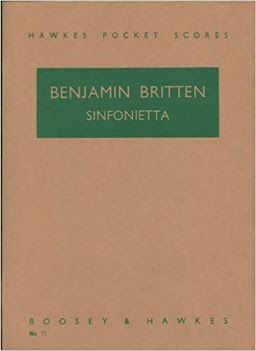
Benjamin Britten: Sinfonietta, Op.1 (1932)

Benjamin Britten’s Sinfonietta, which became his official Opus 1, was written during the summer of 1932 when the he was studying at the Royal College of Music. It was to be his first published work. The same year also saw the Phantasy Quartet for oboe, op.2, and the choral A Boy was Born, op.3.  

The Sinfonietta was originally a chamber piece written for flute, oboe, clarinet, bassoon, horn and string quintet (or small string orchestra); it was later arranged by the composer for a small orchestra in 1936.  The work was dedicated to Britten’s private teacher and friend, the composer Frank Bridge (1879-1941).

The influence of Arnold Schoenberg on the Sinfonietta has been noted by Erwin Stein and others. This is not apparent in the soundscape of the piece, but more in the tight internal construction and the use of motivic development. All three movements are thematically related. Other influences on the music are from Paul Hindemith and Igor Stravinsky. 

The ‘innocent ear’ may not immediately ascribe this work to Benjamin Britten, however there are a number of fingerprints that were to feature in his subsequent music, including his economy of style and inventive use of instrumental colour.

The first few bars of the typically bold opening movement (Poco presto ed agitato) contain all the musical material which Britten develops in the entire work. The pastoral variations (andante lento) seem to nod towards Vaughan Williams’s The Lark Ascending, although one wonders if this was deliberate. It is interesting that the composer has stated that he had to ‘struggle away from everything Vaughan Williams seems to stand for.’  The mood of this movement does move away from the rustic towards something more intense as it progresses. The final Tarantella (presto vivace) is spirited and exploits a fine pizzicato fugato section that sums up much of the work’s thematic argument. 

Critics have tended to deny the Sinfonietta any emotional warmth, but have usually recognised the craftsmanship of the work’s structure and instrumentation.

The Sinfonietta, op.1, was given its first performance at the Ballet Club (Mercury Theatre) London on 31st January 1933 played by the English Wind Players and the Macnaghten String Quartet conducted by Iris Lemare.  The work was published by Boosey & Hawkes in 1935.

A great performance of the original version by the Mahler Chamber Orchestra has been posted to YouTube

Tuesday, 28 January 2020

Benjamin Britten: Variations on a Theme of Frank Bridge, Op.10

Britten’s Variations on a Theme of Frank Bridge was the composer’s first work to Benjamin become truly popular. He had written much music prior to this including a large number of attractive film scores, the choral work A Boy was Born, chamber music and songs.  The Variations were written in a comparatively short period of time during the summer of 1937. It was composed at the behest of conductor Boyd Neel who desperately needed a new piece of British music for his orchestra to play at the Salzburg Festival of that year.

Frank Bridge (1879-1941) began teaching Britten when the young composer was only fourteen years old.  Perhaps Bridge’s greatest achievement as a teacher was to introduce him to the prevailing musical movements of twentieth century Europe including the works of Schoenberg and Webern. It was even mooted at one time that Britten should be sent to study with Alban Berg in Vienna. In honour of his years as Bridge’s pupil, Britten dedicated the score of his Variations to ‘F.B. A tribute with affection and admiration’. 

The work is structured as follows and includes the notes about Bridge’s personality made by Britten on the pencil score; however it is difficult to reconcile some of the elder composer’s character traits with the music presented.
Introduction and Theme [To FB – himself]
Variation 1: Adagio [His integrity]
Variation 2: March [His energy]
Variation 3: Romance [His charm]
Variation 4: Aria Italiana [His wit]
Variation 5: Bourrée Classique [His tradition]
Variation 6: Wiener Walzer [His gaiety]
Variation 7: Moto Perpetuo [His enthusiasm]
Variation 8: Funeral March [His sympathy (understanding)]
Variation 9: Chant [His reverence]
Variation 10: Fugue and Finale [His skill & our affection]

Britten utilised a theme from the second of Bridge’s Three Idylls for string quartet, Op.6, No.2 [H.67] which had been composed in 1906.  The basic concept of the Variations is to present a pastiche of various European musical styles and genres. The original theme is ‘translated, transformed, transferred and transfigured’ into a number of parodies. Examples of this include the Rossini-inspired ‘Aria Italiana’, a Wiener Walzer that is in the manner of Ravel’s La valse and a ‘Bourrée Classique’ that nods to the neo-classical composers of that time. However, the emotional tension of the work is epitomised in the placing of the bubbly ‘Moto Perpetuo’ immediately before the astringent and haunting ‘Funeral March’ which is infused with a Mahlerian intensity.
The final ‘devilish’ fugue is reputed to contain a number of references to other works by Frank Bridge including Summer, Enter Spring, The Sea, There is a Willow Grows Aslant a Brook and the Piano Trio from 1929.   The initial theme is reprised in finale. The Variations are scored for string orchestra with soloists. 

Commentators have often considered that there is an underlying ‘programme’ in the Variations. At the time of composition Britten was still mourning the death of his mother at the end of January of that year and was coming to terms with his homosexuality – he had met Peter Pears in 1936. Certainly the work vacillates between high spirits and downright melancholy and this may or may not suggest some personal struggle.  However, Britten would have nothing to do with such a suggestion. 
The Variations were duly heard at Salzburg on 27 August 1937; however the premiere was actually broadcast on Radio Hilversum two days previously. The work was received with great acclaim. 

An exellent version of Britten's Variations can be heard on the Naxos Label performed by the English Chamber Orchestra conducted by Steuart Bedforf. This recording has been uploaded to YouTube

Wednesday, 19 December 2018

Benjamin Britten: The Holly and the Ivy for choir.


In late 1956, Benjamin Britten (1913-76) was asked by June Gordon (1913-2009), Marchioness of Aberdeen and Temair to arrange ‘The Holly and the Ivy’ for the Haddo House Choral Society’s annual Carol Concert. The Britten Catalogue (1999) explains that the reason for this request was because the choir ‘were heartily sick of all arrangements…tried so far.’
June Gordon was a near-contemporary of Britten and had graduated from the Royal College of Music at the same time. In 1945 she founded the Haddo House Choral Society.

‘The Holly and the Ivy’ for unaccompanied chorus (SATB) was completed by Britten during January 1957. The text is derived from an original carol collected by Cecil Sharp’s published in his English Folk Carols (1911). Sharp states that he heard the tune sung by Mrs. Mary A. Clayton, aged 64, at Chipping Camden in Gloucestershire on 13 January 1909. He had noted five versions of the carol. These were denoted as A, B, C and D – text and tune and E - text only. Britten used version ‘A’ for this setting.  
The sheet music carries the dedication ‘For June Gordon and the Haddo House Choral Society, 1957.’

THE HOLLY AND THE IVY
The holly and the ivy are trees that's both well known;
Of all the trees that grows in woods, the holly bears the crown.
The rising of the sun, the running of the deer,
The playing of the merry harp, sweet singing in the choir.

The holly bears a blossom as white as any flower,
And Mary bore sweet Jesus Christ to be our sweet Saviour.
The rising of the sun…

The holly bears a colour as green as any tree,
And Mary bore sweet Jesus Christ to set poor sinners free.
The rising of the sun…

The holly bears a berry as red as any blood,
And Mary bore sweet Jesus Christ to do poor sinners good.
The rising of the sun…

The holly bears a prickle as sharp as any thorn,
And Mary bore sweet Jesus Christ at Christmas day in the morn.
The rising of the sun…

The holly bears a bark as bitter as any gall,
And Mary bore sweet Jesus Christ for to redeem us all.
The rising of the sun…
English Traditional carol

Britten has created a kind of ‘palindromic’ setting of this carol. The arrangement of each verse is given a different combination of voices as follows: Verse 1, solo treble accompanied by altos, Verse 2, tenor solo accompanied by basses, Verse 3, alto (or mezzo soprano) solo accompanied by tenors, Verse 4, baritone solo accompanied by sopranos and altos. The process is then reversed. The soloists may be replaced by a semi-chorus. In each case the accompaniment is simple, often depending in a ‘pedal’ note.
In the first six verses the refrain ‘The rising of the sun…’ is heard in the same harmonisation. There is considerable use of parallel thirds here. The final chord is at the unison. Britten subtly varies this refrain for the final verse providing a descant and concluding with a six-part (basses and altos divisi) chord contrasting dramatically with the spare conclusion of the previous six refrains. It includes effective crossing of parts.
The harmony of this carol is straightforward: there is not a single accidental in the entire piece. The harmonic interest is devised by gentle clashes in the part writing creating and dissolving gentle dissonances. Much use is made of major and minor 7th and 9th chords.

The carol was published by Boosey and Hawkes in 1957 and was reissued in 1963 by Novello in their compilation volume Sing Nowell: 51 carols new and arranged and edited by Louis Halsey and Basil Ramsey. The present arrangement also appears in The Cambridge Hymnal ed. David Holbrook and Elizabeth Poston. (OUP 1967)

The Britten Catalogue (1999) notes that the first performance of this carol was during a BBC Home Service Broadcast on 22 December 1957. It had been recorded on 14 December at Haddo House in Aberdeen by the Haddo House Choral Society, conducted by June Gordon.  I was unable to find an exact entry in the contemporary Radio Times.

It is good to know that the Haddo House Choral and Operatic Society is still going strong. They have presented a series of Carol concerts over in the run up to Christmas 2018.

There is a splendid version of this carol on YouTube sung by the Choir of King’s College Cambridge, conducted by David Willcocks and originally issued in 1966 on the LP Christmas Music from King's.

Finally, my (very tatty) copy of the sheet music for Britten’s ‘The Holly and the Ivy’ was bought in a now-defunct second hand bookshop in North Wales for 5 pence. The copy, presumably surplus to requirements, is stamped up as belonging to the Frodsham and District Choral Society. It is satisfying to discover that this Cheshire organisation is still performing happily in 2018.

Brief Biography:
Banks, Paul etc., Benjamin Britten: A Catalogue of Published Works (The Britten-Pears Library, 1999)

Wednesday, 26 September 2018

Benjamin Britten: An Alpine Suite for recorder trio.


If the CD catalogues are consulted, the listener will discover that there are 66 versions of The Young Person’s Guide to the Orchestra, 50 of The Ceremony of Carols, 45 editions of the Sea Interludes from Peter Grimes and 37 for the Simple Symphony. All great works and all demanding many interpretations. Turn, however, to the delightful Alpine Suite (1955) for recorder trio and a very different story emerges. There are only three recordings presently available. And one of them is not in the original instrumentation. More about that later.

The Alpine Suite was composed during February 1955 whilst Britten was holidaying with Peter Pears and the artist Mary Potter. Included in the party were Ronald and Rose-Marie Duncan. Duncan was a poet, playwright and writer: he provided Britten with the libretto for his opera The Rape of Lucretia. They were staying in the Swiss mountain resort of Zermatt. Lying in the shadow of the Matterhorn, this town is well-known for skiing, climbing and hiking. The story goes that Mary Potter fell and injured her leg on the first day of the holiday, so was confined to the hotel.

Pears, Potter and Britten were competent recorderists, so the composer felt that a short piece of music for three recorders (2 descant and 1 treble) that the three of them could play, would be a fitting gesture. They had all taken their recorders with them on holiday.

There are six short movements in this charming 7½ minute work:
1 Arrival at Zermatt
2 Swiss Clock (Romance)
3 Nursery Slopes
4 Alpine Scene
5 Moto perpetuo: Down the Piste
6 Farewell to Zermatt.

Unless the listener knew this music was by Britten, I doubt that they would ever guess. It is largely tonal in concept and straightforward, but always spontaneous in form. Harmonic dissonances tend to arrive by contrapuntal clash rather than a ‘piling up’ of chords.  There is a definite ‘modal’ feel to some of this music that may derive from modulations to the submediant (6th degree of the diatonic scale) and the subdominant (4th degree of the diatonic scale).

The Alpine Suite is not programme music, but I think that the temperament of the music captures the mood of this mountain resort. Certainly, the brittle sound of the recorders lends a cool atmosphere to the snow and frost bound winter landscape. Highlights for me are the gentle 6/8 ‘meander’ on the ‘Nursery Slopes’, the swishing ‘Down the Piste’ dominated by semiquaver runs, and a ‘romance’ featuring the charmingly ticking ‘Swiss Clock’, minus the cuckoo…The ‘Alpine Scene’ is probably the most descriptive and challenging of these six pieces. My only concern is that the entire piece is over all too soon.

The first public performance was given on 26 June 1955 by members of the Aldeburgh Music Club by The Meare which is an artificial lake at Thorpeness, near Aldeburgh.  It was broadcast the following year on the BBC Home Service on the morning of 8 December.  This was performed by the Stanley Taylor Recorder Consort.
The score of the Alpine Suite for three recorders was published by Boosey & Hawkes in 1956.

In 2015 Michela Petri (recorder) and Mahan Esfahani (harpsichord) released a CD of music for their instruments (OUR RECORDINGS 6.220611 SACD).  This included works by Gordon Jacob, Malcolm Arnold and Vagn Holmboe. As part of their programme, the artists arranged Britten’s Alpine Suite for solo recorder and harpsichord. In my opinion this arrangement works just as well as the original, and, if anything, is fresher and more vibrant.

The original version has been issued on Dutton Epoch (CDLX 7142) played by The Flautadors. This CD includes the complete recorder works by Britten and Edmund Rubbra. The Alpine Suite has also been included on the massive Decca issue of Britten’s Complete Works.
The three-recorder version can be heard in a splendid performance on YouTube. 

Tuesday, 20 March 2018

Benjamin Britten: Choral Dances from Gloriana

It is not necessary to take a view on the success or failure of Benjamin Britten’s opera Gloriana to be able to enjoy and appreciate these five Choral Dances. However, a little background information is useful.
Gloriana was completed by the composer in 1953 as a major part of the musical celebrations for the Coronation. It was ‘Dedicated by gracious permission to Her Majesty Queen Elizabeth II’. In many ways this was an a-typical opera for Britten. The three-act work was made up of several tableaux, rather than a developed narrative that had been the hallmark of Peter Grimes or Billy Budd.
The basic ‘plot’ of the opera was the relationship between Elizabeth I and the Earl of Essex: it explored the dilemma the queen felt between her sense of public duty and the affection she had for the Earl.  The Earl was condemned to death for treason.
The opera was not particularly well received at the time: in fact, it has been suggested that the young Queen was not amused by watching the ‘affairs’ of her illustrious predecessor. The audience were apparently bored, the critics were disappointed, and the composer became displeased with the work.

The Choral Dances are derived from the second act of Gloriana. In the first scene of this act, Elizabeth I is portrayed making her royal progress to Norwich. The loyal subjects decide to present a masque in her honour. In the opera, the scene was choreographed and was performed by dancers from the Royal Ballet. There were six tableaux which were introduced by the Spirit of the Masque.
The Choral Dances opens with Time, a vivacious madrigal that explores considerable rhythmic and harmonic patterns that are both adventurous and engaging. The second, Concord is written entirely in perfect chords: there is no dissonance. It is a lovely dance that is both ‘simple and subtle’. The two concepts of Time and Concord are united with a well-written, ‘graceful’ double canon, juxtaposing male and female voices. The sprightly Country Girls dance is written for women only. This movement makes extensive use of dotted rhythms and antiphonal use of the voices. This dance is balanced by an energetic scherzo-like movement for male voices, Rustics and Fishermen which is hardly as bucolic as the title suggests. Perhaps the listener will be reminded of the composer’s Spring Symphony? The Final Dance of Homage is a well-poised and gorgeous setting of the subjects final bidding to Gloriana:-
These tokens of our love receiving,
O take them, Princess great and dear,
From Norwich city you are leaving,
That you afar may feel us near.

Donald Mitchell in the Musical Times (February 1955) noted that the Choral Dances ‘gain much from being detached from the distraction of the stage (i.e. the ballet!). In their concert guise it is possible to concentrate exclusively on the freshness of their invention, their beauty of sound and the aptness of their musical imagery.’
To the listener nowadays, when all argument about the opera’s worth seems largely irrelevant these choral dances seem like a perfect fusion of music from the two Elizabethan eras. 
There is a full performance of these Dances on YouTube performed by the Hart House Chorus. 
With thanks to the English Music Festival, where this programme note was first published. I have made a few minor editorial changes.


Wednesday, 20 March 2013

Benjamin Britten (1913-1976) Soliloquy & Prayer from Gloriana.


Gloriana Op.53 was completed by Benjamin Britten during 1952 and the early part of the following year. This was the composer’s eighth opera.  It was commissioned by Covent Garden as a part of the celebrations for the coronation of the present Queen, Elizabeth II and was dedicated to her ‘by gracious permission.’ The libretto was devised by the Anglo-African poet and novelist William Plomer (1903-1973) and is based on the ‘Bloomsbury Group’ author Lytton Strachey’s Elizabeth and Essex which had been published in 1928. Britten has remarked that he and Plomer were most inspired by the relationship between ‘the two protagonists’ and the strong supporting roles of Cecil and Walter Raleigh.
Her Majesty attended the first performance at Covent Garden on 8th June 1953, six days after the coronation.  Unfortunately, the Queen is said to have been unimpressed by the opera. The critical response is still subject to much debate; however there were few positive reviews for this work. The eclectic mix of prose and verse, sung and spoken text, archaic and modern English were seen as part of the problem. However, in a contemporary letter to The Times, Antony Lewis, of the Barber Institute of fine Arts at Birmingham University wrote that ‘...page after page of music of superb richness and invention testifies to ...excellence of the composer’s creative powers...’ He concludes by suggestion that it is ‘exhilarating thee hear a score that unfolds with such masterly confidence...Gloriana is indeed a worthy execution of the royal command.’

The Soliloquy and Prayer follows the scene where Essex has sung two lute songs to divert the queen. However Essex wants permission to sail to Ireland to suppress a rebellion in Tyrone. The Queen refuses and sends him away. The act ends with her praying that she ‘may rule and protect my people in peace’. Elizabeth is torn between love and duty. The queen kneels and prays to God for the strength and the grace to fulfil the high office to which she has been called.

Listen to the Soliloquy and Prayer on YouTube with Leontyne Price. 

Sunday, 6 November 2011

Britten in Scotland: The Complete Scottish Songs


It is great to have all the Scottish songs by Benjamin Britten on one disc. However it is not only the completeness that is important. Most of the works on this CD have been relatively rarely recorded. At present the Arkiv catalogue lists only three other versions of The Birthday Handsel and five versions of Who are these Children? I cannot find a reference to the ‘Four Burns Songs’. So it is a welcome addition to the catalogue. Add to this, the committed and often moving performances from all three soloists and one has a ‘must-have’ CD for all Britten enthusiasts.

A Birthday Handsel was composed in 1975 to celebrate Her Majesty, Queen Elizabeth the Queen Mother’s seventy-fifth birthday. It was one of the composer’s last works. The song-cycle contained seven songs in the Scottish dialect culled from the collected poems of Robert (Rabbie) Burns. Out of interest, the word ‘Handsel' means a gift that is given to someone before the start of a new enterprise, or it can mean a welcome gift.
Britten does not utilise ‘existing’ folksongs, nor does he write pastiche tunes. What he has achieved is a synthesis of the distinguishing features of Scottish folk and dance music and applies it to Burn’s poems. In the present recording, Mark Wilde varies the ‘richness’ or ‘depth’ of the dialect which I think is a good plan. Unremitting ‘Harry Lauder’ would be difficult to stomach. The harp part is much more integral to the work than mere accompaniment: the Britten website notes that it employs ‘a wide range of devices and effects to colourful effect as well as providing the necessary transitions from song to song.’ It is this equilibrium between singer and instrumentalist that makes A Birthday Handsel so effective. It is convincingly performed by Mark Wilde and Lucy Wakeford.
The first performance of A Birthday Handsel was on 16 January 1976 at Uphall which is near to Sandringham. The performers were Peter Pears and the harpist Osian Ellis. A recording was later made at The Maltings, Snape by the same artists and was released as part of the Britten Edition on Decca.
After Britten’s death, the composer Colin Matthews made an arrangement for tenor and piano of four of the songs from A Birthday Handsel. It was published as Four Burns Songs. If I am honest, I prefer these settings to the original!
Finally, Chris Bull has written in the sleeve notes that Britten used an ‘old’ edition of Burns’ poems which had a degree of anglicising of the ‘Lallans Scots’ dialect. He states that in A Birthday Handsel these words have not been corrected: however in the ‘Four Burns Songs’ the text has been collated to ‘The Complete Poetical Works of Robert Burns Bi-Centenary Edition (1993)’
The liner notes gives the listener a good clue for approaching Who are these children?: it is best to regard this difficult song-cycle as ‘two works in one’: it is a balance between the ‘bairn’s’ songs and those of the ‘world of war and pain.’ In fact there are eight songs that explore ‘the happier, more innocent aspects of childhood’ and the remaining four examine ‘the plight of children in the context of violence and war.’ William Soutar is one of the great writers of the Scottish Literary Renaissance – alongside Hugh MacDiarmid. I accept that some of his political views may not appeal to everyone: neither will his pacifism. However, to be fair to Soutar, he did serve in the Royal Navy during the First World War, so at least he has experience of some of the subjects he explores in his poetry.
Yet the song-cycle itself, I find a little harder to come to terms with. I find that it lacks coherence. Some of the ‘songs’ are very short – one is just 34 seconds. Perhaps it is the mixing of the violence and innocence that I find ‘too near the bone?’
I have listened to this work a number of times in this version and also in Daniel Norman’s recording and long felt that it is a difficult work to bring off. However I believe that Mark Wilde manages to approach the ‘dialect’ issue well. It is a fine performance of an often morbid and always challenging piece of music.
The present recording includes three additional poems from the cycle that were not used in the final arrangement. Three of the shorter dialect songs were set – ‘Dawtie’s Devotion’, ‘The Gully’ and ‘Tradition’. Britten wished these setting to be performed as separate songs and insisted that they were not to be incorporated into the song-cycle.

Finally, NAXOS has included all the ‘Scottish folksongs’, including the beautiful ‘Ca’ the Yowes’. However the lovely ‘O Can ye sew cushions?’ and the charming ‘Come you not from Newcastle’ should not be missed. One last treat is the attractive Cradle Song (Sleep, my darling, sleep) by Louis MacNeice who squeezes into this collection as an Ulster-Scot.

Lastly, I note that the assumption is made that listeners will have access to either the Internet or a range of Scottish poetry books for finding the texts of the songs. Interestingly the Naxos website uses the word ‘lyrics’ as its link to the poems! I never really associate Soutar and MacNeice as ‘lyricists’.
The sound quality is good, the singing is effective and as I have noted above Mark Wilde does not overdo the ‘local colour’. Piano and harp both contribute to the overall value of this excellent and often moving CD.

Benjamin BRITTEN (1913-1976)
Britten in Scotland: The Complete Scottish Songs
A Birthday Hansel, Op.92 (1975) Who are these children? (1969) Cradle Song (Sleep, my darling, sleep) (1942) O that I’d ne’er married (1922)
Ca’ the Yowes (1959) There’s none to soothe (1946) O can ye sew cushions (1942) The Bonny Earl o’ Murray (1942) Bonny at Morn (1976)
Come you not from Newcastle? 1946) Dawtie’s Devotion (1969) The Gully (1969) Tradition (1969) Four Burns Songs (arr. Colin Matthews) (1975)
Mark Wilde (tenor), Lucy Wakeford (harp: Hansel, Bonny at Morn) David Owen Norris (piano)
NAXOS 8.572706 [74:42] 
With thanks to MusicWeb International where this review was first published.


Sunday, 9 October 2011

Benjamin Britten: Temporal Variations for oboe & piano

The Temporal Variations were written partially in response to a plea by the writer Montagu Slater. Slater, who was a left-wing dramatist, poet and editor, had originally asked Britten to write a ‘War Requiem.’ Rather naively, Slater had imagined that if the twenty year Britten had written this work somehow the slide to war would have been halted! Of course, the War Requiem did not appear until some 28 years later, but in lieu the Temporal Variations were completed on 12th December 1936.
Unusually, they were given their premiere at the Wigmore Hall only three days later! I suppose I had always imagined that the soloist then would have been Léon Goossens, however it was in fact Natalie Caine with Adolph Hollis on the piano. They must have been quick learners!

I understand the reception of the work was somewhat luke-warm – with the critics not really understanding the significance of what they heard. Apparently, The Times euphemistically cited it as being ‘clever’ which probably could be interpreted as worthless. The work was immediately withdrawn by the composer for ‘reworking’ and was not played again until after his death.
Some critics and musicologists have declared that this work is ‘merely’ a set of variations –with no reference to current events or aspirations. Others have considered it a mine of allusions and cross references to contemporary and not so contemporary composers.
However let us consider when it was composed. It was at a time when the Spanish Civil War was getting under way and when Britten had just returned from a successful trip to the ISCM Festival in Barcelona where his Theme & Variations for Violin & Piano had been performed - so it was almost inevitable that there would be a subtext. In this case it was the inexorable slide to total war.
Furthermore Britten had begun to write music for the GPO Film Unit and this led to some use of instrumental colour in the Variations for extra musical effect (marching, sirens & bomb blasts)
The original theme begins somewhat obliquely before prefiguring some of the imagery that is considered in the variations.
The seven variations that follow are effectively ‘wartime vignettes.’ These cover such diverse images as marching, military manoeuvres (Exercises), an Anglican Church service, a waltz for ‘mutilaté,’ a bizarre ‘polka’ which reminded me of the Berlin portrayed by Christopher Isherwood. However the work comes to an end with a ‘resolution’ which offers an optimistic finish to a disturbing work.
Certainly the energy and intensity of this piece is an eloquent testimony to the prevailing pacifist thinking that pervaded much of the intellectual establishment in the pre-war years. Perhaps it was just a pity that it took some time to realise that dictators could not be defeated by chamber music or requiems, but typically needed bravery and force of arms.
Interestingly, Montagu Slater, the works dedicatee was to write the libretto for what many regard as Britten’s masterpiece, Peter Grimes. And another masterpiece was eventually performed in 1961 at Coventry Cathedral – The War Requiem. So, Slater was one way or another to play a hugely significant role in Britten’s musical achievement – even if the Temporal Variations were not quite what he originally had in mind.
An excellent performance of this work can be heard on Oboe Classics CC2008 with Emily Pailthorpe, oboe & Julian Milford, piano

Friday, 19 June 2009

Britten: Folk Song Arrangements sung by Steve Davislim

I recently had the pleasure of reviewing this fine CD from Melba Recordings in Australia. I began my review with a little reminsicience...
“I first heard The Salley Gardens some 37 years ago. It was in the music department of my old school, Coatbridge High. One of the sixth-formers was preparing for a recital, and Britten's arrangement was part of this. At that time, I was 'into' Richard Strauss's Four Last Songs and Wagner's Wesendonck Lieder, so Britten's arrangement came as a surprise. It was simple, straight-to-the-point and quite simply beautiful. Even at sixteen years old I thought it was one of the loveliest things I had ever heard”.
After a brief resume of the various recordings of this fine music, and noting that “the fundamental recording is by the composer and Peter Pears on Decca London. Love him or loathe him, Pears is the touchstone for all subsequent recordings...”

I felt that “the present CD...is superb. It is does not supersede any past recordings, but it is well and truly in the trajectory of Pears, Ferrier, Langridge, Thomas Allen et al. Steve Davislim, a fine Australian tenor, is able to generate a wide variety of moods as he tackles each of these songs. His vocalism is perfectly capable of showing joy, sadness, happiness, fear, tragedy and wit as he progresses from song to song and verse to verse. There are many surprises, delight and felicities in these pages.

This is a great CD. I am only sorry that it comprises only extracts from the 'collected' works, and is not a complete edition. Yet I guess that is largely impossible for a single soloist. Positively, this is a fine introduction to some of the loveliest and most attractive songs in the vocal repertoire. They are, by and large, beautifully performed by both the singer and the accompanist. And most importantly of all I feel that Steve Davislim thoroughly enjoys singing these songs.

Please read the full review at MusicWeb International


Tuesday, 27 January 2009

Benjamin Britten: String Quartets on EMI - Belcea Quartet

Over the Christmas period I had the pleasure of reviewing this excellent re-release of the Belcea Quartet’s account of the great cycle of Benjamin Britten’s String Quartets.
For enthusiasts of Britten’s music in particular and English music in general this is an important and exciting event and I was privileged “to have this spectacular release in my collection.”
Michael Cookson has written an extensive essay and comparison of these quartets for MusicWeb International and my review did not attempt to compete with this essential reading! I agreed with Michael’s statement that there are “so many excellent accounts of his [Britten’s] String Quartets available…” that it could be a hard choice for the a person approaching these works for the first time.
I considered the disparity between numbers of recordings- “The Arkiv CD database notes some eleven or twelve recordings of the Second and Third Quartets, whereas the First has only five”.
Furthermore, I agreed with him that few listeners would be disappointed with the three main contenders for attention –the Maggini, the Sorrel or the Belcea versions. Naturally, I was forced to come down on one side and state my preference – I suggested that “I would not like to be forced to choose one single version for my library – I believe that all three bring important insights. I guess that if the chips were down it would be the Belcea CDs for the overall interpretation. However, the Sorrel version (on Chandos would be my choice for ‘value for money’ –as they had the two un-numbered Quartets from 1928 and 1931 and the Alla Marcia as additional material.
Please read my full review at MusicWeb International

Wednesday, 26 November 2008

Benjamin Britten: Billy Budd

First things first. This is a stunning and totally impressive recording – in fact it is probably the best version of Billy Budd that I have heard, or seen– including the ‘original’ Pears/ Britten edition that has recently been re-released on DVD.

I guess that when I first heard that there was an opera called Billy Budd, which had its libretto based on Herman Melville’s book, I though that it was going to be a sort of cross between H.M.S. Pinafore and Gregory Peck in Moby Dick. I did not realise that this opera is not precisely a ‘Boys Own’ adventure story but is actually a profound mediation on war, duty and homosexuality. Of course a lot has been written about the typology and allegory of this opera. Much has been made of possible social comment inherent in the text of Billy Budd. But the bottom line is that this is a great story, full of fine characterisation and having much action. Over and above this, there is much reflection, a balance of good and evil and even love. It is a tragedy only in the sense that Budd is executed. Love and goodness are seen in many parts of this opera and of course finally triumphs in the final scene. 

I came to Billy Budd remarkably early in my musical career. In fact it was about the third ‘grand opera’ that I had heard. The first two were Ralph Vaughan Williams’s Hugh the Drover and The Poisoned Kiss. These were part of the 1972 centenary celebrations. A few months later I heard a Radio 3 broadcast of Welsh Opera’s Billy Budd. Of course I was confused by it. After all I was only eighteen! What, with no obvious arias, no diva giving it all she had and an all male cast. It seemed a bit strange.  But even then, aged 18, there was something indefinable that appealed to me: something about the music that has stayed in my memory for many years. In spite of the fact that Errol Flynn was million miles away, I have come to regard this as one of my favourites operas. Full stop.

The present recording is the edited version of 1960: originally it was written in four acts. The opera was revised by the composer for a BBC broadcast, the key change being a reduction to two acts, and perhaps, more critically the appearance of Captain Vere is cut at the end of Act 1. I have two minds about this ‘trimming’ –it seems a pity to miss some ‘Vere’ material, but the consensus of public opinion would appear to be that that the revision is more effective, dramatically.

Ian Bostridge gives a magisterial performance of the confused, but inherently decent Captain ‘Starry’ Vere. Surely if ever a man was the victim of circumstances, it is he. Of course, the final epilogue of Act 2 is perhaps the finest part of the opera. Certainly it is the most significant – the Captain now an elderly man, reflects on the fact that ‘I could have saved him.’ But did not. Of course he concludes that Billy Budd has actually ‘saved me and blessed me.’

Naturally, Nathan Gunn as Billy Budd is a critical part of this opera, yet I have always felt that the action revolves round him and that perhaps he is not as significant a role as would be imagined. Probably sacrilegious to say this! However, I felt that I enjoyed Gunn’s performance least of all in this recording.

Gidin Saks for me steals the show. He gives a strong and deliberately aggressive performance of the Master-at Arms. Yet just occasionally there is almost a questioning, reflective nature to his singing that belies the fact that he is a bully. Without being a bleeding-heart liberal, which I am not- it is possible to feel that even he has reasons for his bad attitudes and desire to ‘do for’ Billy.

There are many other great moments in this opera – for example the Novice who has been flogged in Act 1 played by Andrew Kennedy and Andrew Tortise as Squeak. Of course the male chorus from the London Symphony Chorus lend their nautical charms to this recording – both in the raucous moments and in their more reflective ones.
There are too many highlights of this recording to point out individual triumphs – but for my money the scene in the Captain’s Cabin, when Vere quote classical literature and the aftermath of the flogging are superb. They are truly beautiful and quite simply moving.

I conclude with three observations. Firstly, I am normally a great believer in a strict hierarchy of operatic appreciation. Top of the list, is a live performance. Then, a DVD or televised performance and lastly an audio recording. Yet I am prepared to ignore my ‘invariable’ rule for this present CD. It is so well conceived and performed that with a minimum of imagination it is possible to mentally create the entire operatic scene. I listened to this recording twice – one in my front room and the other on the train. I was quite definitely aboard the ‘HMS Indomitable’ on my travels rather than one of Mr Branson’s Pendolino trains. The sheer brilliance of the performance by the cast and the London Symphony Orchestra and their conductor Daniel Harding is enough to make this an essential recording.

Secondly each hearing of this great work is a minor revelation. The relationship of thematic interrelationships that may be clearly apparent to the scholar with the full score, slowly begin to reveal themselves to lesser mortals. Additionally the orchestration on this recording is transparent. There is a chamber music feel to much of this performance that complements the intimacy of the singing. There is surely a danger that the some of the intimate moments of this opera could be destroyed by an unsympathetic and overbearing accompaniment.

Lastly, I have read a number of critics who suggest that Billy Budd will not be a favourite opera of many listeners. There argument surely goes that Peter Grimes and The Turn of the Screw are the masterpieces. Yet I beg to differ. For Billy Budd has more poetic music, a greater and more powerful story, a more relevant grappling with the issues of the day – especially bearing in mind that homosexuality was illegal when this opera was composed-  and finally the score has some of the finest and best music that Britten wrote.  In fact some of the sea-inspired music seems to me to be even more impressive that that in Grimes and its spin off the Four Sea Interludes.

Track Listing:
Benjamin BRITTEN (1913-1976)
Billy Budd (1951)
Ian Bostridge (tenor)-Captain Vere; Nathan Gunn (tenor)–Billy Budd; Gidon Saks (bass)–John Claggart; Neal Davies (bass)- Mr. Redburn; Jonathan Lemalu (bass)- Mr Flint, sailing master; Matthew Rose (baritone) - Mr Ratcliffe; Matthew Best (bass) – Dansker; Andrew Kennedy (tenor) – Novice; Gentlemen of the LSO Chorus
London Symphony Orchestra conducted by Daniel Harding
Recorded at the Barbican, London, December 2007. DDD
VIRGIN CLASSICS 5 190392 

Wednesday, 5 November 2008

Benjamin Britten: another take on the Oboe Quartet.

I recently posted what is probably one of the earliest reviews of a work by Britten that had been performed at the 1934 International Society for Contemporary Music at Florence. Here is another review of the same performance – this time by Walter Legge. Naturally the Goossens mentioned is Leon.

“The only British work in the programme – Benjamin Britten’s Oboe Quartet- was like Larssen’s work (a Sinfonietta) hampered by conditions. It was placed at the beginning of a programme that began half and hour late, and when Goossens and the Griller quartet were about to begin there was a further delay- to silence an orchestra that was rehearsing in an adjoining room. Britten could do well to shorten this work by three or four minutes. As it stands it is too slender for its length, and for all the cleverness of its structure, the thematic material is not important enough in character to hold the listener’s attention throughout”.
Walter Legge The Musical Times June 1934
An excellent performance of this early work can be hear on Hyperion with Sarah Francis as the soloist

Sunday, 19 October 2008

Benjamin Britten: an early review in the New York Times

The 1934 International Society for Contemporary Music was at the time probably most famous for the ‘Psalm for soprano and orchestra’ by Igor Markevitch and Alban Berg’s Lyric Suite with its “delicate caressing lyric quality” – which was a surprise to an audience that probably expected more dissonance and a sprinkling of quartertones. The latter work is justly famous and the former appears to have disappeared into virtual oblivion – although Marco Polo does have a release of that work in its catalogue.
From the perspective of 2008, the work that endured was the Ravel Piano Concerto for left hand. Arthur Honegger’s Symphonic Movement No.3 and Bartok’s Rhapsody for violin and orchestra is still in the repertoire.

From the British point of view there was only one work. This was by the young, nineteen year old Benjain Britten who was represented by his Phantasy for oboe, violin, viola and ‘cello.
The New York Times reviewer writing from Florence on April 7 1934 was not impressed. Writing about the second chamber music programme he says:-

“With the partial exception of the Sinfonietta for strings by the twenty-six year-old Swede Lars Erik Larsson, all of the second chamber program – Fantasy (sic) for oboe, violin, viola and ‘cello by Benjamin Britten (England, 1913): Trio by Heinrich Neugeboren (Hungary); Cantata on Old German Lieder for flute, oboe d’amore, lute, viola d’amore, viola de gamba, ‘cello and drum by Richard Sturzenegger (Zurich, 1905); Quartettino by Leopold Spinner (Austria); Violin Sonata by Jaroslav Jenek (Prague, 1906) and Five Songs for baritone and piano by Hans Erich Apostel (Vienna, 1901) – appeared styleless concoctions of old and new, hopelessly mediocre and tiresome, and in the case of the Jezek Sonata, downright ugly and exasperating in its interminable vacuity.” [New York Times 24 April 1934]
Our opinion of the Phantasy may be more nuanced some seventy four years later!