Showing posts with label Eric Coates. Show all posts

Sunday, 7 September 2025

Eric Coates: Coquette (1920)

One of Eric Coates’s most charming orchestral miniatures is the little-known Coquette, often described as either a ballet sketch or an entr’acte. Completed on 12 May 1920, it remains unpublished and its first performance undocumented. Nevertheless, Coquette is believed to be one of three ballet sketches Coates wrote around this time. According to Michael Payne (2012), this piece may have been the second number in the sequence, although the other two works have been lost, or even never written, and their titles remain unknown.

The word “Coquette” usually refers to a woman who flirts playfully, often to attract admiration without serious intent. Originating from the French, it evokes charm, teasing, and light-hearted seduction. The term also names a vibrant hummingbird species, known for its vivid plumage and lively display - aptly mirroring the word’s spirited, attention-seeking essence.

Scored for a large orchestra including piccolo, trumpets, and triangle, the piece opens with a mischievous motif that sets the tone for a light-hearted musical narrative. Its three part structure suggests a vignette - a brief scene from an imaginary ballet - envisaging an engaging dancer teasing and twirling across the stage. The music alternates between cheeky woodwind interjections and sweeping string passages, creating a sense of theatrical motion and personality.

Though not part of a full ballet, Coquette evokes the spirit of dance with its vivacious rhythms and flirtatious character, true to its title, it has elegance and vivacity that characterise Coates’s style, blending Edwardian grace with early 20th-century wit.

It shares stylistic traits with his other orchestral miniatures written around this time, such as Summer Days and Wood Nymphs Valsette, which similarly conjure vivid imagery through concise musical storytelling.

Coquette is a snapshot of Coates’s gift for melody and orchestration. It captures the spirit of a bygone era - refined yet whimsical - and stands as a testament to his ability to craft music that dances even without dancers. For enthusiasts of British light music, it is a charming gem worth reviving.

You can listen to Eric Coates’s Coquette on YouTube, here. The BBC Concert Orchestra is conducted by John Wilson, and the recording was released on the ASV Record label, CD WHL2107 (1997).

Bibliography

  • Lace, Ian. In Town Tonight: A Centenary Study of Eric Coates, Thames Publishing, 1986.
  • Payne, Michael. The Life and Music of Eric Coates, Ashgate Publishing Ltd, 2012.

Wednesday, 30 July 2025

Eric Coates’s Two Light Syncopated Pieces (1924)

On Saturday, 5 September 1925, Eric Coates's Two Light Syncopated Pieces received their premiere performance at the Queen's Hall, London, as part of a lengthy promenade concert. The programme that evening was diverse, and included Mozart's Violin Concerto No. 4, Edvard Grieg's Peer Gynt Suite No. 2, and Ottorino Respighi's Fountains of Rome. The concert opened with Engelbert Humperdinck's overture to Hansel and Gretel and concluded with the Valse from Tchaikovsky's Eugene Onegin. The New Queen's Hall Orchestra was primarily conducted by Henry Wood, with Jelly d'Arányi as the violin soloist in the Mozart, however, Coates conducted his own work. Michael Payne (2012, p.71) states that Coates's inclusion in the Proms was notable, as light music and ballads were "gradually phased out" at the time.

The birth of Coates's son, Austin, in April 1922, marked a period of decreased musical output for the composer, as noted by Ian Lace (1986, p.39). Aside from a few songs, no major works followed The Merrymakers Miniature Overture (1923). Coates eventually returned to composition, completing his Two Light Syncopated PiecesMoon Magic and Rose of Samarkand - for the 1925 Proms.

One of the songs he composed during this period was ‘Rose of Samarkand,’ which set a text by Roydon Barrie. Interestingly, "Roydon Barrie" was the pen name of Rodney Bennett (1890–1948), a British lyricist, playwright, and children's author, and the father of composer Richard Rodney Bennett. It was transcribed for orchestra. The song was dedicated to Debroy Somers, bandleader of the Savoy Orpheans. Coates realized that as the Orpheans' music grew in popularity, he could achieve similar effects - known as "symphonic syncopation” -by using a standard symphony orchestra (Payne, op. cit.).

Eric Coates's Two Light Syncopated Pieces were conceived as foxtrots, a sophisticated ballroom dance characterized by walking steps and jazz rhythms. Moon Magic evokes a romantic, dreamlike quality. Its syncopated rhythms and lush string textures suggest moonlight glinting over a still landscape. Sharp leaps, chromatic triplets, and muted brass offer a stylized nod to the well-crafted dance band tunes of the era (Payne, 2012, p. 72). Strings and woodwinds bathe the work in a gentle radiance, evoking the elegance of a moonlit ballroom. Rose of Samarkand shifts into a more exotic register, reflecting the era’s fascination with the East. Its title evokes Central Asian allure, which Coates complements with sultry rhythms, orientalist colours, and percussive intensity. Structured around a persistent drumbeat - first tenor drum, then side drum - it mirrors the rhythmic grounding typical of dance bands. The orchestration divides the ensemble into clearly defined sonic "teams" of brass, reeds, and rhythm, akin to a jazz orchestra (Payne, op. cit.).

Harmonically, both pieces are steeped in the then current language of dance band jazz, using major sevenths, elevenths, and minimal modulation.

These two short pieces reveal Coates’s knack for blending catchy tunes with a sound "classical" musical technique. Rooted in the interwar love of jazz rhythms and syncopation, they carry his trademark melodic polish. Lasting just six minutes in total, they offer a charming window into his playful, light-hearted orchestral style.

You can listen to Eric Coates’s Two Light Syncopated Pieces on YouTube, here and here.  The BBC Concert Orchestra is conducted by John Wilson, and the recording was released on the ASV Record label, CD WHL2107 (1997).

Bibliography
Lace, Ian, In Town Tonight: A Centenary Study of Eric Coates, Thames Publishing, 1986.
Payne, Michael, The Life and Music of Eric Coates, Ashgate Publishing Ltd, 2012.

Monday, 19 May 2025

Eric Coates’s Entr’acte a là Gavotte (1912)

I was listening to Eric Coates’ Entr’acte a là Gavotte (1912) the other day on the ASV recording by John Wilson and the BBC Concert Orchestra. It is a piece that I have not consciously listened to before. Michael Ponder in the liner notes points out that although songs tended to dominate the composer’s output at this time, he did compose a few orchestral works.

Reading Michael Payne’s biography of the composer (The Life & Music of Eric Coates: Ashgate 2012) sheds some light on the piece. It was composed in 1912, after the largely forgotten Six Short Pieces for piano and the well known Miniature Suite for orchestra. At the same time Coates wrote a ‘graceful dance’ called The Mermaid, which may or may not be based on the eponymous poem by Tennyson. Payne suggests that both works were ‘probably conceived’ for piano, however the Gavotte was later orchestrated by the composer. The Mermaid was subsequently scored for orchestra by H.M. Higgs.

The formal inspiration for Entr’acte a là Gavotte is the conventional ‘entr’acte’ written for operas. This was originally music played between he acts of operas, ballets or plays. It allowed for the changing of scenery or costumes. The Entr’acte may also have served the purpose of being an ‘overture’ for the second or third acts. In later years, the title was extensively used by composers who divorced the music from any stage production and wrote stand-alone pieces.

The formal structure of this Entr’acte is ‘Introduction-A-B-A-C-D-A-(B)-coda’ however there is a sense of continuity between the sections. After a short introduction that hints at the gavotte’s main theme, the music continues with a graceful charm that echoes the nature of the historic dance. The contrasting subject is really a development of this tune rather than breaking new ground, although it is more forceful in nature. After the first reprise of the main theme, the trio section presents a contrasting mood that is somewhat wistful. Payne points out the relatively unusual use of the mixolydian mode in the ‘trio’ section. The coda is quiet and restrained. The general feel of this piece is that of ‘Merrie England’ with nods to Elgar (who also wrote a rather uninspiring gavotte for violin and piano) and Edward German.

I agree with Michael Ponder that this present ‘Gavotte’ is untypical of Coates later works. It is more in the style of Haydn Wood or Edward German than the later more ‘symphonic and syncopated’ suites, marches and waltzes that would flow from his pen.

The Entr’acte was dedicated Phyllis Black who would later (1913) become Coates’ wife. The piano score was published by Boosey 7 Co. in 1912. The orchestral set of parts is published by Edwin F. Kalmus

The Entr’acte was seemingly never recorded by Eric Coates. Currently the only recording of the work that is available on Amazon is ASV CDWHL 2112 with the BBC Concert Orchestra conducted by John Wilson, however I am not sure that it is still officially in the catalogue. It can be heard on YouTube, here.

Wednesday, 18 December 2024

Eric Coates: Cinderella - A Phantasy for Orchestra (1929)

One of the best loved (non-biblical) Christmas stories is Cinderella. It will be the focus of many pantomimes up and down the country as well as showings of the Disney film (1950) on TV. There may even be performances of Prokofiev’s eponymous ballet score or the opera La Cenerentola (1817) by Gioachino Rossini.

Eric Coates’s’ (1886-1957) Cinderella was the third work to have been inspired by his wife Phyl’s bedtimes stories told to their son Austin. The other two were The Selfish Giant (1925) and The Three Bears.

Cinderella was completed at Selsey House on 9 September 1929. The Daily Express, (1 July 1937) explains that some of the work’s orchestration was done during a bridge party. (cited Payne, 2012, p.81). It was premiered on 28 November during an Eastbourne Festival Concert. I was unable to find a review of this concert. However, Geoffrey Self explains that the composer conducted, and the “work was rapturously received by the audience and, with unqualified approbation by the critics.” (Self, 1986, p.45). Coates “held the Phantasy in the highest regard, informing the conductor Joseph Lewis: ‘I think it is really the best thing I have done...’”

The orchestral and piano scores were published in 1930 by Chappell. One significant feature are the notes included in the score explaining the events in his musical interpretation of the story. It carries the following note: “This Phantasy, dedicated to the "Cinderella" of our imagination, can be performed either as a concert piece or as a ballet.” The work is scored for a normal full orchestra with a wide range of percussion. The piece lasts about thirteen minutes.

The piano score of Cinderella gives a detailed synopsis of the Phantasy:

"Opening with a quiet unaccompanied melody (andante 4/4) Cinderella is discovered sitting sadly alone by the fire. A little four-note phrase, repeated several times, then gives us the keynote of the piece - the Fairy Godmother's call "Cinderella!" This is followed by an agitato 12/8, where the Fairy Godmother calls her attendants, who dress Cinderella for the ball. The fairy coach arrives, and she is driven away (allegro 2/ 4), the reiterated chords in the right hand representing the ponies' hoofs. A change in the character of the music (a descending chromatic phrase, aptly illustrating her sinking heart) shows a moment of anxiety for Cinderella, which soon disappears as she nears the Palace. Upon her arrival in the ballroom, we hear the music of the dance in full swing. She surveys the dancers, and the music broadens as the Prince sees her and enraptured by her beauty, approaches, asking her to dance. She hesitates shyly for a moment (rall.), and then she and the Prince dance together to the principal valse theme (valse lento). This works up to a climax, at the height of which the striking of the midnight hour is heard. Through this comes the Fairy Godmother's call of "Cinderella!" - a fully harmonised version of the original "Cinderella" call. A rapid ascending chromatic scale shows Cinderella running from the ballroom to her fairy coach, leaving one little slipper at the Prince's feet.

Two pause bars, tremolo dying down to a pp., mark the passing of time, and we find ourselves back once more with Cinderella at the fireside. The original melody of the introduction, now accompanied by quiet tremolo chords, denotes her loneliness. She fancies she hears her Fairy Godmother calling to her again, and dreams of the Prince. The Prince's drummers and trumpeters are heard in the distance. He is searching the town for the owner of the little slipper. This fanfare leads to a tempo di marcia, a humorous little march which, commencing p., as if in the distance, increases in power and fullness as the Prince and his retinue approach, reaching the climax as they enter Cinderella's house. A sudden diminuendo and we hear the Fairy Godmother's call of "Cinderella" while Cinderella's sisters are vainly trying on the slipper. We now return to the Valse theme, but this time in 4/4, broadly, and the final climax is reached as the shoe slips on to Cinderella's little foot. The phantasy finishes with a brief return to the march theme (allegro molto), and they all live happily ever after."

The work opens with a nod to Debussy’s Prélude à l'aprés-midi d'un Faune, before a more typical Coates sound gets underway. The listener will note the little four-note phrase (E, Eb, D, G) that mimics the Fairy Godmother calling ‘Cin-der-ella.’ All the usual Coates fingerprints are present in this piece – gentle syncopation, good orchestration, and memorable tunes. Often waltzes and marches are the underlying formal principle. Two important waltzes emerge, firstly, the sweep of the ball in full progress and secondly a “slower sensuous” dance as the Prince and Cinders meet. The climax of the work is reached when the clock strikes midnight. It is interesting to note that at the conclusion of the Phantasy, the slow waltz is revisited, but this time in a forceful and romantic 4/4 time.

Although Coates’s work was conceived as a tone poem or Phantasy for the concert hall, there are many elements of this piece that will strike the listener as being ideal ballet music.

One last footnote. Cinderella was used in the British drama film, Symphony in Two Flats (1930). This starred Ivor Novello. Coates had previously agreed with the BBC to broadcast the work on 28 January 1930. However, the film’s directors were “anxious that the public did not hear Coates’ music before the release of the film.”  Coates asked for the piece to be excluded from the BBC concert. (Payne, 2012, p.81).

Listen to the BBC Philharmonic Orchestra  conducted by Rumon Gamba on Chandos CHAN9869, 2002, here.

Bibliography:
Self, Geoffrey, In town tonight: A centenary study of the life and music of Eric Coates, Thames Publishing, 1986.
Payne, Michael, The Life and Music of Eric Coates, Farnham, Ashgate, 2012.

Saturday, 5 August 2023

Eric Coates: Lazy Night - a valse romance (1932)

During the 1920’s Coates’s began to make a considerable amount of money from his compositions. He and his wife, Phyllis, were able to buy a house at Selsey in Sussex. This was to be a retreat when he wanted to get away from London.

Writing in his autobiography, Coates wrote that the house was in “one of the most barren spots on the South coast.” However, the contrast of this “unpretentious village, with its bathing, its glorious beaches and the life-giving air” was to act as the perfect restorative to the pressures of the Capital. The house itself was on the main street and was regarded by the Coates family as the ‘bathing box’ from where they could walk on a hot summer’s day to the beach and bathe in waters as clear and almost as warm as you would find in any South Sea Lagoon.

It was at this time that Eric Coates wrote one of his most celebrated pieces – Sleepy Lagoon (1930), which is still the signature tune for Desert Island Discs. How many folk listens to this music and feel that it must have been inspired by somewhere in the Seychelles rather than Bognor Regis!

Yet, one of the lesser-known works of this period is the valse romance Lazy Night. This was composed in 1932 but failed to catch the public imagination. It was recorded in 1938 by the Cedric Sharpe Sextet and was not heard again on disc until the 1988 recording by the BBC Concert Orchestra under John Wilson on ASV. A decade later the piece was recorded by Andrew Penny and the Slovak Radio Symphony Orchestra on the Marco Polo Label. It has since been transferred to the Naxos label. 

Lazy Night is full of ‘Coates style’ atmospherics. However, it is not a miniature tone poem musically painting images of the sun setting over the beach at on the South Coast. It is much more active than that. The clue is in its subtitle – 'valse romance'. This is music that is evocative of someone dreaming, perhaps whilst sitting in the garden of a big art deco hotel in Bournemouth and hearing the waltz music in the ballroom. Maybe the listener is waiting on his lover’s arrival? Or perhaps she will never come... However, there is a warmth to this music that suggests contentedness rather than sadness. Coates makes uses of a lovely tune that is repeated with slight changes to the harmony and orchestration. Good use is made of sweeping strings and some introspective woodwind writing.

There has been little attention in the media and reviews of this piece are few and far between. On MusicWeb International, Ian Lace has noted that “Lazy Night has a nice, dreamy atmosphere which is just as satisfying as Wilson's more hurried but nicely turned version.” Another reviewer has suggested that this piece is a “mirror image” of Sleepy Lagoon. I can find no reference to the piece in Geoffrey Self’s otherwise helpful In Town Tonight study of the composer. It is not even mentioned in the ‘list of works.’

A performance of Eric Coates’s Lazy Night can be heard on YouTube. It is played by the Slovak Symphony Orchestra conducted by Andrew Penny. (Naxos 8.555194, 2022)

Friday, 5 August 2022

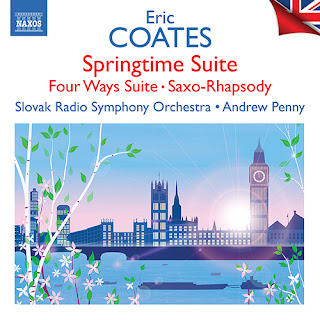
Eric Coates Orchestral Music on Naxos

First things first. This present album is a repackaging of the 1998 Marco Polo CD (8.223521) issued as part of the record company’s exploration of British Light Music series. This sequence featured many well-known names from that genre: Ronald Binge, Robert Farnon, Richard Addinsell, Trevor Duncan and many others. There were two albums of music by Eric Coates. It is fair to say that the present CD’s companion volume contained the pot-boilers, including the ubiquitous Dam Busters March, the evocative London Suites and the wartime favourite, Calling All Workers. That said, the opening track on this present CD, Sleepy Lagoon, is world famous as the theme tune to Roy Plumley’s long running Desert Island Discs. How many people hear this and think it must evoke a tropical island in the sun. In fact, it was inspired by the view from Selsey towards Bognor Regis. 

Springtime (1937) is Coates’s eleventh suite. It has never gained the popularity of some of the other examples. There are three well-balanced movements: 1. Fresh Morning: Pastorale, 2. Noonday Song: Romance and 3. Dance in the Twilight: Valse. The opening two movements cast a backward glance to a lost pre Great War idyll, whereas the final Valse is both optimistic and thoughtful at the same time. Overall, this is one of Coates’s most subtle works that deserves more popularity.

I have never really enjoyed the Saxo-Rhapsody (1936), and I cannot tell the reader why. Although it is written in a single movement, the structure is ternary with an “energetic” Allegro vivace bookended by a sympathetic Moderato passage. Unusually for Coates, this is the only orchestral work “that [is] not pictorial or programmatic, but a piece of ‘absolute’ music.” It majors on the instrument’s lyrical characteristics.

At the time of composition, the saxophone was looked at suspiciously by serious artists. But as a contemporary critic noted, “…when its resources are skilfully exploited, when its melancholy tones are blended with those gender and nobler instruments, it is capable of effects both novel and pleasant.” It is given a splendid performance here by Kenneth Edge.

Romance is in the air with the pensively-titled rhapsody Last Love. It has been described as a “song without words.” Whatever the emotions evoked by this dreamy music, it is a romantic number that pushes beyond the trite to something deeper and more expressive. Last Love is one of only two pieces written in the fateful year of 1939. The other is the Footlights Waltz. This is a wistful reflection on Coates time working in the theatre. Rob Barnett in these pages has described it as ‘dreamy, silvery and convey[ing] that floating effortlessness so typical of the Coates magic’. Footlights Waltz is the third of only three concert waltzes that the composer wrote: the other two are Sweet Seventeen and Dancing Night. It is probably the best.

The Four Ways Suite was completed in 1927. It was dedicated to the conductor Basil Cameron. The idea here is to celebrate the four corners of the world. The first movement, the North, is a rhapsody on the well-known Scottish tune Ca’ the Yowes. The atmosphere is sometimes pastiche Scots. This is followed by a “languorous waltz” depicting points South. Just how far in this direction is not clear. The night-time venues of London are nearer the mark, rather than some more exotic locations. Eastwards looks to East Asia and is full of “oriental clichés.” Albert Ketèlbey’s In a Persian Market is never far away from the listener’s memory. Equally stereotypical is the West movement which majors on things American, especially the Charleston. It is a jazz parody, and one of the best. Sadly the Four Ways Suite did not generate a deal of enthusiasm. It has fallen out of Coates’s repertoire.

Lazy Night (1931, not 1932, as in the track listing) is another “nature work.” Like Sleepy Lagoon, it was inspired by the surroundings of Selsey. That said, this is not a tone poem, more of a mood picture. The clue is in its subtitle – 'valse romance'. It is evocative of someone dreaming, perhaps whilst sitting in the garden of a big art deco hotel in Bournemouth, and hearing waltzes in the ballroom, or an early evening stroll in a London Park.

The Eighth Army and the High Flight Marches have not retained the popularity of the Dam Buster’s. The former was dedicated to General Montgomery after his victory at Alamein in 1942. Later, it was used as the signature tune for BBC Middle East broadcasts. Once again, the main theme bounces along, and the trio is more invigorating than may be expected. The orchestration is remarkable. High Flight was Eric Coates’s final composition, finished in 1956. It was devised for the eponymous film, telling a story of officer cadets training at Cranwell. Coates’s march was incorporated into the film score, which was devised by Douglas Gamley and Kenneth Jones. The movie was a failure, but the march remains a success, and deserves to be heard more often. The “big tune” is every bit as good as The Dam Buster’s March.

The sound quality of this CD is excellent. The playing is enthusiastic and never patronising. The original 1993 liner notes by Michael Ponder are most helpful.

This disc introduces repertoire that is a little beyond the better-known potboilers of the companion disc, Naxos 8.555178. That said, there is much wonderful stuff here that deserves the listener’s attention. Optimistically, this present delightful re-release will be purchased by those Coates’s enthusiasts who missed it thirty years ago.

Track Listing:
Eric Coates (1886-1957)

By the Sleepy Lagoon (1930)
Springtime Suite (1937)
Saxo-Rhapsody (1936)
Footlights Waltz (1939)
Four Ways Suite (1927)
The Eighth Army March (1942)
Lazy Night (1931)
Last Love (1939)
High Flight March (1956)
Kenneth Edge (Saxophone)
Slovak Radio Symphony Orchestra/Andrew Penny
rec. 23-30 April 1993, Concert Hall of Slovak Radio, Bratislava, Slovakia
NAXOS 8.555194
With thanks to MusicWeb International where this review was first published.

Wednesday, 13 January 2021

Eric Coates: Orchestral Works, Volume 2 on Chandos

Brian Wilson has given a perceptive review of this CD in these pages. Part of his study explores past recordings of many of these pieces. Jonathan Woolf investigates differences in timings and stylistic parameters between various recordings. I do not intend to repeat this valuable and interesting information. 

First off, there is nothing ‘new’ here. As an Eric Coates fan, I have heard all this music in the past, mainly on CD and record. Nevertheless, there are some relative rarities which are a pleasure to revisit.

The concert opens with the less-often heard London Bridge: March written in 1934. This was composed shortly after the phenomenal success of the Knightsbridge March, from the London Every Day Suite. It is devised in Coates ‘standard’ march formula. The piece was premiered on the popular In Town Tonight programme. The recording of this work had been captured by Pathé News. Geoffrey Self (In Town Tonight, Thames Publishing, 1986) has suggested that this March ‘is hardly in the same class for its main theme is hopelessly tied to the word-rhythm of the title and becomes monotonous because it cannot develop.'  Despite this negative criticism, I enjoyed this work. There is a sense of energy about this music that suggests the bustle of the both the famous bridge and the adjacent railway station.

The Selfish Giant, a Phantasy for Orchestra (1925) is a work that is rarely heard. It is one of a series of ‘Phantasies’ that were written with Coates’s son Austin in mind: a celebration of fairy-tales and bedtime reading. The others include those based on The Three Bears and Cinderella. The plot of The Selfish Giant is centred around Oscar Wilde’s evergreen tale: remember the giant who would not allow children to play in his dismal winter garden. But his mood softens and the garden blooms. There is, alas, a sad note: with the coming of spring: the giant dies, albeit peacefully, covered in white blossom. Listen for the orchestral onomatopoeia of bird sounds and little scurrying furry creatures.  Much of the magic is created by Coates syncopated style and his use of the ‘foxtrot’ as a kind of underlying motif.

Many listeners will have heard The Enchanted Garden in one of its earlier recordings. I was introduced to this work on the recording by the Sydney Symphony Orchestra conducted by John Lanchbery on the old HMV Greensleeves label (ESD 7062). Interestingly, Eric Coates never recorded this work.

Much of the music or The Enchanted Garden had been used in an unpublished ballet entitled Snowdrop (1930). This was based on the story of Snow White and the Seven Dwarves. Some years later, Coates planned to revise this score, but due to Disney’s iconic film (1937), this project was deemed unworkable due to possible copyright issues.  So, in 1938 Coates reworked this ambitious ‘ballet’ as The Enchanted Garden. Regardless of being subtitled ‘ballet’ it was not really meant for dance performance. It is, in fact, a fully blown symphonic poem, which pushes the ‘light music’ genre to its limits. So, inspired by his garden at Ivy Grange, Sidlesham and using a new ‘book’ devised by his wife, Coates proceeded to create his latest score. He wrote that he ‘was inspired to write it by the owls screeching by night and the small birds singing by day in my garden.’ The plot is the usual battle between good an evil. There is a definite ogre (how wicked?) in the Garden as well as the Good Prince and Princess. The outcome of this ‘cosmic struggle’ is never in doubt.

Geoffrey Self (op. cit.) has given a paradigm for listening to this tone-poem. He reminds the listener that The Enchanted Garden ‘is no Delian Summer Garden, rather it is an enchanted forest - Bax like…’

This work is ambitious. It was one of few works scored for a full symphony orchestra. Most of his other music could be played by a ‘pier end’ outfit that often had to rely on an adventurous system of ‘cues’ to make up for missing instruments.

I first discovered Eric Coates’s Summer Days Suite in a piano reduction I had borrowed from the Coatbridge Public Library in Lanarkshire during my schooldays. I remember trying it out on the piano. For me it was a non-starter. Like much of Coates’s music, the piano arrangements are not easy to play. At least not for a Grade 5! I did manage to pick out a few bars of the magical second movement, ‘On the Edge of the Lake’ (The Isla of the Waters). The melody of that gorgeous piece has remained with me ever since. There is surely a hint of Highland Heather in this movement, despite the use of the word ‘lake’ rather than ‘loch’. Here we have Coates almost out Delius-ing Delius. The first movement is a little rustic romp which certainly fits the bill for ‘In a Country Lane’. I guess we must recall that this was completed on 18 November 1918, only seven days after the Armistice. It is part of what ‘we were fighting for.’ The final movement, ‘At the Dance’ is one of Coates’s greatest waltzes. 
An anecdote states that Edward Elgar loved this suite so much that he wore out his record of the work. 

Three short pieces are included. The first, Wood Nymphs: Valsette was written in 1917. It was originally for a stage production, an ‘elfin ballet’. The music ‘sparkles’ from start to finish. This Valsette is evocative of happy, lazy days, despite being composed during the First World War. It was one of the composer’s earliest successes. The Serenade, For Your Delight, was written to a commission in 1937. The entire piece is characterised by a ‘gentle but catchy melody.’ Lazy Night is one of those works that is a sheer delight to listen to. For me, it is a perfect musical evocation of some rural retreat or perhaps an early evening stroll in a London Square.

The final work on this CD is the March: Calling All Workers. This piece carries the inscription ‘To go to one’s work with a glad heart and to do that work with earnestness and goodwill’. The story goes that Coates was coy about the title until the first broadcast performance. Interestingly, the actual title was inspired by a Hollywood film, where one of the actors playing a ‘G-man’, spoke the words ‘Calling all Cars.’  The rest is history. The March was adopted by the BBC for the programme ‘Music while you Work.’ This ran for some 27 years and was heard five days a week.  

The BBC Philharmonic’s performance under the baton of John Wilson is perfect. It is always good to hear Coates’s music played well, and without any condescension. The liner notes, by Richard Bratby provide all the information needed to add value to this CD. Eccentrically, the order of pieces in the booklet notes does not match the batting order of the CD.  The sound recording is ideal.

This is the second volume of what (hopefully) may result in a ‘cycle’ of Coates’s complete orchestral music. Let us hope the subsequent future releases appear with due haste. There is certainly a lot of music to still to be recorded for this project.

Track Listing:
Eric COATES (1886–1957)
London Bridge, March (1934)
The Selfish Giant, a Phantasy for Orchestra (1925)
Wood Nymphs: Valsette (1917)
The Enchanted Garden, a Ballet (1938)
For Your Delight, Serenade (1937)
Summer Days Suite (1919)
Lazy Night, Valse Romance (1931)
Calling All Workers, March (1940)
BBC Philharmonic/John Wilson
rec. MediaCityUK, Salford, Manchester; 14 and 15 November 2019. DDD.
CHANDOS CHAN20148

Monday, 13 May 2019

Eric Coates: Springtime Suite (1937)


It is an established fact that during the 1930’s Eric Coates’s orchestral music displayed one of two contrasting styles. On the on hand, there was the up-tempo, syncopated ‘dance-band’ mood used in The Three Men and the London Again Suite. And on the other, there was the post-Edward German ‘pastoralism’ which came to the fore in The Meadow to Mayfair Suite and the present work. Over his career, Eric Coates composed some 13 orchestral suites: Springtime is the eleventh.

The Springtime Suite has three equally balanced movements: 1. Fresh Morning: Pastorale, 2. Noonday Song: Romance and 3. Dance in the Twilight: Valse which reflects the progress of a spring day.  Each is around the four-minute mark.  The work is scored for woodwind, brass, an array of percussion including bass drum, cymbals, glockenspiel, side drum, timpani and triangle as well as harp and strings.
Geoffrey Self writes that this work has been overshadowed, even in the composer’s own mind. It is not mentioned in his autobiography, Suite in Four Movements (1953). Self also notes that it has not ‘received direct attention from the press.’ The work has been unjustly neglected in comparison to several of his other Suites.
According to Payne, Coates was working on the Springtime Suite at the time he moved house from Baker Street to Berkeley Court. This music was thought out ‘despite the chaos of unpacking.’ In a letter to Harold Lowe (12 June 1936) Coates explained that ‘the work is quite unpretentious and on the lines of my old “Summer Days”, so please do not expect to hear anything out-of-the-ordinary.’

Springtime Suite: Fresh Morning. 

The opening movement, ‘Fresh Morning’, looks back to the Edwardian pre-Great War era, with its innocent pastoral mood and carefree 6/8 rhythm. This certainly nods to Edward German, but also reflects the style of music that Coates was writing in the immediate post-Great War years. Coates introduces three tunes, all of which relate to the opening theme. Toward the conclusion, there is a delicious modulation into a loose and short-lived Gb major (7 flats).  It is a perfect musical postcard of an English meadow, soaked in dew with the sun just peeping up from behind the hill.
This is contrasted by a thoughtful ‘Romance’ that reflects on the sadness of a lost age or lover despite its title being ‘Noonday Song.’ The movement opens with a wistful flute melody, before the main ‘yearning’ theme is announced on the solo violin. This tune is characterised by an upward leap of a minor 7th (e.g. G to F). This leads to a highly-charged passage for full orchestra and harp culminating in a sweeping ‘allargando.’ The movement closes with a quiet reminiscence of the opening flute melody. Self writes that this movement alludes to some of the ideas included in the score Seven Dwarfs, later to be ‘recast’ as The Enchanted Garden.
The final movement, ‘Dance in the Twilight’, is a splendid example of Eric Coates’ waltzes. I guess the impetus and drive of this music suggests an evening ‘In Town’ rather that some rural retreat or village hall. There are four ‘themes’ in this piece that are all repeated with various endings. Its style may owe more to the ‘Scène du Bal’ from the Miniature Suite or ‘At the Dance’ (Summer Days Suite) than to the later ‘London’ based works such as From Meadow to Mayfair.   It is characterised by an optimism that seems to blow away the sadder reflections of the previous movements.
The Springtime Suite was published by Chappell in 1937.

The first performance of Springtime Suite was on 13 May 1937, played by Section C of the BBC Orchestra conducted by Eric Coates. Readers should recall that the Coronation of King George VI had taken place on the previous day.
This hour-long concert, mostly conducted by Joseph Lewis, began at 6pm with Benjamin Britten’s delightful movements on themes by Rossini, Soirees Musicales. This was followed by the ‘Waltz’ from Tchaikovsky’s Sleeping Beauty and thee aria ‘Lend me your aid’ from Charles Gounod’s opera Irene (an adaptation of his The Queen of Sheba). The soloist was Parry Jones. The second half of the concert included the Coates, Michael Balfe’s ‘Come into the Garden, Maud’ and Haydn Wood’s Fantasia: The British Empire. This last work was conducted by Wood.

For a modern view of Coates’s Springtime Suite, I quote a sentence from Rob Barnett’s review of Eric Coates conducts Eric Coates (Living Era Classics CD AJD201) He writes: The mid-1930s were a productive time for Coates as we can hear in the rather hackneyed-bland Springtime Suite although the final ‘Dance in the Twilight’ is good and kicks the trend rather well. (MusicWeb International, 7 Jan 2007). I disagree with contention that this Suite is either hackneyed or bland. However, I can see that Barnett has a problem with a stylistic appraisal of the final movement. As noted above, this waltz does seem to belong to the city rather than the country.

Eric Coates conducted the Light Symphony Orchestra in a recording of the Springtime Suite made on 24 September 1937. This was released on HMV C2926 & 2927. On the fourth side of these two 78rpm records ‘For Your Delight: Serenade’ (1937) was also included. Several subsequent recordings have been made.

There is a splendid recording of Eric Coates’s Springtime Suite on YouTube. It is played by the BBC Concert Orchestra conducted by John Wilson. It was uploaded from the now deleted CD ASV CD WHL 2112.

Friday, 24 February 2017

Eric Coates: Donald Brook’s Pen-Portrait from 'Composer's Gallery' (1946)

Donald Brook wrote a series of books presenting attractive short studies or pen-portraits of a wide variety of composers, conductors, pianists, violinists and authors. He had met these people and had a chance to speak to them about their achievements and interests. Sir Granville Bantock endorsed Composer’ Gallery (1946) by insisting that it ‘will be welcomed by music lovers and the larger public throughout the civilised world.’
On a personal note, this was one of the earliest second hand books about music that I bought in the days before the internet, it served as my introduction to a wide range of composers and their music.  I include several footnotes to Brook’s pen-portrait of Eric Coates.
The main resources for students of Eric Coates music are Geoffrey Self’s In Town Tonight: A Centenary Study of the Life and Music of Eric Coates (London: Thames, 1986) and Michael Payne’s, The Life and Music of Eric Coates (Farnham, Ashgate, 2012).  

TURNING to lighter music for a moment, we find that Eric Coates [(1886-1957] is one of the few who can write cheerful melodies that appeal to the masses without being musically vulgar. We have the assurance of many eminent composers that this is not as easy as one would imagine.
Eric Coates, who is in no way related to Albert Coates the conductor, was born at Hucknall, Nottinghamshire, in 1886, son of a physician. [1] He has happy memories of a carefree boyhood spent in the quiet old house [2] in which his father practised for forty years, and he recalls that his earliest efforts at music-making started when a friend from London happened to leave a fiddle at the house after a visit to the family. Eric, aged about five or six, began to experiment with the instrument, and within a couple of weeks could play quite a number of little tunes to amuse himself.
This led ultimately to violin lessons with Georg Ellenberger of Nottingham, instruction in harmony from Dr Ralph Horner [3] of West Bridgford (Nottinghamshire), and, at the age of twelve, the leadership of a little string orchestra in his native village. Then his father generously paid ten shillings a season to the Nottingham Sacred Harmonic Society for the privilege of allowing his son to play in their orchestra, but by the time he was sixteen, Eric had become such a useful member of the ensemble that instead of accepting a fee, they paid him half-a-guinea a concert for his services.
Coates began to compose when he was very small, but Dr Horner forbad him to do so and insisted that all his efforts should be put into his study of harmony. Despite this injunction and a stern warning from his father about ‘wasting time’ he continued to write.

He was still at school when he took up the viola as well, and as he seemed to make very rapid progress he wrote to Dan Godfrey, the conductor of the Bournemouth Municipal Orchestra, asking if there were likely to be any vacancies for viola players. Godfrey replied saying that he wanted a viola player who could ‘double’ on a wind instrument, so Coates prevailed once again upon the parental generosity and obtained a fine Boehm flute. Although he soon became quite an accomplished player, he never succeeded in getting into Godfrey's orchestra.

The question of his career brought a dismal suggestion from his father's bank manager eulogizing that monotonous profession. Eric was horrified, and after several feverish entreaties, his father at last agreed to give him the chance of a year in London to study music, on the condition that if he did not succeed within twelve months, he was to return home and go into a bank.
Coates went to the Royal Academy of Music in 1906 determined to win his laurels as a professional musician. He studied the viola under Lionel Tertis, and composition with Frederick Corder. [4] In a surprisingly short time he won a scholarship for the viola, and then resolving to become independent, set about finding part-time work so that he could pay for his own rooms as well. Again, he succeeded; for a friendship with a professional viola player enabled him to secure sufficient work as a deputy in various theatre orchestras to proclaim his financial independence.
After eighteen months at the Academy he went to South Africa with the Hambourg String Quartet, [5] and while he was there he wrote his first great success: the song ‘Stonecracker John’, which sold over half-a-million copies.
Returning to England, he joined the Beecham Orchestra in 1909, and in the same year his ‘Four Old English Songs’ were sung by Princess Olga Ouroussoff [6] at the Queen's Hall Promenade concerts. Later, these songs were made famous by Melba, who sang them all over the world.
Two years later Sir Henry Wood performed his Miniature Suite at the Promenade concerts, and invited Coates to become his principal viola. The invitation was accepted, and the appointment
lasted until 1918, when Coates gave up the viola and never touched it again.

In 1913 he married Miss Phyllis Black, daughter of Francis Black R.B.A., the eminent artist. Their son Austin, born in 1922, has been serving as a flying-officer with the R.A.F. in India.
As a child, Austin loved the story of the three bears, and persuaded his father to put it to music. The result was the well-known Phantasy, which was first produced at the Eastbourne Festival in 1926. I might add here that Mrs. Eric Coates wrote the story of The Enchanted Garden, and several other successes enjoyed by her husband.

Coates's first appearance as a composer-conductor was when he directed his Summer Days at the Queen's Hall in 1919. Since then he has toured extensively abroad, and has always enjoyed a great welcome in such countries as Norway, Sweden, Holland and Denmark.

It is now many years since he wrote his world-famous London Suite. The BBC was partly responsible for its phenomenal success, because the ‘Knightsbridge March’ was chosen for that remarkably popular feature In Town Tonight. [7] Within a fortnight of its debut, the BBC was swamped with over twenty thousand letters from listeners eager to know the name of the jolly tune. When the London Suite was performed in Copenhagen the audience went almost mad with excitement, and the members of the orchestra joined in by applauding on their instruments,
creating the most cacophonous furore ever known in the capital.

There is of course the old story of the provincial gentleman who told the ticket-clerk of a London tube station that he had forgotten his destination but knew that a song had been written about it. The clerk immediately burst into an ear-splitting whistle and issued a single to Knightsbridge!

Eric Coates's Sleepy Lagoon [8] was a success as soon as it came from the publishers' hands, but when someone in America added words to it, the sales went up to something like half-a-million within a few weeks. Coates knew nothing about it until he received a cable from the States congratulating him on having written ‘No. 1 song hit in America.’ [8]

His latest [1946] works include the Three Elizabeth’s Suite, the ‘Eighth Army March’ and the ‘Salute the Soldier March’. It can be said with little fear of contradiction that Coates is responsible for the great ‘march vogue’ we are experiencing at the present time.

Although he specializes in light music, he is absolutely sincere about it, and takes the greatest care with his work. ‘Sincerity is the keynote of existence’ he says, and he abominates people who write with their tongues in their cheeks. He listens critically to all new music, and although he enjoys the work of such people as Vaughan Williams, William Walton, Arthur Bliss and Arnold Bax, he feels very doubtful about much of the modern music we are expected to accept to-day. He finds difficulty in appreciating the modern trend one finds in the work of many of the American and Russian composers and feels that they concentrate too much upon effects because they are afraid of being thought conventional.

There is now such a craze for originality that in trying to be ‘different’ people will write almost anything. Coates is acknowledged by millions of musicians as the link between classical and ‘Light’ music, and he can best be described as one who produces light music from a classical background, for he was brought up on Bach, Beethoven and Brahms. He cannot tolerate banality in music. One critic declares him to be the ‘first English composer to treat modern syncopation seriously’ and another has said that he is ‘the only modern composer who can write a simple, popular melody without being common.’

He is very fond of dancing, and frequently complains about the sentimental drivel sung by the crooners, for he demands a sparkling vitality in dance music. At one time, Ambrose [9] would always put on his liveliest tunes when he saw Eric Coates and his partner taking the floor.
Eric Coates confesses that he is an incorrigible lover of speed. He can never find a car that will go fast enough for him, and delights in air travel.  He also enjoys photography, and is always looking for a better camera than the one he already possesses.

Notes:
[1] Hucknall was known as Hucknall Torkard until 1916. The composer’s father, William Harrison Coates, was a local doctor. In his spare time, he was an amateur musician. He played the flute and ran the St Mary [Magdalene] Church Choir.   
[2] Shortly after Eric Coates’ birth, the family moved to Tenter Hill. Here Coates grew up. The house bears a plaque provided by The Eric Coates Society and Ashfield District Council.
[3] I could find little out about Georg Ellenberger, save he was a onetime pupil of Joachim. Dr Ralph Joseph Horner (1848-1926) was a local musician, composer, conductor and teacher.
[4] Lionel Tertis (1876-1975) was an English violist and well-respected teacher. Frederick Corder (1852-1932) was an English composer, conductor and music teacher.  He is best recalled as the teacher of Josef Holbrooke, Arnold Bax and Granville Bantock. His musical compositions have disappeared.
[5] The Hambourg String Quartet was founded by Boris Hambourg (1884-1954) a Russian born cellist. At the time of the South African tour the members were Jan Hambourg (violin), John Robinson (violin) Eric Coates (viola) and Boris Hambourg (cello).
[6] Princess Olga Ouroussoff (? -1909), a Russian born soprano, was Sir Henry Wood’s first wife. They were married in 1898.  The name and title have been a bit exaggerated. Her given name was Olga Michailoff. Henry Wood refers to her as ‘Princess Olga Ouroussoff’, in his memoirs, but according to Arthur Jacobs (Henry J. Wood; Maker of the Proms, 1994) she was entitled to neither the rank nor the surname, although her mother was Princess Sofiya Urusova.
[7] In Town Tonight was first broadcast on Saturday, 18 November 1933.  The Radio Times reports that it was ‘A Topical Supplement of the Week's Programmes…
featuring items of topical interest which have come to hand too late for inclusion in the printed programmes of the Press or The Radio Times. ‘In Town Tonight’ has been started experimentally as a weekly framework for the various 'surprise items' which have been hitherto scattered about the programmes, often at times inconvenient to the ordinary listener.’
[8] ‘Sleepy Lagoon’ was famously used as the theme tune to the long-running radio programme Desert Island Discs, first broadcast on the BBC Home Service on 29 January 1942 with Roy Plumley. The first castaway was Vic Oliver, the Austrian-born British actor and radio comedian.
[8] ‘Sleepy Lagoon’ reached Number 1 in the USA Billboard Charts during April 1942. It was played by Harry James and his Orchestra.
[9] Benjamin Baruch Ambrose (11 September 1896 – 11 June 1971), known professionally as Ambrose or Bert Ambrose, was an English bandleader and violinist. Ambrose became the leader of a highly acclaimed British dance 

Sunday, 30 October 2016

Eric Coates: Interlude -The Unknown Singer (1952)

Much criticism of the early years of the Cheltenham Festival was aimed at works which seemed to exhibit a relatively conservative concept of ‘modern music’.
Malcolm MacDonald, in The Symphonies of Havergal Brian. Volume 2, Symphonies 13-29. (Kahn & Averill, 1978) summed up much criticism of many of the festival’s ‘novelties’: ‘....it may be [a] prevailing 'Englishness' that leads one to view it as almost a representative manque of that peculiarly English genre, the 'Cheltenham Symphony': the formally correct, harmonically fairly innocuous symphony in a 'modern English' idiom (Post-Hindemith, post-neo-classical Stravinsky, with some post-Vaughan Williams tunes, if we must be unkind) acceptable to the English critical establishment of the 1950's but with little to offer more exploratory minds.’ I understand that he later retracted the force of this comment. I am glad he did, as I am a great fan of the so-called Cheltenham Symphony’.

In spite of this seemingly ‘innocuous’ diet of modern music, it must have come as a wee bit of a surprise when a new piece, Interlude: The Unknown Singer, by the then doyen of light music was given its first performance at the 1952 Cheltenham Festival.  It was performed by the BBC Midland Light Orchestra conducted by the composer on 20 July 1952. Also heard at that concert of ‘light music’ was Coates Valse from the Four Centuries Suite.

Other premieres that year included Richard Arnell’s String Quartet No.2, op.14, Arthur Benjamin’s Piano Concerto (quasi un fantasia), Geoffrey Bush’s Overture: The Spanish Rivals, Anthony Collins’ Hogarth Suite for solo oboe and string orchestra, Gerald Finzi’s Suite: Love’s Labour Lost, op.28, John Gardner’s Variations on a Waltz of Carl Nielsen, the revised Symphony No.1 by John Veale and William Wordsworth’s Sinfonia in A minor for string orchestra, op.6.
Clearly, looking at the above list, very few works have entered the repertoire: the Finzi is the exception, although live performances of this piece are few and far between. I think only the Arnell Quartet has been professionally recorded (Dutton Epoch). There are radio broadcast ‘downloads’ of some of the other pieces.
None of the new works (that I have heard, or read reviews about) can be regarded as avant-garde or cutting edge: certainly not by the standards of then contemporary ‘modernist’ music being composed on the continent, or by the British composers Humphrey Searle and Elisabeth Lutyens.  In actual fact, Coates Interlude harks back to a pre-war light music tradition, which in 1952 would have been seen as ‘dated.’

Eric Coates: Interlude -The Unknown Singer was written after a lean period for the composer. Geoffrey Self notes that after an illness, Coates has been advised to give up smoking. The composer’s son Austin wrote: ‘For three years he didn’t write a note of music, not connecting this in any way with smoking. Then one day he thought, ‘Doctors be damned. I must have a cigarette.’ And musical ideas promptly began to flow again. It was only then he realised the connection.’ The musical silence was broken with the completion of the score of the present work on 24 May 1952.  At this time the composer was living in Selsey, on the South Coast.

The composer’s wife, Phyl, (Phyllis Marguerite Black) had been admitted to hospital for an emergency appendectomy. Whilst she was recovering in hospital, Coates stated that the idea of the work occurred to him. In his important study of the composer, The Life and Music of Eric Coates, Michael Payne (Ashgate, 2012) cites a letter from Coates to Oscar Preuss (24/02/1952):
‘Early one morning, as I slept, I dreamt I heard someone singing from out of a deep wood – it was a lovely soprano voice. I listened to the melody the unseen soprano was singing and to my astonishment, on waking I remembered every note of it. Such a thing had never happened before and I can assure any possible readers that it saved me a great deal of trouble, besides getting me out of an awkward predicament. And so my dream-melody became “The Unknown Singer” The original title had been ‘A Voice in the Night’.

The Interlude -The Unknown Singer is restrained, with an attractive melody for saxophone which has been described as representing a crooning singer. There is no outstanding climax in nearly seven minutes of music. However, the composer makes use of three melodies, which are, according to Payne presented in ternary form and ‘is essentially a set of variations’ on these tunes though none are played in combination or counterpoint.
This is a beautiful miniature, which deserves to be in the repertoire. It seems to have been ignored, even by aficionados of Eric Coates.

As far as I know there is currently only one performance of this piece currently available on CD. This is Eric Coates: 17 Orchestral Pieces played by the BBC Concert Orchestra conducted by John Wilson. It was released on the ASV label in 1997. I understand that is has been deleted, but is still regularly available at Amazon.  The score was published in an arrangement for solo piano (Chappell & Co., 1954) as well as for light orchestra (Aldwick, c.1952) 

Sunday, 17 April 2016

Eric Coates: Last Love-Romance

Last Love: Romance is one of Eric Coates delightful miniature tone poems. It was written in 1939, and received its first broadcast during an evening concert on the BBC Home Service on 8 December of that year. The BBC Theatre Orchestra was conducted by Stanford Robinson. The liner notes of The Definitive Eric Coates explain that the composer struggled with this work. He wrote to Robinson: ‘I am in the throes of orchestrating a short Romance –it is extraordinary how difficult it is to make a simple piece interesting to play; there seems to be nothing to work on somehow’.

It has been noted that in 1939 Coates seemed to be composing relatively little. Only the present piece and Footlights -Concert Valse were composed then. The previous year had seen the ballet The Enchanted Garden as well as the first performance of the Seven Seas March. There were also a few songs. The following year, 1940, saw the hugely successful Calling All Workers March as well as the orchestral ‘I sing to you’. In the same year lyrics were added by Jack Lawrence to Coates’ great hit, By the Sleepy Lagoon. It was not until 1943 that the flow of major orchestral works began to flow again with the Four Centuries Suite and the ever popular Three Elizabeth Suite (1945).

Last Love has a rhapsodic feel to it: Michael Payne, in his The Life and Music of Eric Coates (Oxford, Ashgate, 2016) has described it as a ‘song without words.’ The work is constructed in ternary form, however Payne points out that it is largely monothematic, with the ‘B-section’ being a reprise of the opening A-section, but played faster.
This miniature is a beautiful evocation of a languid mood of reflection and perhaps even remorse. I guess that the title could suggest the memory of the lover that has just departed, or maybe, the listener feels that no-one could ever replace the personality their ‘last love’. Whatever the emotions evoked, it is a romantic piece that pushes beyond the trite to something deeper and more expressive. In spite of the composer’s doubts, it is beautifully orchestrated.
The score, with 14 orchestral parts, was published by Chappell & Co. in 1940. A piano reduction had been published by the same company in 1939.      

A number of recordings exist of this work. The earliest was by Eric Coates himself recorded at Abbey Road Studios on 31 January 1940. It was released on Columbia DX 966, coupled with the vivacious Footlights–Concert Valse (1939). Interestingly, Coates substitutes the vibraphone for the scored glockenspiel in this recording.  It has since been reissued on CD (Nimbus NI 6131). In 1940 Columbia released in America the 78rpm disc (7408-M) featuring the Light Symphony Orchestra conducted by Coates. ‘Side A’ featured Sleepy Lagoon played by the London Philharmonic Orchestra also conducted by the composer.

The reviewer of Columbia DX 966 in The Gramophone (May 1940) suggested that ‘if anyone thinks it too easy to turn out Last Loves, let him try…as lots of us in aspiring youth have tried – and be abashed. Even in experienced age, few can serve up these nothings so well. But surely this ought to be entitles Latest – but not Last –Loves?’  
In 1993 Marco Polo issued a selection of orchestral music, including Last Love on 8.223521. The Slovak Radio Symphony Orchestra was conducted by Andrew Penny. Finally, ASV released 10 orchestral pieces, The Enchanted Garden with the BBC Concert Orchestra conducted by John Wilson.  There is no YouTube upload. 

Friday, 27 November 2015

Eric Coates: London Calling March

Eric Coates’ most popular marches include The Dambusters, The Knightsbridge and Calling All Workers. There are many more. Surprisingly, the London Calling March does not seem to have caught on quite as much as the others. Yet this work is thoroughly enjoyable. Ian Lace, in a review on MusicWeb International has suggested that it ‘sweeps you along and gets your toes a-tapping.’ It is a good description. Like much of Eric Coates’ music, there is little analysis or descriptive notes in print. My main source of reference here is Michael Payne’s The Life and Music of Eric Coates which was published in 2012. It was based on his thesis The Man Who Writes Tunes: An Assessment of the Work of Eric Coates (1886–1957) and his Role Within British Light Music (PhD Dissertation, University of Durham, 2007).

The London Calling March was completed on 11 December 1941. It was originally called This is London Calling March but this was crossed out in the manuscript and the current title applied. It was dedicated to his godson, Alick Mayhew, on his sixth birthday.
This march was written as a signature tune for the BBC’s Overseas Children’s Programme.  The original concept of the piece was to provide a short piece incorporating some ‘well-known airs from the four countries’ of the United Kingdom and also the tune ‘Boys and girls come out to play’. This desieratum bears no resemblance to what Coates finally delivered.

The London Calling March was one of a number of marches composed at this time, including the once ubiquitous Calling All Workers March written for the BBC radio programme Music While You Work in 1940.  The Eighth Army March celebrated ‘General Montgomery, the Officers and Men of the Eighth Army.' The Over to You, March was composed in 1941 and dedicated to 'to all those who make and fly our aircraft'. Another important work written around time was the orchestral Four Centuries Suite, completed in November 1941.  

Like many of Coates’ marches, London Calling is written using the formal structure of Elgar’s Pomp and Circumstance marches. Michael Payne (2012) defines this as Introduction-ABAB-coda. The theme from the March is based on the radio call-sign. The introduction is a verbalisation of the words ‘This is London calling’. It is applied to both rhythm and melody.
The work was first performed ‘on-air’ on 22 March 1942 as the signature tune to one of the BBC’s children’s programmes on the BBC’s Latin American service. The BBC Theatre Orchestra was conducted by Stanford Robinson. The march was played on the BBC Home Service on 13 June 1942 with the same players, although I cannot find reference to this in the broadcast schedules. The Radio Times for 25 August 1943 notes a further performance conducted by the composer.

Eric Coates and the London Symphony Orchestra recorded the London Calling March at the Abbey Road Studio One on 3 October 1945. It was released the following year on Columbia DB 2233 and was coupled with the Television March (1946).

Subsequent recordings have been relatively sparse. John Wilson conducted the BBC Concert Orchestra (The Enchanted Garden ASV CD WHL2112). Naxos released this march as part of Eric Coates’ Music for Wind Band, Volume 1 featuring the Royal Artillery Band led by Major Geoffrey Kingston.  A version of London Calling payed by Charles Williams and the Queen’s Hall Light Orchestra was issued on the Guild Light Music Series GLCD5107.

Wednesday, 23 September 2015

Eric Coates: Is English Light Music a Dying Art?

I make no excuse for posting this essay by Eric Coates. It is largely self-explanatory, however I could not resist adding a few glosses at the end.
As I look at the trend of musical matters today I ask myself: ‘What does the future hold for our composers of light music?’ Present-day conditions seem to point to the unpleasant fact that this form of art will die out unless something is done to give our younger composers of light music the encouragement which, once upon a time, was theirs. Do we appreciate the heritage of English light music or are we content to let it die? Are we grateful for the melodies that have survived the years, for those songs and tunes that have been handed down to us from our composers of yesterday? What of the music of Purcell, Dibdin, Arne, and Boyce (to mention only a few); the carefree ‘It was a lover and his lass’ or ‘Tom Bowling’ with its simple appeal, and the charming ‘Cherry Ripe.’ [1]
One could fill a page with the names of the familiar melodies which our writers of the past have given us, unaffected melodies which breathe the spirit of England. Melody! Where should we be without it? How much the poorer, for instance, should we be without the lilting melodies of Arthur Sullivan, that prolific composer of so many invigorating tunes! And what of Edward German? How many of us would care to forego the wistful appeal of this most fastidious of composers, who caught the spirit of the English countryside as none other has done. [2]
They were great men, and stood head and shoulders above their contemporaries in their particular line.  Both were masters of their craft and each spoke to us in their inimitable way, through the medium of the orchestra- for it is in the orchestration that the composer can make his personality felt more surely than in any other form of musical expression. [3]

About this time, of course, there were several very successful composers of light music in the theatre world who delighted us all with their haunting tunes – Leslie Stuart, Sydney Jones, Lionel Monckton, Howard Talbot, and Paul Rubens; even the school-children of today seem to know their songs. Sullivan and German were, however, in a class by themselves because of their knowledge of the orchestra; for, with the exception of Sydney Jones and Howard Talbot, most of the writers for the theatre of those days were obliged to call on the services of an expert orchestrator to arrange their music for them, as indeed they do in the theatre today. [4]

Most people do not realise that the writing of a light work is a serious business and takes just as much thought and skill to produce as one of the ‘heavier’ type –the symphony, for instance; and I think the reason the former is not now taken seriously is that far too many writers are content to jot down a top-line and sit back while the orchestrator does the rest. We shall never produce a future school of light music so long as this practice persists, and the only way to improve matters is by encouraging our younger composers to study the difficult art of orchestration. Our Academies of Music should wake up to the fact that something must be done about it. They should enlist the services of up-to-date professors who are sympathetically disposed towards light music of this type which entertains and delights the ear without being vulgar. The BBC (which does so much to encourage our moderns) [5] should work hand-in-hand with our Academies and stimulate an interest in this practically forgotten art.

Not long ago I asked one of the Directors of the BBC why certain orchestral works of the more popular type were not included in our broadcasts of representative English music and I received the reply that such works were excluded for the reason that they could be heard any day in our restaurants and theatres and over the air by smaller combinations. [6] But surely these works should be played occasionally at any rate, by the sized orchestra which the composer had in mind when he scored them, otherwise it seems unfair to the composer-the very absence of such works from programmes casting a slur on this kind of music and doing a great deal of harm through acting as a deterrent to any young composer who might feel the urge to express himself in this way.

I am not suggesting that programme-builders should give us concerts  composed entirely of light music, for that would defeat its own ends – too much of the same thing is always a mistake- but I would like to see the masterpieces of light music sandwiched between works by the masters of the classics.  It would be the right gesture to make to all those composers who through their inspiration have given so much pleasure to the music-loving public, and it would bring light music into its own. It may be the one of these days someone will come along to right the wrong being done to the wealth of lovely melodies which this country possesses. We may then look forward to a revival of interest in our much neglected light music, and the exponent of this delicate art will once again receive the recognition he deserves.
Eric Coates Radio Times c.1942 (reprinted in The Musical Digest No.6 Summer 1948)

Notes
[1] The music of Henry Purcell has been rediscovered in the 20th century and has been widely recorded and written about. To a lesser extent the same can be said about William Boyce and Thomas Arne. Dibdin remains a largely undiscovered country. It is fair to say that none of these composers currently capture the general musical public’s imagination at the present time (2015). The three melodies that are noted by Coates have survived, largely through Thomas Wood’s Sea Songs (Tom Bowling) and perhaps Coates own musical portrait of ‘Covent Garden’ (Cherry Ripe). 'It was a lover and his lass' remains popular.

[2] Coates notes that Sullivan ‘stood head and shoulders above their contemporaries in their particular line.’ I guess that he is referring to the sheer melodic achievement of their operettas rather than his symphonic and orchestral works.

[3] Arthur Sullivan has survived as the musical partner of G&S. However, in recent decades his ‘non-Savoy’ music has been investigated and has been found to be interesting and worthy of rediscovery, if not revelatory.  The same could apply to Edward German. However Coates would appear to be alluding to to the idealised English world created in Merrie England. Recent evaluations of German’s Symphonies and orchestral suites reveal a composer who is competent, imaginative and deserving our attention, if not at the forefront of Edwardian musical endeavour.

[4] It is highly unlikely that school-children in 2015 would even have heard of Lionel Monckton and Howard Talbot let alone know their songs. One does wonder how prevalent this engagement with these tunes was even in Eric Coates’ time. These composers of musical theatre are little-recalled today with the possible exception of The Arcadians (Talbot) and The Geisha with music by Sydney Jones which have been recorded and are given occasional revivals.

[5] Eric Coates would have regarded himself lucky that he did not have to deal with William Glock at the BBC. 

[6] This is not longer the case; however Classic FM does play a small number of light classics. Major recording projects such as Guilds’ Golden Age of Light Music and Marco Polo’s survey of a number of light music composers, including Eric Coates have allowed listeners in the 21st century approach a huge range of this genre of music.