Showing posts with label Edward Cowie. Show all posts

Monday, 13 July 2026

Edward Cowie: Darkness into Light

The outstanding booklet notes by Edward Cowie offer an exceptionally detailed introduction to the four works on this disc, with further commentary from flautist Laura Chislett and harpist Alice Giles. The booklet is generously illustrated with photographs of the performers and examples of Cowie’s pre‑compositional art studies, while the cover reproduces Darkness into Light, a painting by Heather Cowie. I have drawn extensively on these programme notes in developing my review.

The disc opens with La Primavera - Nine Figures in an Orange Garden (2022). This suite for solo flute is an evocation of Sandro Botticelli’s legendary painting La Primavera. Cowie notes that this “massive work” radiates light and movements. It is on display at the Uffizi Gallery in Firenze. The gallery website explains that “although the complex meaning of the composition remains a mystery, the painting is a celebration of love, peace, and prosperity.”

La Primavera has seven sections preceded by a Prelude: The Orange Garden, which sets the scene. The musical journey follows the painting right to left. Here, Zephyrus is embracing a nymph named Chloris before abducting and marrying her, then transforming her into Flora, the spring goddess. The central figure in the painting is Venus, the goddess of love and beauty. Over her Cupid is firing his arrow of love. Then there are the Three Graces: Aglaia, Euphrosyne, and Thalia. Lastly, in the final movement, Mercury prepares to take wing. The liner notes suggest that Zephyrus "blows" the listener into the music and Mercury "flies" them out at the end.

The soloist creates “the limpid and hugely flexible sonorities” of the characters, with the flautist’s breath symbolising the wind god Zephyrus. Cowie’s composition embraces complexity, contrasting sharply with Vivaldi’s pastoral, dance-like eponymous Spring, from the Four Seasons, by exploring the shifting terrain of human mood and memory.

“Extended techniques” and occasional vocalisation is required, which to my ear spoils the overall impact. However, Cowie told me that he felt it necessary to take music from the flute to human throat and that he took tiny fragments from Dante to do it! Still, it remains an impressive piece, played by Laura Chislett. Whether heard with the cast in mind or simply as an ‘experience,’ it is an attractive, impressionistic work. One thought lingers: is the entire suite ultimately just a shimmer of light across the painting that inspired the composer?

I guess since having first seen Punch and Judy on the promenade at Fleetwood, Lancashire, I have had a soft spot for Harlequin and the 16th-century Commedia dell’arte. Cowie has produced several works inspired by this tradition, including his opera Commedia, Columbine for soprano and chamber orchestra, Commedia Lazzi for solo guitar, and Harlequin for solo harp dating from 1979. In 2019, Cowie “re-shaped and re-composed” this latter piece to incorporate a deeper understanding of the harp and its possibilities.

Harlequin Dances for solo harp, depicts the protagonist’s “suicide lazzi” where he rehearses “dancing himself to death” after being rejected in love. The work is highly percussive, using pedal buzzes, slides, and soundboard knocks. The form presents complementary sections of “restless” passages and bell-like harmonics. Although ostensibly an entertainment, it is a black comedy. Harlequin tries out numerous methods of self-destruction – tickling himself to death, hanging himself from a small bush, drowning himself in a jug of ale (how many of us have nearly done that?) and “dancing himself to death.” It is this final “method” that is the focus this piece. Ignore the programme if you wish but be aware of the "transcendental beauty" found within human despair and loneliness.

It may not come as a surprise to find that Australian Water Music for flute and harp (2025?) was inspired by Handel’s semi eponymous suite dating from 1717, which was commissioned in response to King George I’s wish for a concert on the Thames. Beyond that, however, there is little comparison.

The suite was written specifically for the "superb brilliance" of harpist Alice Giles and flautist Laura Chislett and was designed to exploit the "tremendous velocities" and expressive richness of both instruments. Sadly, there is a movement missing: due to recording and rehearsal time constraints, a section evoking the Great Barrier Reef was omitted. The three remaining ones focus on specific Australian locations: Kiama Blowhole in New South Wales, Black Swans at Dangar Lagoon, again in New South Wales and finally Humpback Whales – Hervey Bay in Queensland. The three movements of Australian Water Music reflect the behaviour of water in contrasting states: fountains, “limpid placid pools,” and coastlines.

The liner notes suggest allusions to the “liquid” qualities of water, evoking the sound-worlds of Debussy and Ravel. A listener might be reminded of Debussy’s Syrinx for solo flute, or Ravel’s Introduction and Allegro for flute, clarinet, harp, and string quartet.

While both instruments carry their own invention, the duet also makes use of a ritornello form, where thematic materials are reworked in a lively dialogue. The performers employ “extended techniques,” including knockings on wood, scraping strings, overblowing, and exploring the extreme upper registers in the harp. The overall impact is characterised by colour, imagination, and a “wondrous iridescence.” This exquisitely played piece makes a splendid addition to the relatively rare combination of flute and harp.

Cowie explains that Darkness into Light (2025) was inspired by a series of paintings by his wife Heather titled Into the Deeps. This sequence depicted the colour shift from the "deepest, darkest blues" of the ocean abyss to "shimmering aquamarines" at the surface. To add to the uncertainty, it is explained that the performers had got into the “groove” by swimming (individually) in the waters of the Great Barrier Reef. In the subsequent improvisation they share their (presumably varied) experiences of transitioning from shallow, luminescent waters to the "impenetrable" blackness of the reef edge. Add to this, there is an implied “metaphorical journey” representing the progress of the mind and spirit from darkness into “divine Light” and it gives a clue as to what the piece should be like.

Cowie notes that there was initial “bemused doubt” from the performers about improvising this track, especially without using a pre-written score. It begs the question, was there any “given” material, or did they all just do their own thing: could they recreate the experience? Or would they want to? There is a danger that the divine light becomes a one-time accident.

My opinion is that there are some lovely sounds, especially from the flute. Lots of extended techniques on the piano and the harp are deployed, but mostly it functions as an atmospheric backdrop rather than a careful exploration of Cowie’s usually complex metaphors. It leaves me pondering where his vision ends and where the performers’ intuition begins. For me, the “shimmering aquamarines' are beautiful, but I still find myself yearning for the solid ground of a definitive score."

This is a beautifully presented recording. The sound quality is ideal for this intimate exploration of flute, harp, and piano music. Even if the repertoire is not your “bag” there is no doubt that the performance is brilliant. I have already mentioned the disc documentation. Dates of each work would have been useful.

Despite my reservations regarding the improvisational elements and occasional vocalisations, this is an absorbing release. The Métier label has provided another stunning disc of Edward Cowie’s unique, nature-inspired sound-world. Supported by virtuoso performances and lavish documentation, this disc is a must-buy for enthusiasts of contemporary chamber music.

Track Listing:
Edward Cowie (b.1943)

La Primavera – Nine Figures in an Orange Garden, for solo flute (2022)
Harlequin Dances, for solo harp (1979/2019)
Australian Water Music for flute and harp (2025?)
Darkness into Light: Improvisation for flute, harp, and piano (2025)
Laura Chislett (flute), Alice Giles (harp), Edward Cowie (piano)
rec. 8-9 June 2025, The Wesley Centre, Canberra, Australia
Métier MEX77143
With thanks to MusicWeb International where this review was first published.

Sunday, 28 September 2025

Edward Cowie: Because They Have Songs

The title of this album is derived from a traditional African text which states, “Why do birds sing? Because they have songs…” Which seems as good a reason as any for God’s creatures, be they human or avian.

The inspiration for Edward Cowie’s Because They Have Songs came from an “Untamed Botswana Safari” taken in 2014. He writes that this was no normal “tourist package” but a 3000-kilometre journey touching on many Southern African landmarks including the Victoria Falls, the margins of the Kalahari Desert, the Okavango Delta, and the Chobe National Park. During this journey, the composer and his wife Heather saw a vast range of wildlife, including wild zebra and antelope. And then there were the birds…

Regarding Cowie’s method of composition, there is an interesting, innovative process at play. He has stated that as a child, before he could write crotchets and quavers, he was able to physically “draw sounds from nature.”  Typically, he uses four notebooks “in the field.” These include one that deals with the “shape” or “form” of his natural surroundings. The second majors on perceived colours, and those that blend or clash. Most creative is the third jotter which records “representational” drawings of the birds, bees, and flora. The final notebook features traditional musical notation of what he “hears” about him – be it birds, insects, or water features. Cowie suggests that these “…[are] in the form of a translation or relocation of those natural sound-sources [made] into a potentially musical outcome.” The result of his studies results in music that is “in almost all cases [a] quotation of an actual birdsong…[adhering] to the actual pitch and shape of that song.”   This is often heard in the solo instrument, in this case a suite of saxophones, whilst the piano frequently provides the background atmosphere.

I did ask the composer if there was any improvisation in this score. He responded that “…everything is notated but of course I always try to compose music where the performers can ‘bend’ and sculpt sound and rhythm in ways close to their own emotional place in the music.” This factor can conspire to make Cowie’s work feel as though it is being created on the spot - fluid, instinctive, and liberated.

I wondered about an effective listening strategy for this “concept” album. I suspect that for many listeners, 88 minutes of sax and piano is pushing the attention span. Is it possible to listen to a Book at a time? Or even select a sequence of “birdsong” taken from all four volumes? No indication is given as to what the environment each book is evoking. Is it veldt, forest, or desert? Or all mixed up. Without deep ornithological study the listener is not going to be aware of each bird’s habitat. However, none of this really matters.

Cowie told me that Because They Have Songs can be “listened to in parts…even just an individual movement…these are not themes and variations, but instead clusters of very individual musical impressions, treatments, and responses…” Furthermore, it is not essential to understand the geographical, ornithological, or topographical allusions or backgrounds to appreciate this imaginative work. That said, I did look up on Google maps Botswana and some of the geographical sites visited by Cowie and his wife. And I could not resist looking at pictures of the evocatively names Southern Pied Babbler, Helmeted Guinea Fowl, and the Scarlet-Chested Sunbird.

I make no attempt to explore each of the twenty-four featured feathered friends, and neither does the booklet. One impression I gained was the subtle influence of jazz. This was reinforced by the scoring for the saxophones. I thought of innovative performances such as made by the late Miles Davis. Cowie told me that in his younger days he was impressed by the sounds of the Modern Jazz Quartet and Dave Brubeck. (He was not a Mod in his younger days, was he?). Beyond this, there is little to pin down the stylistic impact of this work. Messiaen perhaps, but there is no suggestion that Cowie has religiously adopted the Frenchman’s modus operandi. Absent from these pages is any theological speculation, beyond a numinous wonder at the marvellous natural environment, whether created by a Deity or not.

The overall impact of Gerard McChrystal’s (saxophones) and Richard Shaw’s (piano) performance is bewitching. It is aided and abetted by a clear, luminous recording.

As with the previous “bird portrait cycles” the liner notes, by Cowie, provide an excellent introduction to the overall creation, but avoids detailed discussion of movements or pieces. There is also a helpful ‘Afterword’ which considers the resultant recording and the soloists’ contributions. Of interest are two pages giving the “Performers’ Reflections” on the music and the project. Resumes of the composer and soloists are included. The booklet is illustrated with four beautiful examples of Cowie’s pre-composition designs and sketches. There are some snaps of the recording session at the Ayriel Studios in Whitby.

The insert features a remarkable painting of a Zulu Ceremony by Heather Cowie, to whom Because They Have Songs is dedicated.

This serenely confident and richly suggestive work is the fourth “epic cycle” of bird portraits that Edward Cowie has completed in recent years. Bird Portraits (2020/21) was reviewed here, Where Song was Born: 24 Australian Bird Portraits (2021), reviewed here and Where the Wood Thrush Forever Sings for clarinet[s] and piano (2022-23) reviewed here.

Because They Have Songs is not merely a catalogue of avian caricature, nor a travelogue in sound - it is a deeply personal meditation on the act of listening, of translating transitory encounters with the wild into lasting musical form. Cowie’s approach invites us to hear not just birdsong, but the emotional resonance of place, memory, and artistic response. Whether taken in full flight or savoured movement by movement, this cycle rewards the curious ear and the imaginative soul. Like the birds themselves, it sings because it must - because it has songs.

Track Listing:
Edward Cowie (b.1943)
Because They Have Songs: Books 1-4
Disc 1
Book 1

I. White-crested Turacos
II. Black-collared Barbet
III. Southern Pied Babbler
IV. Kori Bustard
V. Lesser Striped Swallow
VI. Verreaux's Eagle Owl
Book 2
I. Scarlet-chested Sunbird
II. Marabou Stork
III. Bearded Woodpecker
IV. Hildebrandt's Spurfowl
V. Blacksmith Lapwing with Skimmers
VI. Red-crested Korhaan (Nocturne)
DISC 2
Book 3

I. Speckled Mouse Bird
II. African Green Pigeon
III. Pied Kingfisher
IV. Saddle-billed Stor
V. Black-necked Weaver
VI. Southern Ground-Hornbill
Book 4
I. African Skimmer
II. Burchell's Starling
III. Cape Turtle Dove
IV. African Crowned Eagle
V. Helmeted Guinea Fowl
VI. Ostrich
Gerard McChrystal (saxophones); Richard Shaw (piano)
rec. 12-14 September 2023, Ayriel Studios, Whitby, North Riding.
Métier Records MEX 77122
With thanks to MusicWeb International where this review was

Friday, 29 August 2025

Edward Cowie: Rock Music

This is not another rock album – progressive, hard, or punk: it is about rocks. Now this gives me a problem. I can decline second-declension Latin nouns and muddle through the history of the 1745 Jacobite Rebellion and the Industrial Revolution, but geology? Absolutely nothing. I’ve climbed mountains without once wondering what they are made of. Yet this lack of technical knowledge should not put the listener off this remarkable disc, if (like me) they are clueless about, or indifferent to, that noble science.

I am beholden to the liner notes, the advertising brief, and private correspondence with Edward Cowie in these elucidations.

The initial point to make in coming to terms with these three piano sonatas is that they are “both an independent exploration and part of a greater whole, mirroring the classical sonata cycle in an ambitious and deeply evocative form.” This means each work can be heard independently, or they can be presented as a cycle, in the order given on the track listing, as three “classical” movements. I suggest that they be heard individually, at first. However, in the recital room, a complete performance (lasting 85 minutes) would be the ideal way of presenting these Sonatas. It will certainly tax the stamina of both pianist and attendee.

It is important to consider Cowie’s thought processes for each sonata, without allowing it to cause confusion and detract from the listening experience. He has often used natural phenomenon as an inspiration for his art. He has studied ornithology, incorporating birdsong into his pieces. His scientific background training as a physicist also influences his art, leading to essays inspired by particle physics and environmental phenomena. Additionally, Cowie is an accomplished painter and draughtsman, using visual art as a preparatory tool, often sketching landscapes and natural forms as a mode of pre-composition. His interdisciplinary approach blends music, science, and visual art into a unique creative process.

Edward Cowie's Rock Music (2023) is a remarkable piano composition that transcends traditional musical themes, drawing its inspiration directly from the fundamental physical processes that shape our planet. This ambitious structure, presented as a sequence of three sonatas, serves as a meditation on geology, translating the forces and transformations of the Earth into a compelling auditory experience.

For those less familiar with geological terms, here are the core definitions that underpin Cowie's work:

  1. Igneous: Refers to rock formed through the cooling and solidification of molten magma (below the Earth's surface) or lava (on the surface).
  2. Sedimentary: Describes layered rock formed over time from compressed mineral and organic material.
  3. Metamorphic: Denotes rock that has been transformed by intense heat, pressure, or mineral changes deep within the Earth's crust.

With these definitions in mind, the three movements (or sonatas) of Rock Music vividly portray their geological counterparts. With the help of the liner notes, some brief descriptions will be of interest:

Sonata No.1 Igneous
This lengthy sonata explodes with fiery, wild energy, just like a volcanic eruption. Its rhythms are unstable, surging and then briefly pausing, showing the power of lava and volcanoes. Very much stop/start.

Sonata No.2 Sedimentary
This unfolds slowly and patiently, like the gradual layering of rock over vast aeons. It moves between quiet, gentle sections and more dramatic periods, revealing nature's slow but powerful changes.

Sonata No.3 Metamorphic
The final sonata is the most expansive and complex. It takes themes from the earlier movements and transforms them with a series of twelve “variations” showing how intense heat and pressure reshape rock. This creates a powerful, unified ending that reflects concentrated changes in nature and music.

Two points. I asked Edward Cowie if parts of this massive trilogy relied on improvisation or aleatory procedures. He assured me that every note was written out “painstakingly.” A huge achievement. Secondly, the listener will wonder what the Sonatas sound like. I suggest that there are hat tips to Beethoven, Ravel, Messiaen, and Sorabji. And just occasionally, unless I am mistaken, there is a nod towards the rock music of my (and his) generation.

The liner notes were devised by Cowie and give a good and fathomable introduction to this intricate cycle. In addition, he provides an Afterword which explains his reaction to hearing the recording. The final part of the booklet features a Note on the Recording by Roderick Chadwick. These include a discussion with Cowie, which can be a bit technical and prolix at times. There are biographical details of the composer and performer. The beautiful CD cover is Rock Music by Edward’s wife, Heather Cowie.

The sound recording is second to none. Every nuance of sound is clear and bright, from the most subtle chord to the thumping explosions and extended piano techniques. Chadwick’s rare brilliance, sensitivity, and transcendent genius is to the fore throughout. Although the listener has nothing to compare the performance with, the sheer virtuosity of these three sonatas is palpable. There is beauty here, as well as passion, energy, and ferocity.

Track Listing:
Edward Cowie (b.1943)

Sonata No.1 Igneous (2023)
Sonata No.2 Sedimentary (2023)
Sonata No.3 Metamorphic (2023)
Roderick Chadwick (piano)
rec. 30 September – 1 October 2023, Ayriel Studios, Westerdale, Whitby, North Riding.
Métier MEX 77123


Thursday, 27 June 2024

The Kreutzer Effect: Edward Cowie

The context of this new CD of music by Edward Cowie is his long-running collaboration with the Kreutzer Quartet. Over the past decade they have recorded the composer’s first six string quartets, as well as participating in several solo and duo works. The String Quartet No.7 (“Western Australia”) was written with the talents of the Kreutzer in mind. In addition, Cowie has produced four “portrait pieces” dedicated to each member of the ensemble. It does not state when these four pieces were composed. I am guessing that it would be around the same time as the Quartet, 2017.

I acknowledge the extensive liner notes which I have mined in the preparation of this review.

The CD opens with Glaukopis described as “Five Atmospheric Nocturnes for Athena.” The title derives from the Homeric name for the goddess of wisdom and war, Athene, but may also refer to the Greek phrase for owl-faced or owl-eyed. Written for solo cello, this suite “places five distinct species of European and British owls in their own typical dusk and nocturnal habitats. These may be dark and brooding woods; sparse and remote moorland; jade and black shaded conifer forest or the open pastures of farmland fields and meadows.”

The first movement explores the Little Owl which carries the name Athene Noctua. Moving then to the Tawny Owl (Strix aluco) and then short-eared (Asio flammeus) and long-eared owls, (Asio otus) the suite ends with the barn owl (Tyto alba).

Cowie states that “All of these avian and mythological characteristics are evoked in this suite for cello.” They are not studies of birdsong, in the sense of Olivier Messiaen, but are intended to exploit the “colour and phrase” resources of the cello, which include a wide range of “dynamic and expressive techniques.” That said, there are some “screeches” which may be a direct representation of the owls. It is an ear-catching work that is successful in creating a numinous and nocturnal atmosphere.

Ever since reading about Daedalus and Icarus in primary school days (it was probably a bowdlerised edition of Ovid), I have enjoyed the story of the father and son’s escape from imprisonment in Crete. By using wings, they fly high above the Aegean Sea. Despite his dad’s warning Icarus flies higher and higher towards the sun. Sadly, the wax is melted, and the lad falls into the ocean. A wonderful tale. This myth is often interpreted as exploring the pitfalls of excessive ambition.

Edward Cowie has used this fable as the starting point for an “aria for solo viola and about global warming” (I did think it was nowadays referred to as Climate Change). The musical symbolism is obvious: starting with the lowest note a viola can play the music climbs slowly ever higher by way of “a progress-by-variation.” The ultimate moral of the work is that it turns out “that Icarus is the entire human race. In wishing to progress and rise, our species approaches a point of self-destruction-a world-once-noisy left without the ‘sounds of life.’” One could counter this philosophy by suggesting that humankind may be able to get itself out of the mess by its determination and ingenuity - if it so chooses.

If you like vocalisation, screams and mutterings, the use of a metronome as a prop and disjointed, hard edged, violin music, then On Second Fiddle is just the number for you. I found it challenging to say the least. I am sure that Mihailo Trandafilovski (violin) gives it his best shot. The allusion in the title refers to the fact that this member of the quartet plays Second Violin. 

I found the Menurida Variants longwinded. At thirteen minutes for a solo violin piece, it demands more concentration than many listeners may be prepared to commit to. Once again there are vocal noises off which add nothing to the sometimes-beautiful violin “melodies” and passage work. Based on Cowie’s response to the “song” of the Australian Lyrebird. He records “The sky was fast altering from jade shadows and indigo darkness into bronze and fiery copper and red dawn light. It was at this hinterland between night and day that a solitary Lyrebird began his grand cadenzas on the sonatas of the night. So magnificent; so complex; so virtuosic and rich was this song that I doubted I could ever compose something that would evoke (not imitate) the magic of that morning.” Whether he achieves this is up to the hearer to decide. For me, he does, but with the above-mentioned caveats. 

The String Quartet No.7 (“Western Australia”) was finished in 2017, after what Cowie calls a “mind blowing three weeks exploring (north) Western Australia.” He was impressed by a constant flow of new life forms and vistas as he travelled. This suggested to him the “possibility of music that travels and mutates.” He continues by explaining that the musical progress evolved in a continuous line, but “also of ‘places’ (musical passages), where it is necessary to stop and explore the intricacies and complexity of form at each pausing place.” This sense of forward momentum with pauses informs the first movement - The Road of Flowers. The middle movement, Hamelin Pool – Shark Bay is a subtle balance between “movement and stasis.” It is a meditation on the acrobatic displays of birds, the “Blue on blue horizons” of the seascape, and the 3,500-million-year-old algae found there. The music coruscates and sparkles, before dissolving into the ether. It is the mysterious Pinnacles: Nambung National Park that informs the final movement. (Look them up on Google: they are amazing). This site was sacred to the Aboriginal community. Cowie considers the multitude of shapes apparent in these natural sculptures. The music reflects these ever-evolving shapes, with the movement ending in a shimmer of light before dying to ‘niente.’ 

The thorough liner notes are written by Edward Cowie, with additional material from members of the Quartet. There are the usual biographical details of all concerned. The booklet is illustrated with photographs of the recording session, the composer, and the quartet. The evocative cover painting was created by Heather Cowie. The recording is splendid. And the performance is clearly formidable. 

Summing up, I did not enjoy On Second Fiddle or the Menurida Variants. I was impressed with Icarus and the Glaukopis. But the highlight of this CD is the String Quartet No.7. It is a splendid and often moving portrayal of “the ever-changing landscapes and intricate ecosystems of Western Australia, inviting listeners on a transformative journey through time and space.” 

Track Listing:
Edward Cowie (b.1943)

Glaukopis
Whatever happened to Icarus?
One Second Fiddle
Menurida Variants

String Quartet No.7 (“Western Australia”)
The Kreutzer Quartet: Peter Sheppard Skærved (violin), Mihailo Trandafilovski (violin), Clifton Harrison (viola), Neil Heyde (cello)
rec. 7 June 2022 (String Quartet No.7); 28 June 2022 (One Second Fiddle & Glaukopis); 19 February 2023 (Menurida Variants); 21 June 2023 (Whatever happened to Icarus), Hastoe Village Hall, Tring, Hertfordshire.
Métier MEX 77103


Monday, 15 April 2024

In Two Minds Edward Cowie (b.1943); Laura Chislett

The advertising for this disc explains that it “offers a unique fusion of musical expression and the natural world, inviting audiences to join in this extraordinary sonic exploration created through skilled and instinctive improvisation.” It further suggests that “this profound ritual of spontaneous outpourings invites listeners on an immersive journey, experiencing the direct transmission of sensory encounters through eight tracks that shape the discovered music of the moment.”

I am grateful to the liner notes and personal communication with Edward Cowie during my preparation of this review.

The word “improvisation” needs a little unpacking. It is often associated with the organ loft and the filling in of awkward gaps in the service. And then there is jazz… In both cases the performers tend to perform within “a prescribed musical world.” They often use a series of melodic and harmonic cliches. Another manifestation of improvisation was in the invention of complex and technically challenging cadenzas for concertos. One thing that it should not be (at least to this listener) is a jumble of notes chucked around any-old-how.

I asked Edward Cowie what preparation went into these pieces. He responded that “all effective improvisation would entail something akin to pre-composition.” With the present works each movement was planned in terms of certain “cues” that the performers give to each other, whilst leaving the improvisation as flexible as possible. There are no graphic/notated scores of any sort. The inspiration was the shared experiences of the sounds of the birds, the natural habitats and the paintings of Kandinsky, Rothko, Pollock, and Heather Cowie. Even the duration of each number was not fixed beforehand but resulted in a sympathetic response between the players. Each was made in a “continuous and unbroken take.”

The recital opens with the Dawn-Bellbirds. These are imagined to be in an Australian forest as the light slowly emerges from the darkness. The flute indulges in a variety of extended play techniques, before other bird species join in and create a kind of “avian counterpoint.”

An understanding of the art theories of Kandinsky infuses Guten Morgen, Herr Kandinsky! The artist insisted that “Points,” “Line” and “Planes” are “the three basic structural and dynamic paradigms of not only the cosmos and nature but also of music and the visual arts.” The Point is the beginning of all things, the Line is in effect a moving Point, and a Plane represents multiple Lines, producing a composition… Kandinsky reveals how “geometrical, physical, aesthetic, and spiritual concepts coexist naturally.” Cowie has used this paradigm in his Kandinsky (1995) Kandinsky’s Oboe (2009), both issued on Métier MSV28612. The present number is clearly a cheery greeting to, and an acknowledgment of, the artist’s theories. It is certainly much more satisfying than the theoretical underpinning would suggest.

Leighton Moss wetland nature reserve, near Carnforth, Lancashire is famous for its bittern colony. Boom Time - Bitterns at Leighton Moss celebrates the moment in late winter when the male of the species “warms up” before creating his powerful call. Cowie creates a splendid impression of landscape, mist, and sheer stasis, building up to the “boom” and eventually the other birds awakening. It is the longest piece on this CD, lasting for nearly ten minutes. Like Olivier Messiaen, Cowie can manipulate time: the work seems to last forever but contradictorily is over too soon. The bittern has the loudest bird call in the United Kingdom and is often compared to a foghorn or like the wind blowing over the top of a gigantic milk-bottle.

Sadly, due to a printing error, the booklet failed to print any commentary on New York - New York Mark Rothko - Jackson Pollock. I asked Edward Cowie about this, and he gave me this ‘take’ which I quote in full: “The two painters, Mark Rothko and Jackson Pollock, key members of a group of New York painters…worked in hugely diverse ways. Indeed, the personalities of both men could not be more starkly different. Rothko worked slowly and in a constant state of meditative tension, whilst Pollock was filmed working his strange, ferocious, and frenetic ‘dances’ holding a huge paint-dripping brush over a canvas on the ground. There is, thus, an obvious contrast between the steady application of layers of colour forms and delicately blended fringes that separate and join these often-huge geometric planes, and the gradually accelerating cascades and arabesques of paint that form the complex linearity of Pollock’s constructions. Thus, this improvisation plays with these contrasted ways of forming things. Rothko signs off with gentle hymn of colours whilst Pollock ends with a scream or loud slam of paint!”

There are two solo pieces on this disc. The first, Ornitharia, explores bird habitat in and around Sydney, Australia. Although this is for solo flute, the sustaining pedal on the grand piano is depressed. Cowie explained to me that the flute is often directed to the inside of the piano, sometimes “generating sympathetic vibration and harmonics, much as it would when birds in Australia sing in vast open spaces.”

The second solo, Stonehenge Thunderstorm and Skylark for piano, recalls a visit to the ancient monument with a distant thunderstorm over Salisbury Plain. Throughout, the song of the skylark is heard against the distant noise, before getting gradually quieter and finally fading away. For me, there are considerable echoes of Messiaen in these pages.

Out of curiosity I looked up Lake Eacham on Google Maps. It looks an idyllic place. The colour of the water at the shores is an inviting aquamarine, with the deeper reaches revealing an “unearthly black and jade colour.” The venue is ideal for bathing, sailing, and kayaking. Cowie explains that the place is “undoubtedly an Aboriginal sacred site for even to the uninitiated, it oozes an atmosphere of primal power - an almost magnetic feeling of life and history in wrapt and wrapped co-dependency.”  He has created a beautiful nocturne which compliments the special mood of the place, along with personal echoes of times past, when he was courting his wife, Heather. It is the most evocative piece on this CD.

The final improvisation is Dusk/Night Lyrebirds. Once again, it is inspired by Australia and is another ‘nocturne.’ This time it evokes the rainforest haunts of the lyrebird. Cowie writes, “Darkness falls in a rainforest where a chorus of avian ‘goodnights’ are uttered before a solitary lyrebird begins its bewitching and bewitched song.” It is a melancholy sound, nodding to the fragility of this and other avian habitats.

It is interesting to note that the Latin name of the lyrebird is Menurida: this happens to be the name of the Chislett/Cowie Duo.

The booklet is most helpful and gives a proficient introduction to the content. There is an interesting foreword by Cowie which discusses the nature of improvisation and puts these eight works into context, both in a performative and creative sense. Then follows the notes on the music, which unfortunately misses out any discussion on New York-New York Mark Rothko - Jackson Pollock. A personal note is given by Laura Chislett. Finally, there are the usual resumes of the performers and composer. The insert is illustrated and features a painting by Heather Cowie, Two Minds.

The recording quality is second to none and compliments the often-intimate nature of these improvisations.                                                 

I enjoyed this CD immensely. If I had not been aware of its improvisatory nature, I am not sure that I would have guessed it. The impact is sensuous, inventive, and often fantastic. Edward Cowie is keen to point out that although the titles are full of meaning for the performers, the listener can make their own “sonic” pictures and ignore the Notes on the Music. For me, although I have not been to the locales mentioned (Leighton Moss excepted) and I am unaware precisely what paintings inspired the music, I was prepared to use his notes as an aural prompt.

Track Listing:
Edward Cowie (b.1943); Laura Chislett

Pre Dawn and Dawn: Australian Bell Birds
Guten Morgen, Herr Kandinsky! (Point and Line to Plane)
Boom Time- Bitterns at Leighton Moss
New York-New York Mark Rothko - Jackson Pollock
Ornitharia (Flute Solo)
Stonehenge Thunderstorm and Skylark (Piano Solo)
Lake Eacham Blue
Dusk/Night Lyrebirds
Duo Menurida: Laura Chislett (flute), Edward Cowie (piano)
rec. October 2023, Ayriel Studios, Whitby, Yorkshire
Métier MEX 77121

Monday, 16 January 2023

Edward Cowie: Streams and Particles

As I am not an expert on particle physics, the Japanese poet Matsuo Basho, Wiltshire limnology or Kandinsky, I am beholden to the exceptional liner notes for aiding my understanding of the music on this CD. That said, Edward Cowie does admit that “Music ought, of course, speak for itself.” I agree. But he goes on to state that “my use of titles is to try to at least give a listener some terms of reference…Each of these titled pieces has a specific inspirational core. The evocations that these inspirational responses seek to share with a listener are intended to take the listener to either a sense-of-place or even something more personal and that's the stimulation of experiences the listener might already have of the phenomena that have inspired each of my pieces.” I wonder if they always help.

The first work is Particle Partita, written for two violins, and completed in 2012. It was commissioned by the Experimental Physicist, Professor Brian Foster FRS of the University of Oxford. Cowie explains: “Each movement is inspired by key and epic discoveries about atoms and parts-of-atoms (sub-atomic particles), from The Heraclitus [should this be Democritus?] Question postulated in the mid-4th century BC in Greece, and through to the postulate Higgs Boson and beyond.” Now that does not really help me too much: I only managed to scrape A Level Physics at my second attempt. Yet I think that I can just about manage to gain a mental picture of an atomic particle that “curves through time and space - that spins and coils - that collides and refracts - that is sometimes simple as well as complex - that moves at different speeds and directions - that has different elemental substance…” to gain an idea as to what is going on musically. One interesting formal device is that the two violin soloists act in tandem – like a relay race, so their contrapuntal interaction is limited. That said, this collaboration increases as the Partita progresses. Overall, it is a sonically interesting work, splendidly performed. I guess I see it as an essay in dialogue, rather than a debate on a scientific thesis.

On the Basho Meditations, I am on safer ground. Edward Cowie has used eight of the notable 17th century Japanese poet’s haiku to provide inspiration for the work. It is written for guitar duo. The haiku is traditionally an unrhymed verse, with three phrases, and a set number of syllables per line. It has often a seasonal or landscape reference. The haiku used here are given in translation. I suggest the listener read these, bear them in mind, but do not try to apply a detailed programme to the music. These are lovely Meditations, with some gorgeous and varied sounds from the two guitars. There is even a touch of flamenco, surely a million miles away from Basho’s world.

Stream and Variations (2019) was commissioned by the Julian Bream Trust. Bream’s words to Cowie tell all that is needed to understand its genesis: “I'm an old man now…and I thought I'd like music that connects with a part of my life that has sustained and nourished me for decades – and that is my living in a beautiful house in Wiltshire, not far from the little River Sem, where my dog (Django) and me used to go so often on healing and soothing walks.” Bream added that, “I'd remembered some of your earlier landscape pieces and a close friend of mine confirmed that you were the ideal composer for the job.” Cowie explains that he walked along the same paths as Bream had done. One thing that he noticed about the river’s progress were two distinct aspects of the stream: “there were pools of much slower and limpid water, sometimes gently twisting into groups of eddies or spirals, but often with scarcely any real and perceptible dynamic movement. But these were always preceded and succeeded by “runs” of narrower stream in which the water tumbled, buckled, coiled and folded in rapid and everchanging relationships with each other…” The reader will note the use of the words “twisting,” “eddies,” “spirals,” “coiled” and “folded.” These are all terms that could apply to photographs of particle collisions and to [some] drawings by Wassily Kandinsky. To me, the resulting theme and variations mirror these natural phenomena. Each variation is either “pool” or “run” successively. Knowing this background allows the listener to come to terms with this often magical “water music.” Add to this the topographical and emotional associations suggested by Julian Bream’s walks beside this stream, and we have a perfect landscape piece too.

To understand the background of Kandinsky (1996) for guitar quartet, we need to look at a bit of art theory. Kandinsky’s idea was that “Points,” “Line” and “Planes” are “the three basic structural and dynamic paradigms of not only the cosmos and nature but also of music and the visual arts...”  The first, Point, is the beginning of all things, the Line is in effect a moving Point, and a Plane represent multiple Lines, producing a composition. I think! In his writings Kandinsky reveals how “geometrical, physical, aesthetic, and spiritual concepts coexist naturally.” Just how Cowie has used this theory and applied it to his music, is a matter for future research students. For me, it succeeds as an abstract work, without the intellectual underpinning. The different guitars used (terz, “normal” and bass) add to the huge “range of colours” in this piece.

Kandinsky’s Oboe was completed in 2009 as a commission from the present soloist Christopher Redgate. It is constructed as a triptych: the three sections are once again Points, Lines and Planes, highlighting the theory previously mentioned. It is much more avant-garde in impact than the other works on this CD. Cowie uses extended techniques including ear piercingly high notes, breathings, sneezes, Klingon-like vocalisations, tappings and clickings. It is certainly not relaxing in any way. Whatever the listener feels about this piece, it is highly virtuosic and clearly challenging to perform. Not, however, my favourite number here.

As noted above the liner notes are essential reading unless the listener just wants to allow the music to wash over them. In fact, the entire booklet is a masterclass of design. The composer gives a brief overview of the works on this CD. This is followed by a detailed discussion of each work, placing it in context and giving the listener a handle for getting to grips with it. The texts of Basho’s haiku are included. An additional valuable resource are comments from the performers: Peter Sheppard Skærved on the Particle Partita, Hugh Millington and Saki Kato discuss aspects of the guitar music, and finally Christopher Redgate majors on Kandinsky’s Oboe. Thorough biographies of the soloists and Edward Cowie are included. Of considerable interest are the illustrations. They include subatomic particle collisions recorded at CERN (European Organization for Nuclear Research), a sketch by Kandinsky and pen and ink drawings of the little River Sem. Two examples of Cowie’s pre-compositional graphics for Streams and Variations and Particle Partita are given: these are major works of art. Finally, the haunting CD cover painting, Stream Partita, is by the composer’s spouse, Heather Cowie.

All the performances are top of the range. The recording is perfect. I enjoyed most of the works on this disc. Whatever the theoretical underpinnings are, the majority can be enjoyed “abstractly”: after all that is what Kandinsky was all about. 

Track Listing:
Edward Cowie (b.1943)
Particle Partita (2012)
Peter Sheppard Skærved (violin), Mihailo Trandafilovski (violin)
Basho Meditations (2019)
Miyabi Duo: Hugh Millington (guitar), Saki Kato (guitar)
Stream and Variations (2019)
Saki Kato (guitar)
Kandinsky (1995)
Spectrum Guitar Quartet: Hugh Millington (terz guitar), Saki Kato (guitar), James Girling (guitar), Bradley Johnson (bass guitar)
Kandinsky’s Oboe (2009)
Christopher Redgate (oboe)
rec. 15 January 2019, St Michael’s Highgate, London (Particle Partita), 10-12 August 2021, Silverdale Institute Hall, Silverdale, Lancashire (guitar works), 16 February 2016, St John the Evangelist, Oxford, (Kandinsky’s Oboe)
MÉTIER msv 28612

With thanks to MusicWeb International where this review was first published.

Wednesday, 15 June 2022

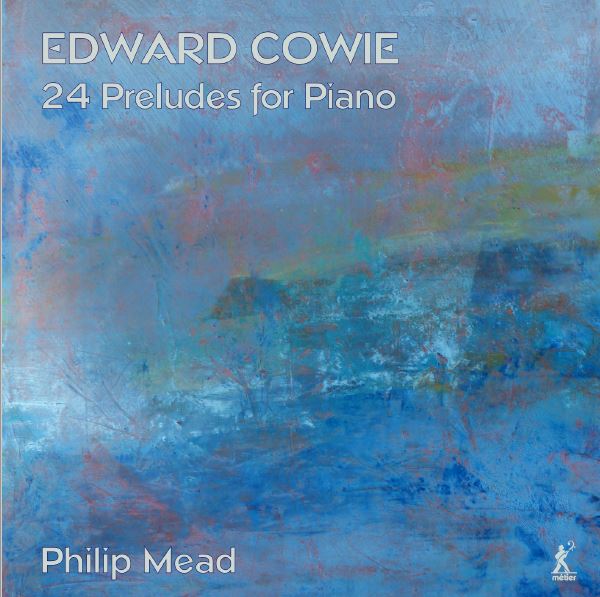
Edward Cowie: 24 Preludes for piano

This extraordinary CD of Edward Cowie’s 24 Preludes for piano is a reissue of a rare recording released by the University of Hertfordshire Recordings back in 2008. I am beholden to the excellent booklet notes and personal communication with the composer in preparing this review. The 24 Preludes were composed between late 2005, and mid-2007. They are dedicated to the present soloist, Philip Mead, who gives such a stunning performance on this CD. 

The original CD liner notes give a good basis for appreciating these Preludes. Cowie explains that he has travelled extensively, and that his “memories of landscapes and places in some of those far-flung habitats are as strong as ever, no matter how long ago they were first visited.”  Furthermore, he states that he has “nearly always written music that derives from a direct “on site” interaction with wild places; the voices of the natural world.” The present sequence of Preludes recall twenty four “distinctive yet sometimes related and interconnected locations.” 

No listener will need to be reminded of historical precedents for this procedure. Most obvious is J.S. Bach Das Wohltemperirte Klavier. Equally relevant to this exploration are the cycles of Preludes by Frederic Chopin and there are the early Preludes by Olivier Messiaen which are often forgotten about in any consideration of his music. Most pertinently of all is Claude Debussy who applied titles to his Preludes after he had written them. With Cowie the imagery came first.

There is another aspect to this massive composition. Surprisingly, for a contemporary composer, Cowie wanted to use the 24 major and minor keys of the well-tempered system as a structural basis for the music. I have no access to the score and do not possess perfect pitch, so I wondered if each prelude was written using the precise key signature or if each note had the relevant accidental added. Cowie assures me that “all the key signatures were written as Bach did.”  The progress of the key sequence is C major/minor then the dominant G major/minor and so on. Bach began in C major/minor and then moved up a semitone to C# major/minor etc. So Cowie’s structure is a fusion of key relationships.

What the listener must be aware of is that these are not character sketches, where the composer wrote the music and then dreamed up a catchy and commercial title. Here, each place/event is the fundamental inspiration for the genesis and development of the individual prelude. To understand his methodology, it is essential to recall that Cowie does his preparatory work with four notebooks. The first one records “shape” or “form” of what is round about him, the second puts down colours: those that blend and clash. Notebook three is devoted to representational drawing, and may include landscapes, flora and fauna. The final jotter is where Cowie records the musical notation of what he hears. Using his collection of notebooks, Cowie then creates what is effectively a work of art, combining the various elements of his research. Several of these are included in the CD booklet. It is from these that he completes his score.

Philip Mead has categorised Cowie’s Preludes as being neo-baroque but belonging wholly to the 21st century and balancing a “stark tonality” with a “non-tonal flavour.”  He considers that Bach is the main inspiration for technique – “There is an accent on polyphony, lithe, contrapuntal textures, sometimes even imitation, in strict 2-part writing.”

Several times the word “improvisatory” is used in connection with this music. I asked Edward Cowie about this. He explained that they were all “strictly notated” but allowed a “regular scattering of rubato.” This is a method of playing that allows for “subtle rhythmic manipulation and nuance.” In other words, the performer may “stretch certain beats, measures, or phrases and compact others.”

I did wonder if the composer imagined that the entire cycle would be played at a single sitting. He assured me that he “always imagined they’d be played in whatever grouping the performer likes. Performed in pairs...like Scarlatti...or perhaps a group of four with one each from the elements...”  On the other hand, like Bach and Debussy these Preludes are “like a series of linked parts to a greater whole.” So hearing the cycle complete is a valid option.

As an aid to listening, the Preludes are assembled into four books: Water, Air, Earth, and Fire. This elemental structure gives the music a kind of alchemical validity. The geographical reach of this music is impressive. From the opening evocation of O Brook (Devon) to the Blast Furnaces at Port Kembla Steel Works (Australia) and from St Maxime Beach, Provence to the New Year Fireworks, Kassel, Germany, the imagery is striking.

I listened to these pieces a book at a time. And then had a short break. In future I will cheat and pick out some of the places that I know and love such as Glencoe, Loch Carron, Boscastle and Rosedale in Yorkshire. But then, it is possible to extend one’s geographical reach to the Tennessee River, Lake Eacham in Queensland and to 35,000 feet inspired by a view from the flight deck of a jet airliner high above the Straits of Java. I did notice one lovely touch: the cycle opens and closes with an evocation of Glorious Devon. What could be more appropriate?

I have come to expect superlative liner notes to be provided with Edward Cowie’s recordings. And this latest CD is no exception. There is a considerable essay by the composer. This is followed by some important “Personal Thoughts on the Cowie Preludes” by the soloist, Philip Mead. Of interest is the biographical notes on the composer and the pianist. But the added value of this booklet is the artwork. There are four examples of Cowie’s “pre-compositional sketches” for these Preludes. It is safe to say that these are works of art. They feature representational images of the locations, various abstracted designs, and patterns, fugitive text as well as interpolated notational extracts. There is also a photo of a selection of his notebooks. The CD cover features a remarkable painting by Heather Cowie, Cancleave – Sea Mist in oil and cold wax medium on paper. All this material contributes to a satisfying and rewarding experience. For details of the composer’s biography and achievement, please see his excellent website.

Philip Mead provides an ideal, succinct summary of this cycle of Preludes: “One can look for similarities with its predecessors, but this seems to me a fruitless task as these works inhabit a wholly original world which only Cowie could create. Original, yet omnipresent, tonal, yet non tonal, full of movement yet also sometimes of stasis.” They are a splendid addition to the cycles of Preludes of Bach, Chopin, Debussy and Messiaen.

Track Listing
Book 1 – Water

I. O Brook (Devon, England) in C major [3:16]
II. Kiama Blowhole (NSW, Australia) in C minor [2:50]
III. Cancleave (Cornwall, England, sea mists) in G major [3:19]
IV. River Dronne (Dordogne, France) in G minor [1:47]
V. St Maxime Beach (Provence, France) in D major [3:30]
VI. Tennessee River (Tennessee, USA) in D minor [4:38]
Book 2 – Air
I. Boscastle (Cornwall, England, gale) in A major [2:06]
II. Hay Plains Twisters (NSW, Australia) in A minor [2:48]
III. 35,000 feet (Straits of Java) in E major [6:41]
IV. Tapada (Portugal, thermal raptors) in E minor [2:18]
V. Lake Eacham (Queensland, Australia, night breezes) in B major [3:23]
VI. Dartington Gardens (Devon, England, autumn leaf-fall) in B minor [4:14]
Book 3 – Earth
I. Uluru (Australia) in F sharp major [3:29]
II. Crackington Haven (Cornwall, England) in F sharp minor [1:21]
III. Rosedale (Yorkshire, England) in C sharp major [3:07]
IV. Glencoe (Scotland) in C sharp minor [3:25]
V. Brecon Beacons (Wales) in A flat major [1:17]
VI. Shenandoah Valley (Virginia, USA) in A flat minor [4:19]
Book 4 – Fire
I. Sunrise (Loch Carron, Scotland) in E flat major [2:19]
II. Bush Fires (Bluewater, N. Queensland, Australia) in E flat minor [1:00]
III. Home Fire (Garlinge Green, Kent, England) in B flat major [1:56]
IV. Blast Furnaces at Port Kembla Steel Works (Australia) in B flat minor [3:14]
V. New Year Fireworks (Kassel, Germany) in F major [1:34]
VI. Sunset (Dartmoor, Devon, England) in F minor [2:57]

Wednesday, 13 April 2022

Edward Cowie: Where Song was Born (2021)

I note with thanks my dependence on the liner notes and correspondence with Edward Cowie during the preparation of this review. 

It may be thought that anyone who has not been to Australia will find it hard to relate to the music on this CD. This is in contradistinction to Edward Cowie’s previous ornithological exploration, Bird Portraits, (reviewed here and here) which featured species native to the United Kingdom and Northern Europe. The only two birds from the Antipodes that many Northern Hemisphere listeners will have come across by name are the Lyre Bird and the Kookaburra.

In fact, it is the numinous quality of this music that transcends the need for a deep understanding of the local birdlife. It comes down to the didgeridoo, that most characteristic of Aboriginal instruments. During my first run through of Where Song was Born, I was conscious that Cowie had made considerable use of extended techniques for the flute (including vocalisation). One of these innovations sounded very much like the didgeridoo. He agreed with me, but more than this. Cowie has been influenced by singing which he experienced at several major ritual ceremonies attended. The piano too sometimes “paints” both indigenous wind and percussion Aboriginal instruments and music. He reminded me that “Aboriginals have animal ancestors which transmit spirit messages and guard the families.”  It is this mystical and sacred element that infuses Where Song was Born more, perhaps, than in Bird Portraits.

The genesis of Where Song was Born was back in 1981, and again in 1982, when Cowie first visited Australia. This was further developed during his extended stay there between 1983 and 1995 as an academic. At that time, he made many drawings, sketches, paintings and notations of birds he had seen and heard. Equally important is the location, giving a definite sense of place. Compared to the more circumscribed territories of British birds, Cowie writes that: “Most Australian habitats – especially those inland from its extraordinary coastal habitats – are vast. Many have either seemingly infinite horizons or in the case of the great jungle rainforests, no horizon at all. In both cases, there is an often overwhelming sense of the primal and elemental. Many places feel like they have never been seen by a human eye at all.”

Edward Cowie told me that he never imagined that his research would be used on such a scale as the present work. Initially, his Australian residence resulted in only a handful of pieces, including the 15 Minute Australia composed for the Merseyside Youth Orchestra, the Lyrebird Motet for 24 Voices, the Bellbird Motet for SATB choir and finally the String Quartet No. 3, "In Flight Music" with the first movement suggesting hang gliders in Stanwell Park, on the mid-eastern coast of New South Wales.


Where Song was Born

Part 1

Part 2

Book 1

Book 2

Book 3

Book 4

Australian Raven

Superb Fairy Wren

Bell Birds

Mangrove Kingfisher

Australian Wood Duck

Brolga Crane

Wampoo Pigeon

Helmeted Friarbird

Australian Masked Plover

Pied Butcher Bird

Golden-Header Cisticola

White-breasted Sea Eagle

Eastern Whipbird

Bush Stone Curlew

Tawny Frogmouth

Green Cat Bird

Willy Wagtail

Wedge-Tailed Eagle

Pied Currawong

Sooty Owl

Golden Whistler

Australian Magpie

Kookaburra

Lyre Bird


As can be seen, the structure of Where Song was Born falls into two main sections and is presented in four “books.”  Cowie suggests that “Part 2 breathes a rarer air than Part 1. There is more a sense that the birds are not only being placed in a musical setting, but that the setting has become more mysterious, with an element of ritual and meditative mediation between subject and music and between landscape and our emotions.”

I do not intend to write comments on every “section” of this work. What is clear is that this is a concept album (as we would have said back in the day about Prog. Rock). Sometimes there is a psychedelic feel here. However, it would be wrong to label any of this “new age” or a pastiche of “world music.”  It is a synthesis of many things, not all of which I have fathomed. Here and there jazz seems to emerge, there are ritualistic sounds and the above noted vocalisations by the performers. The pianist Roderick Chadwick is correct in suggesting the composition’s raison d’être is to link “our modern sensibilities with the earliest songsters,” the birds. Equally satisfying is the sense of continuity between the earliest sonics of humankind and the post avant-garde musicality of the 21st century.

Why did the composer choose the flute? Firstly, it is one of the most ancient instruments in the history of humankind (possibly only the drum is earlier?). Cowie notes that “wind instruments form an integral part of the instrumental music of the Aboriginals of Australia.” Furthermore, “virtuoso didgeridoo players often incorporate the songs and movements of birds into their ceremonial music.”  Another reason is the relation between birdsong and breath, hence the flute – a wind instrument. There is a sense of timelessness which makes it an ideal solo instrument at the “conjuring of a natural sound for the Australian birds being portrayed.”

Typically, (but not exclusively) the piano provides the “landscape” where the flute majors on the birdsong.

Edward Cowie told me that “the scale, vastness and strangeness of this cycle is intentional. I want, more than ever, to take a listener into an elemental experience of the music. To feel carried to the New World...which is in fact…as far as birds are concerned...an OLD world...”

Conceivably Cowie’s achievement can be summed up by an old African saying, cited in the liner notes: “Birds sing not because they have answers, but because they have song.”  This sums up perfectly the two already written, and the two projected cycles (see below), where the emphasis is always on the “birds and the places where they fly, dance, fight, nest and sing…”

As expected with Métier products the liner notes are beyond reproach. The booklet opens with a long and detailed “Introduction” by Cowie. This is followed by a postscript, where amongst other things, he outlines plans for the two further ornithological cycles. One will major on the United States and will be called Where the Wood Thrush forever sings. And the other, But Because they have songs, will be an exploration by percussion, marimba and piano of birdlife in (mainly) Zambia and Botswana. An interesting addition to these notes are the two essays by the performers, Sara Minelli, flute and Roderick Chadwick, piano. Both give helpful interpretive suggestions for this music. There are detailed biographical notes about the performers and the composer. For more information about Cowie’s life and achievement, see his excellent new webpage. A particular highlight of this booklet is the beautiful cover artwork, Eruption of Cockatoos, by Heather Cowie, Edward’s wife. It is an evocative masterpiece. Finally, there is a broad selection of photographs of the composer, the performers and two of the feathered folks featured on this album – the Superb Fairy Wren and the Golden-Headed Cisticola.

In an ideal world, the CD booklet would contain a selection of the underlying sketches, as well as photographs of each one of the 24 avian subjects. Over and above, it would be helpful to have some images of the background landscape. Feasibly, a webpage could be devoted to this work. Interestingly, Cowie’s new website devotes several pages to images of the artwork that explains his process of writing music such as the present composition and the earlier Bird Portraits. These illustrations are beautiful.

It will be clear to the reader that I consider Where Song was Born to be a multi-media piece that would benefit immensely from visuals.

The performance by Sara Minelli (flute) and Roderick Chadwick (piano) is stunning, beautiful, revelatory, often moving and thoroughly committed, both in creativity and technique. 

The listener can sit (or even lie) back and enjoy and appreciate this transcendent journey through the ornithological landscape of Australia. The sounds and music evoked will play strongly on the imagination, even if the species are unknown quantities. And there is always the Internet to find out more information about the flora and fauna of that great country.

Track Listing:
Edward Cowie (b.1943)

Where Song was Born: 24 Australian Bird Portraits (2021)
Sara Minelli (flute), Roderick Chadwick (piano)
rec. 12-13 July 2021 St George’s Headstone Lane, Pinner View, Harrow, UK
MÉTIER MSV 28620
With thanks to MusicWeb International where this review was first published.


Saturday, 18 December 2021

Edward Cowie’s’ Bird Portraits for violin and piano, (2020/21)

The genesis of Edward Cowie’s’ Bird Portraits was the enforced isolation caused by the Covid-19 pandemic. The composer (CD Liner Notes) reminds the reader that all “concerts, master classes, workshops and recordings were cancelled.” Limitations were placed on travel for anything but essential reasons. Luckily Edward and his artist wife Heather live in a stunning part of the country. The “permitted” exercise took them to the wonderland of the neighbourhood of Morecambe Bay. Cowie writes: “…only a short walk – less than 10 minutes in any direction, we could explore wild woodland, wetland and pastures. The birdsong, in the first spring of Covid, was stunning - the more so because we didn’t meet anyone else on our walks – the roads were almost silent, and the skies were devoid of vapour trails.”  Hearing and seeing these birds inspired Cowie to compose the present piece. He explains, “slowly and with a delicious inexorability, a ‘procession’ (or should I say, ‘fly-past’), of British birds came to fill my head with fresh and refreshing inspiration.” 

The resulting work consists of 24 Bird Portraits. Not all were seen in Morecambe Bay: the composer has had a lifelong interest in our feathered friends and has tracked them down in many UK locations. Over Cowie’s career, a quarter of his musical compositions allude to birds - either implicitly or explicitly.

I acknowledge the aid and assistance of the excellent (if sometimes philosophical) liner notes in completing my review of this CD. I have also had personal communication with Edward Cowie. The booklet opens with a “preface” by him. This is followed by Peter Sheppard Skærved’s reflections “On playing Edward Cowie’s ‘Bird Portraits’ – a view from the violin” which may be a little esoteric in places (number symbolism etc.) but offers several clues to enjoying this music. There are some “Scattered Thoughts” by the present pianist Roderick Chadwick, which I found useful. Included are considerable biographies of the soloists and the composer. Several illustrations compliment the CD and include two of Cowie “in the field.”  Of significant importance is a side-by-side photograph of the composer’s Preparatory Drawing, and the resultant score. The former contains sketches of a Skylark at rest and in-flight, Stonehenge, and various bits of notated music. I just wish the detail had been clearer, even under the magnifying glass. The enigmatic painting on the CD cover is Spring Song by Heather Cowie.

In his commentary on Bird Portraits Skærved gives a hermeneutic for approaching this massive work. The key is the number 24. Think of Bach’s two books of Preludes, Paganini’s 24 Capricci and Pierre Rode’s Vingt-Quatre Caprices. Cowie himself had used twenty-four movements in his Birdsong Bagatelles (2004), and other examples. There is often a tendency for musicians to equate the number twenty-four with the totality of major and minor keys, and their relationship. That said, key affiliation does not seem to be a factor here.

Skærved notes that Cowie has divided the movements of Bird Portraits into four books of six: (4 x 6=24). And the reason is easy to see. Looking at the titles discovers four avian habitats – Water, Field, Wood/Garden and Sea. There is the notion of Wet and Dry too. The waters, it can be seen surround, the land “like the encircling sea of the ancient and medieval worlds, or Tolkien’s, Ekkaia.” Further allusions could be drawn, but this combination is sufficient to give a grip on the progress of the Portraits. I would suggest listening to one group of six at a time. Personally, I would explore these birds in the order that Cowie has presented them in his score. But I see no harm in listening to any “complete” habitat group. A table of movements thus categorised is shown below: 

Water/Wet

Field/Dry

Garden/Dry

Sea/Wet

Mute Swan

Barn Owl

Tawny Owl

Curlew

Kingfisher

Pheasant

Green Woodpecker

Cormorant

Great Crested Grebe

Rook

Song Thrush

Osprey

Dipper

Magpie

Wren

Arctic Terns

Bittern

Starling

Bullfinch

Puffins

Coot

Skylark

Wood Warbler

Great Northern Diver

I am not convinced that the general listener to Bird Portraits will be aware of the intellectual superstructure of this music. A cursory hearing will reveal it all about birds: the relationship to their unique landscape may be a bit harder to divine. But this is no problem. The work can be enjoyed “absolutely.”

I do not intend to discuss each movement for this review. I think that to do so with any sense of perspective would require sight of the score, as well as a study of the composer’s preparatory sketches. Perhaps these will be published, or even be uploaded to his webpage.

Pianist Roderick Chadwick has given some wise pointers towards appreciation of Bird Portraits. I agree with him that each of these would be “musically satisfying” without the bird being evoked. Yet, the title does give the listener a mental hook on which to imagine the musical progress of each movement. I admit to looking up the Great Northern Diver in my bird book to remind me of what they look like. Also, knowing Morecambe Bay, the Northumberland Coast and Farne Islands, seemed to make this music closer to my heart. Another essential reminder from Chadwick is that, as a rule of thumb, the violin is the bird, the piano “portrays” the landscape.

There is a danger of assuming that Edward Cowie’s Bird Portraits follow directly in the footsteps of Olivier Messiaen’s Catalogue d'oiseaux. The composer, however, writes “apart from sharing a deep interest in ornithology with that great man, my approach to music inspired by birds is substantially different from his.” Using his account, it is possible to drill down deeper into the difference between these two great works. The fundamental distinction is that Cowie believes that Messiaen took his “Music to Nature.” There were the jotted down bird calls, but to this the Frenchman brought his own theories of rhythm, Indian ragas, and his “idiosyncratic harmonic procedure – even to the harmonisation of birdsong.”  In other words, Messiaen “applied his techniques in the registration and translation of natural sounds to his own musical settings.”

Cowie claims that he writes the other way round: he takes “Nature to Music.” It goes back to the composer’s younger days. Before he could write down music, he was able to “draw sounds from nature.”       Thus, his sketches for these short Portraits play an important part in the development of his piece. He explains that four notebooks are used in the “field”: one dealing with the “shape” or “form” of what is round about him, the second to record colours: those that blend and clash. Notebook three is devoted to representational drawing, and may include birds, insects, and flowers. The final jotter is where Cowie records the musical notation of what he hears. But the interesting statement that he makes is that many of these “being in the form of a translation or relocation of those natural sound-sources [are made] into a potentially musical outcome.” Surely this is what he suggests Messiaen did - recreating the sounds in his own sophisticated compositional image? Cowie told me that he did not use a tape recorder in the field: Messiaen did but did not make this information public.

Another difference that Cowie has promulgated is “in almost all cases of (quasi)-quotation of an actual birdsong, I have adhered to the actual pitch and shape of that song.”  He writes that Messiaen “often took [transposed] many songs down at least one or two octaves and ‘harmonised’ them too.” Yet the following sentence in Cowie’s notes reveals that “the patterner in me takes centre stage in musically (my italics) portraying the drama of these birds in a state of song.” This suggests that musical and artistic aesthetic trumps literal transcription. Indeed, that is what Messiaen was doing too.

A major difference is that Messiaen brought his deep Catholic faith to bear on his Catalogue d'oiseaux: I am guessing that Cowie develops his Portraits from a more secular point of view. That said, never for one moment is this piece devoid of a sense of the numinous. In fact, that is its supreme achievement.

Resultantly, I think Edward Cowie’s approach to birdsong is not as far removed from that of Messiaen, as he suggests.

Finally, what does this music sound like? The adage attributed to Elvis Presley is called to mind: “It don’t sound like nobody.” Not altogether true, however. Clearly Cowie’s music teachers, Alexander Goehr, Michael Tippett and Witold Lutoslawski have had an impression. The impact of nature, and Cowie’s response to the specific birds and their habitat, has created a musical language that is unique. Like all great composers, Edward Cowie has managed to create a synthesis of his influences, and has added to them, and pushed well beyond. As noted above, no one can approach this CD without at least having Messiaen at the back of their mind (assuming they know his music).

The sonic impact of this work is characterised by a continuum between dissonance (say, Cormorant) and concord (say, Dipper).

The playing by both partners of this violin/piano duo is revelatory. Engineer Jonathan Haskell provided the wonderfully sensitive and always vivid recording.

The advertising blurb for this CD sums up the total experience better than I can: “Cowie has drawn even closer to composing music that not so much imitates nature, but that – after much study and extensive field-work – has led to contemporary music with highly original treatments of the relationships between the bird singers and where and how they sing.”

I look forward to Edward Cowie’s Where Song was Born for Flute(s) and piano. This work was written after Bird Portraits and was inspired by Australian Birds. That said, as I have never been to the Antipodes, it may be harder to relate to these creatures. It has been recorded for Métier Divine Arts and is due for release during January 2022.

Track Listing:
Edward COWIE (b.1943)

Bird Portraits (2020/21)
Peter Sheppard Skærved (violin), Roderick Chadwick (piano)
Rec. 17-18 May 2021, St George’s Headstone, Pinner View, Harrow, Middlesex.
Métier MSV 28619