Showing posts with label John Ireland. Show all posts

Saturday, 4 July 2026

Minor Masterpieces of Organ Music No.5: John Ireland’s Capriccio

John Ireland is not the first English composer that an organist would consider when assembling a programme for a recital. His best-known works are the piano miniature The Holy Boy, the song Sea Fever, and his anthem Greater Love Hath no Man.

I first discovered him in 1973 when a friend of mine at Coatbridge High School sang If there were dreams to sell, a setting of Thomas Lovell Beddoes’s unpretentious, if slightly melancholic poem. Since that time, I have explored Ireland’s compositions which include more songs, much interesting chamber music, some impressive orchestral pieces, and an important corpus of piano works. His style tended towards French Impressionism and Romantic expressiveness, often infused by a native mysticism. This latter was inspired by his reading of the Welsh author Arthur Machen and his sympathetic reaction to the ancient landscapes of the Channel Islands, Dorset, and Sussex.

Ireland’s output for organ was largely completed over a brief period between 1902 and 1912, with a final notable offering, Meditation on John Keble’s Rogationtide Hymn as late as 1958. These include the Elegiac Romance (1902), a Miniature Suite (c.1905), and the solemn Sursum Corda (1911).

The Capriccio dates from 1911 and was dedicated to H.L. Balfour, at that time the organist at Holy Trinity, Sloane Street, London. It was published in The Organ Recitalist, No.23, by Stainer and Bell, in that year. Contemporaneously, Ireland was organist at St Luke’s Church, Chelsea.

Unusually for John Ireland, who normally explored themes of solitude, longing, and transcendence, the Capriccio is characterised by wit, bravura, and technical prowess. It is of interest as acting as a bridge between the early 20th century Edwardian English organ tradition and a later, more modernist mood, being a move away from pastoral lyricism towards a more continental sophistication.

Formally, the Capriccio could be defined as a modified rondo, (recurring theme with more or less related episodes) or a perpetuum mobile (unceasing motion driven by relentless rhythmic energy). The progress of this six-minute piece moves from intimate moments to shattering tuttis, even calling for a tuba stop (where available). A large three or four manual organ is required for maximum effect.

Fig.1

The opening bars (Fig.1) set up the mood with semiquavers accompanying a four-bar phrase of straight quavers introduced by “impudent” grace notes. This roiling mood is repeated and then varied with some subtle syncopation. 

Fig.2

The first episode (Fig.2) is quieter, calling on a clarinet solo on the Choir or Great organ. Then the return of the principal theme is recalled, slightly varied. The second episode is heard on the Choir flutes. From this point, it builds up with a “long crescendo” This is interrupted by a final reprise of the opening, before the work ends with a powerful march-like coda, using the tuba stop, calling for full organ and a final ffff chord in the home key.

The Capriccio is ostensibly in C major, but typical of Ireland’s style there are many passing modulations. Harmonically, it features chromaticism and modality, echoing influences from French Impressionism and the English pastoral school, though with a more urban, whimsical character.

A contemporary review in the Musical Times, (June 1912, p.384) stated:
“Among those modern composers who are endeavouring to raise the standard of organ music must be included the name of Mr. John Ireland. He proves that while it is not necessary to sustain the organ's reputation by writing a Fugue, it is quite possible to present acceptable examples in lighter form and yet to maintain the true character of the instrument. The Capriccio is admirably written, and while within the powers of those possessing even moderate technical skill, should prove a charming addition to the programme of many an organ recital.” Organists should be aware that this work depends on more than “moderate technical skill.”

To this end, Peter Hardwick, in his essential British Organ Music of the Twentieth Century (The Scarecrow Press, 2002, p.94), states that: “a good keyboard technique is…called for in order to execute the saucy little sixteenth-note accompanimental figurations, the principal melody’s impudent grace notes and passages that require the crossing of hands.”

Finally, commentators have noticed the potential of more “popular audience appeal” with the Capriccio, than any of his other pieces for this instrument. Part of this is the obvious “cinema organ” (despite this instrument only beginning to appear in 1911) sound apparent from the opening bars. It would make a popular encore, with the audience most definitely tapping their feet.

The score of Capriccio can currently be found in The Organ Music of John Ireland (ed. Robert Gower), Novello, 2003

With thanks to the Glasgow Society of Organists Journal where this essay was first published.


Sunday, 21 December 2025

“From pagan rites to pastoral reveries, Ireland at his best" - Rebeca Omordia

For readers of a certain age, the progress of recordings of piano music by John Ireland has been astonishing. I first heard his piano music on an old Saga album (XID5206) lent to me by an older friend, where Alan Rowlands played the Decorations and the Holy Boy: Prelude. This album had been released in 1962. In the early 1970s I acquired three Lyrita records of Ireland’s piano works, once again played by Rowlands. Since that time there have been another four more or less complete editions of this repertoire - two by Eric Parkin (one Lyrita and the other on Chandos), John Lenehan on Naxos and Mark Bebbington on Somm. All bring their unique talents to this notable music. Rebeca Omordia has chosen a fine conspectus of Ireland’s piano compositions: three major essays and a selection of five more ephemeral, but none the less, important “character pieces.”
The recital gets off to a great start with an outstanding account of the expansive and visionary Piano Sonata in E minor. This is his most significant piano composition. That said, it is certainly not his most popular or oft played. It was written between October 1918 and January 1920. Although not a “war work” as such, its period of gestation coincided with the end of hostilities. The liner notes explain that it is conceived on a “large scale” not so much in temporal terms as “in concentrated intellectual command and expressive ire.”

John Ireland once suggested that the first movement of his Piano Sonata was about “life,” the second was “more ecstatic” and the last was “inspired by a rough autumnal day on Chanctonbury Ring & [the] old British Encampment.” It is a good hermeneutic for appreciating this music.

The opening movement, Allegro moderato, features an “emotional struggle” that is never quite resolved, although it never descends into violence, nor is tranquillity discovered. The slow movement, Non troppo lento, is hardly ecstatic: it is hard won and deeply felt. The finale, Con moto moderato, is the most demanding movement, with a “jubilant” conclusion, that certainly creates a vivid evocation of the South Downs topography. There are references back to earlier themes and motifs bringing the Sonata to a satisfying conclusion. It is given a rewarding performance here, with a remarkable equilibrium between the “mystical,” the “late romantic” and the “passionate” elements.

The three movement Decorations is another one of Ireland’s most significant works. It was completed in the years before the First World War. There is a watery mood to The Island Spell, which may remind the listener of Ravel or Debussy. It is possible that quieter passages from Shakespeare’s The Tempest may have been an inspiration. The actual quotation heading the score is taken from a poem by the Symbolist poet, Arthur Symons. Moon-Glade is a decent evocation of a melancholic poem about “sorrowful dreams,” also by Symons. It is characterised by “subtle dissonance” created using bitonality. The final section, The Scarlet Ceremonies, is the most dramatic and intense. Drawing on a passage from Welsh poet Arthur Machen’s occult tale The White People, the listener is led into a world far removed from the pastoral convention popular at that time. What the Ceremonies were, we must imagine, but Eric Parkin has suggested “forgotten and forbidden pagan rites.” It is certainly not a walk along The Towing Path.

There is a definite impressionistic feel to the first of the Two Pieces (1921), Amberley Wild Brooks which is predicated on “rippling, sparkling sonorities” creating a mood of “rushing, fluttering and trembling of nature, green springing, joyful.” There is the occasional irruption of a melody, but this is about keyboard figurations. On the other hand, Remembrance has been likened to moments in Wagner’s Parsifal in its solemnity and introspection. They are two delightful pieces, which deserve to be better kent.

John Ireland’s Two Pieces for Piano (1925) are often underestimated as mere “character pieces.” This is unfair. April is a gentle miniature, which complements its title. Calmness is balanced by a short but virtuosic climax in the middle section before the recapitulation of the pastoral theme. In contrast, Bergomask could nod to the Italian courtship dance hailing from Bergamo. It is spirited, mischievous and may remind the listener of Ragamuffin from his London Pieces. They are given convincing performances here.

One of the highlights of this disc is Rebeca Omordia’s superb performance of Sarnia: An Island Sequence, which pianist Eric Parkin described as one of Ireland’s “pianistic masterpieces.” The title refers to the Roman name for Guernsey in the Channel Islands, a place of deep personal resonance for the composer.

This suite (or is it a Fantasy-Sonata?) would become Ireland’s final major work for solo piano. He began writing it in Guernsey and completed it upon returning to Banbury, England in 1940, having been evacuated shortly before the German occupation. The three movements - Le Catioroc (named after a Neolithic site), In a May Morning, and Song of the Springtides - form a wonderful tribute to the island he first visited in his late-twenties.

The pianist’s role in Sarnia is to navigate the suite’s complexity with sensitivity, balancing its mystical - at times pagan- nuances with luminous depictions of the island’s landscape. Of importance is the subtle innocence/supressed passion dichotomy in the second movement Song of the Springtides, dedicated to Michael Rayson, the son of a hotel owner, and whom Ireland was infatuated. It is one of the loveliest movements he composed. The final movement, Song of the Springtides, requires that, as Ireland wrote to Clifford Curzon, the performer must “display charm, subtlety, passion, and above all [the] beauty of a high alluring order.”

It is good that the recital ends with a lesser-known number as a kind of encore following Sarnia. Columbine was finished in 1949, late in his career. It appeared in an anthology of pieces, Down the Centuries, edited by English-born Canadian administrator, teacher, pianist, conductor, and arranger Leonard Isaacs. Connoisseurs of Italian commedia dell’arte will recall Columbine as clever, charming, witty, graceful, flirtatious, and resourceful - forever outsmarting masters and lovers with a playful twist of cunning. Ireland’s little Ravelian waltz is full of charm and insight into this engaging lady, notwithstanding a touch of melancholy.

The soloist’s website explains that she was born in Romania to a Romanian mother and Nigerian father. She studied in Bucharest, Birmingham, and London. Her acclaimed recordings include African Pianism and Errollyn Wallen’s Piano Concerto. Omordia’s doctoral thesis is focused on John Ireland’s piano music.

The liner notes by Robert Matthew-Walker are comprehensive and provide a great introduction to the man and the music. The booklet is illustrated with six photographs of the performer, but sadly none of the composer. It is a pity that the quotations that head each movement in the scores of Decorations and Sarnia - they would have enriched the listener’s experience further.

Rebeca Omordia’s recital distils Ireland’s piano legacy with clarity and passion - from mystical movements to sparkling miniatures. An engaging tribute to a composer whose musical imagination continues to inspire and astonish.

Track Listing:
Piano Sonata in E minor (1918-20)

Decorations (1912-13)
Two Pieces for Piano (1921)
Two Pieces for Piano (1925)
Sarnia: An Island Sequence (1940-41)
Columbine (1949)
Rebeca Omordia (piano)
rec. 27-28 January 2025, Potton Hall, Suffolk, UK
Resonus Classics RES10372
With thanks to MusicWeb International where this review was first published. 

Thursday, 18 December 2025

Music of the Month: John Ireland by H. E. Wortham Part II

This is the second and final part of British biographer, journalist, and music critic Hugh Evelyn Wortham's (1884–1959) portrait of composer John Ireland. It was published in the arts journal; Apollo (August 1928).

THROUGHOUT his work, indeed, one notices a certain insensitiveness to such considerations. Admittedly, the collaboration of piano and violoncello offer difficulties which have been surmounted with entire success by no composers (though Brahms has very nearly done so). Still, the Sonata for ’cello and piano by Ireland is one of his most significant works. [1] It really is what it purports to be - in other words, the composer has expressed himself within the limits and under the restraints which the sonata form imposes. And in spite of this he has avoided any suggestions that the music comes from the head rather than the heart. On the contrary, the whole composition palpitates with life and feeling, with feeling under that restraint which is the mark of the true creative spirit. His control of form is absolutely sure and gives that impression of consciousness which the sonata form, filled with the sense of its own importance, so often fails to produce. As mood follows mood with the beauty of contrast that shows emotion controlled by will one has no doubt of Ireland’s poetic insight. An intense first movement, coloured by a sternness that is never long absent from Ireland’s work, is succeeded by a passionate seven-bar introduction leading to the lovely theme (A) played first by the piano alone.
Cello Sonata: Second Movement

One could hardly believe that so simple and suave a melody could have been written in the stormy years after the war, when music was suffering from just another attack of such convulsions as the Duchesse de Choiseul complained of when Gluck was leading opera into the fields wherein Wagner, nearly a century later, reaped so fruitful a harvest.[2] And with what ingenious beauty of harmonic device does Ireland proceed to elaborate this charming idea! Then in the last movement, in an atmosphere of increased rhythmical tension, he returns to use up material taken from the first and thus rounds off a work in which there is not a redundant bar or an incongruous phrase. There are many other qualities, too, which one might note in this sonata, in particular the solidity of the diatonic idiom (which at the same time is perfectly individual to himself and conveys no suggestion of reminiscence) and the firm control of rhythm, admirably illustrated in the flowing lines of the slow movement. Its weakness in performance - and here I am speaking of my own personal experience - is that the piano part is apt to overbalance that of the ’cello. A passage like this (B) for instance,

Cello Sonata: Third Movement

…comes off ungratefully for the string instrument, and there are many others in the first and third movements where the elaboration of the piano writing detracts from the unity of ensemble. We may ascribe this in part to the special difficulties, already alluded to, that beset the composer writing for piano and ’cello, and also to the fact that Ireland is not primarily a musical colourist and is chiefly interested in other things than timbres. Insensitiveness is perhaps too strong a word to use in this connection. At the same time, it does remain a defect, the outstanding defect in Ireland’s work, appearing in many places, not least in his songs where the beauty of many is clouded by piano accompaniments which obscure the fine drawing of the vocal line.

He seems to have become aware of this in his latest songs, and in settings to such poems as “Friendship in Misfortune ” and “ The One Hope,” [3] both of which echo with deep sincerity the dark moods that inspire the words, he has returned to the simplicity of an earlier manner, though he has now thrown off the influences which that betrayed. In spite of this, his songs, which must number at least sixty, form a remarkable collection for the variety of moods they mirror, as also for the fidelity with which he always treats the poet’s line. Though Ireland belongs to a generation which cannot but be sensible to the current of folksong, against which only our younger composers can successfully struggle, he never definitely surrenders to it. He goes, of course, to the country, but he does not pretend to be a countryman. A song like “The Vagabond” [4] is a good example of the rarely shown picturesque side of his art. “The Land of the Lost Continent,” [5] a cycle of six songs taken from A Shropshire Lad, without being in any way bucolic have a ring about them that is always English and sometimes Purcellian. To this category belongs “Ladslove,” where the long rhythmic curves of the vocal line wonderfully fit the deliberate movement of the poem. Of another sort is “Santa Chiara,” [6] certainly an exception to the generalization that his accompaniments are inclined to be out of perspective with the voice, a song which recaptures in more subtle form the impressionist feelings which ran through his popular piano pieces of 1919, the already mentioned Chelsea Reach and Soho Forenoons.

But the works which have done the most to make Ireland’s reputation as a composer of other things than miniatures are, as I have already said, his two sonatas for piano and violin, though he reverses the usual precedence and puts the violin first. The first is well made and effective to play, and it was this work which raised the enthusiasm of my Viennese friend whose remark I repeated at the head of this article. The second sonata, however, has many more qualities than this, and on the whole, we may take the judgment of English music-lovers, which considers this as easily his best work, to be justified. The first movement has the same grimness that underlies a good deal of the ‘cello and piano sonata and is found in its most undiluted form in the E Minor piano trio. [7] But we must remember, for one thing, that it reflected the war spirit, and for another that music, tending always to the sweetness of insipidity, as the impulse of inspiration leaves it, has been particularly emphatic in avoiding this imputation in its reaction against romanticism. Ireland is inclined to be harsh, rugged, and grim. Sometimes he overdoes it, but not in this violin and piano sonata. The second movement by contrast is a beautiful piece of lyrical writing, strongly felt, richly endowed with melody, and worked out with the utmost nicety of skill. The cadenza-like passage in the middle for the violin alone, climbing to the C an octave above the C in alt and followed by a bar’s silence, is one of those touches that make this movement one of the greatest achievements in contemporary English music. Then comes the finale, where a tonic and dominant theme gives an atmosphere of quite irresistible jollity. The whole of this last movement is a proof of two things - that music can still be unsophisticatedly gay without dropping into banality, and that it is possible for a composer to be as diatonic as you please without suffering the same fate.

Notes:
[1] John Ireland’s Sonata in G minor was completed in 1923 and was premiered on 4 April the following year. The soloists were Beatrice Harrison (cello) and Evelyn Howard-Jones (piano). This is not programme music; however, it is difficult not to sense some of the feeling that imbued works such as The Forgotten Rite. Places associated with this work may include The Devil’s Jump and Chanctonbury Hill, both in Sussex. The Sonata is written in three movements - a ‘moderato e sostenuto,’ a ‘poco largamente’ and a ‘finale, con moto a marcato.’ Musically, this is a tightly constructed work that has cross-referencing of themes across all movements. For me, the highlight is the introverted middle movement –it is one of the loveliest things in the cello/piano literature. The work has been well described by Marion Scott as ‘...beginning quietly for cello alone, is cumulative and [ends] very brilliantly!”
[2] I was unable to find any reference to this anecdote. However, Béatrix de Choiseul, Duchesse de Gramont (1729-94), was a sharp-witted French salonnière and bibliophile. She wielded influence at Louis XV’s court through her brother, the Duke of Choiseul, and famously rivalled Madame du Barry for royal favour. Richard Wagner saw Gluck as an important precursor to his own work, particularly in the area of reform and seriousness of dramatic purpose.
[3] Being the second and third number of Three Songs completed around 1926. Friendship in Misfortune sets an anonymous text, whilst The One Hope was Sonnet 101 from Dante Gabriel Rossetti The House of Life (1881, first published 1870). The first song in the series was Love and Friendship (Emily Bronte).
[4] The Vagabond: Song for voice and piano 1922) Text by John Masefield (1879-1967), from Saltwater Ballads (1902).
[5] John Ireland’s The Land of Lost Content (1920–21) sets six poems by A.E. Housman in a poignant cycle reflecting nostalgia, youth, and transience. With lyrical vocal lines and sensitive piano writing, Ireland evokes pastoral melancholy and emotional restraint, capturing Housman’s elegiac tone with understated beauty and deeply English musical sensibility.
[6] John Ireland’s Santa Chiara (1927) is based on a poem recalling Palm Sunday in Naples. The poet’s spiritual longing and exile infuse the setting. The singer complains that “I have grown tired of all these things, And what is left for me?” The poem was by Arthur Symons (1865-1945), from Images of Good and Evil (1899).
[7] The Trio in E written in 1917, is known as No.2. It is not to be confused with the later example, in the key of E minor, which was completed during 1938.

Concluded.

Monday, 15 December 2025

Music of the Month: John Ireland by H. E. Wortham Part I

John Ireland (1879–1962) was a British composer whose music evokes the introspective spirit of early 20th-century England. Deeply influenced by the landscapes of Sussex and the Channel Islands, his works often blend lyrical melancholy with mystical overtones. Best known for his piano miniatures, songs, and chamber music, Ireland also composed orchestral pieces marked by emotional depth and harmonic richness. A teacher to Benjamin Britten, he bridged Romanticism and emerging modernist currents. Sensitive and reclusive, Ireland found consolation in literature and nature, writing music that resonates with personal reflection and quiet intensity - an artistic voice both rooted and visionary.

Hugh Evelyn Wortham (1884–1959) was a British biographer, journalist, and music critic known for his wide-ranging cultural commentary and historical insight. Educated at King's College, Cambridge, Wortham began his career as a foreign correspondent in Egypt before becoming a prolific author and columnist. His writings spanned biography, politics, and religion, with notable works including A Musical Odyssey (1924), reflecting his deep engagement with music criticism. From 1934 until his death, he penned the "London Day by Day" column in the Daily Telegraph under the pseudonym "Peterborough," blending wit with sharp observation.

The present essay was published in the Apollo journal, published during August 1928. This is a leading monthly art magazine, founded in 1925, covering visual arts from antiquity to contemporary, with scholarly depth. It features exhibition reviews, art-world news, collector profiles, interviews, and expert commentary, serving as a vital resource for art historians, curators, and enthusiasts.

THE remark of a Viennese, to whom I was recently talking about music, that he considered John Ireland to be the most characteristically English of our composers induces me to devote these lines to his work, the more readily since Ireland has never been estimated quite at his true worth. At one time he enjoyed what was perhaps an excessive popularity through some of his songs, which showed the influence of his master, Stanford, [1] himself the greatest song-writer this country has produced, certainly since Arne and probably since Purcell, and through one or two piano pieces - Chelsea Reach [2] being the best known - of an impressionist tendency. Fame, however, which is easily won is as easily lost, and John Ireland, who has not, I think, produced any best-sellers comparable with these written a decade ago, has never escaped association with the rather facile success he then achieved. The result is that an extremely conscientious and painstaking artist has been, to a certain extent, misjudged by the smaller public upon which ultimately rests the responsibility of making reputations. Yet, in many ways there is no more interesting composer in England today. He is more definitely in the main stream of our music than any of his contemporaries, more definitely than Bax, Holst or Vaughan Williams; he is more typically English than any of these, and hence perhaps the growing popularity of his chamber music, of which the two sonatas for piano and violin enjoy already a European reputation. [3] Their melodic freshness, their clear, logical construction, based on a style which in these examples at any rate avoids either intense emotionalism (a German foible) or over-elaboration of craftsmanship (a French weakness), make them attractive to any audience at a first hearing, and further acquaintanceship only strengthens one’s first pleasurable feelings.

One of the reasons why John Ireland is apt to be undervalued is that the bulk of his music is small; he has not a great number of published works above his name. For a man of fifty [4] this may be, and often is, put down to a weakness in the inspirational impulse. Fecundity in the past has always been looked on as a merit, whether the offspring were of a man’s loins or a man’s brains. But when one looks through the catalogues of the masters, and thinks of the long “opus” list, with its consequent lack of self-criticism, that has marked almost every composer, both great and small, one begins to see that birth-control might be as usefully applied in the one case as in the other. How much better it would have been for music if Schubert had halved his work and given nothing to the world that had not the true impress of his genius! What is true of the mightiest is still truer of the second raters, amongst whom move Schumann, and truest of all of the great crowd of composers whose music has returned to the quarry of silence from which they hewed it so easily. How many of Raff’s two hundred odd works [5] have you ever heard? Do you know that Spohr, once the idol of his age, wrote nine symphonies, seventeen violin concertos, and thirty-three string quartets? [6] With these examples before one, the restraint of John Ireland in having suppressed all the work he composed before he was thirty-four seems highly commendable. He understands, at any rate, that self-criticism is a valuable asset in the artist. What he wrote in early manhood his more mature judgment found wanting. So, he withdrew it, and the consequence is that we have practically nothing of his published which was composed more than some sixteen years ago. Amongst this collection there are only two orchestral pieces, a prelude dating from 1913, The Forgotten Rite, [7] which is an example of the “nature-worship mood” that has almost degenerated into a convention amongst modern English composers, and a symphonic rhapsody, Mai-Dun, [8] written eight years ago, that does not often, however, find its way into the programmes of our symphony concerts. Ireland, so far, has not shown himself to have any great interest in the problems of colour and timbres which present themselves to the symphonist, and so he does not take kindly to the orchestra.

Notes:
[1] After some unsuccessful approaches and rejection, Ireland became a pupil of composer, music teacher, and conductor, Sir Charles Villiers Stanford (1852-1924). Muriel Searle (John Ireland: The Man and his Music, Midas Books, 1979) wrote “Ireland worked with his hero from 1897 to 1901, thus earning the standard biographical entry for his generation, 'studied under Stanford'.” The roll call of Stanford’s pupils from that era is striking. Alongside John Ireland were Frank Bridge, Rutland Boughton, Gustav Holst, George Dyson, and Ralph Vaughan Williams.
[2] Chelsea Reach was the first of John Ireland’s London Pieces. These evoke the capital’s moods with impressionistic charm - wistful, bustling, and poetic. Each movement presents a distinct atmosphere, from foggy introspection to vibrant street scenes and nostalgic reverie. The other two were Ragamuffin and Soho Forenoons.
[3] Ireland’s Sonata No.1 in D minor for violin and piano was completed in 1909. It won the first prize in the important Cobbett Chamber Music Competition of that year. The Sonata No.2 in A minor was written between 1915 and 1917.
[4] Ireland was only 49 years old, just shy of his 50th birthday when this essay was published.
[5] Over recent years, Joachim Raff (1822-82) has been enjoying a modest revival. Once a leading Romantic figure, he was long neglected, but recent recordings and scholarship have renewed interest in his symphonies and chamber works.
[6] Louis Spohr (1784-1859) is currently regarded as a significant but overshadowed figure of early Romanticism. Once celebrated, his music fell into obscurity, though recent scholarship and recordings have prompted a modest revival. His innovations in conducting, chamber music, and performance practice are increasingly recognised, even if his compositions remain selectively appreciated. There was a Spohr Society in Great Britain (now defunct) and one very much active in the USA.
[7] John Ireland’s The Forgotten Rite (1913) summons a misty, ancient atmosphere, inspired by pagan ritual inspired by the Welsh author Arthur Machen’s mysticism. Its haunting harmonies and slow, brooding pace evoke a dreamlike procession through shadowed landscapes and half-remembered spiritual lore.
[8] Mai-Dun (1921) evokes the gloomy power of an ancient hillfort. Inspired by Thomas Hardy’s Wessex, its orchestral textures suggest mythic struggle, windswept grandeur, and a timeless, almost primeval sense of place and memory.

To be concluded…

Tuesday, 18 February 2025

John Ireland: February’s Child for piano (1929)

February’s Child is often described as a musical depiction of a child's innocent and playful nature. It is characterized by its light, delicate melody and gentle, flowing accompaniment, capturing a sense of tenderness and simplicity. 

This short work was written during 1929 to celebrate the 24th birthday of the former St Luke’s choirboy Arthur Miller. The score was inscribed “To AGM [Arthur G. Miller] for 22 February 1929”. Miller (1905-1986) was the son of a Chelsea antique dealer. He was one of the witnesses at Ireland’s ill-fated wedding to Dorothy Phillips in 1926. Miller became such a valued friend that around 1932 the composer made a will leaving all his estate to him.

In 1922, Ireland had bestowed his On a Birthday Morning to the same lad. Other works dedicated to AGM include ‘Love and Friendship’ from the Three Songs (1926), the song cycle We’ll to the Woods no more (1927) and Bergomask (1925).

In a short programme note for the Alan Rowland’s Lyrita (REAM.3112) recording of Ireland’s piano music, Julian Herbage wrote that the “piece is built on a two-bar phrase that the composer happily marks Allegretto amabile, which is treated in the manner of a passacaglia and with characteristic harmonic complexity.” 

Christopher Palmer has suggested that this piece has “more than a hint of wildflower freshness. Despite the title, winter is banished: the music ripples and laughs in the sunny warmth of spring.”  Building on Rowland’s conception of the work as a passacaglia, Palmer notes the “essentially symphonic nature of Ireland’s thought even in a miniature context.”  The main climax is devised by repeating the opening phrase “over and over again, against a constantly shifting background of harmonic colours:” (Liner Note, Chandos SRCD.2277)


February's Child was premiered on the BBC, London National Programme, on 7 July 1930 by Ireland's composition pupil Helen Perkin. It was published by B. Schott (Mainz) in 1931 and was printed with companion piece Aubade. Both were available separately. At the same time, the Ballade (1928-29) was issued. The Musical Times (December 1931, p.1097) was suitably complimentary: “February’s Child…looks back to an earlier, more lyrical manner. This is more the Ireland of Amberley Wild Brooks and April, and it is pleasant to find the composer in this genial mood again.” This contrasted with the Ballade which looked back to the acerbity and despair of the Sonatina.

Bora Ryu, in their thesis, Comparative Study of Frank Bridge's Character Pieces for Piano from the 1910s and 1920s and Character Pieces of His Contemporaries Arnold Bax, Cyril Scott, and John Ireland, 2019, writes that “February’s Child from the Two Pieces for Piano (1929-30) has been aptly described as an “example of a heart-easing lyricism which often sounds like an improvisation.” Ireland’s improvisatory style is heard in the reappearances of the main melody in different keys and harmonic progressions. Transitions between statements of the melody present his modulation technique using chromatic harmony. Chords with an altered note or added note are another reminder of the sonority of late-romantic harmony.”

In his essay Elgar and other British Composers in Sussex, Ian Lace quoted Eric Parkin: He recalled how he was first attracted to the work:- “I remember playing a piece called February’s Child by John Ireland for a diploma when I was in my teens and I immediately fell in love with it and, of course, I tried to find as much of his music as I could. It’s difficult to say what I felt about the writing, I just loved the feel of it at the keyboard. I later discovered that I had a similar north-country temperament, background, and upbringing to Ireland himself so this may have had something to do with it.”

Listen to pianist John Lenehan playing John Ireland’s February’s Child on YouTube, here. (Naxos 8.553889, 1999) 


Sunday, 3 November 2024

John Ireland Prelude in E flat for piano (1924)

Amongst John Ireland’s (1879-1962) better-known compositions for piano such as Sarnia, Decorations and the Piano Sonata, there is the enigmatic Prelude in E flat. Completed whilst he was living in London, it was dedicated to Arthur George Miller (1905-86), the son a Chelsea antique dealer and chorister at St Luke’s Church. It was one of seven pieces dedicated to this young man, although not specifically noted on the score, the clue is the date at the end of the score, 22 February 1924, which was Miller’s birthday. Other works dedicated to Miller include On a Birthday Morning (1922), Bergomask (1925) and February’s Child (1929).

The Prelude was originally entitled Penumbra, but this was crossed out in the score. It is difficult to know what sense of the word Ireland meant but possibly “a penumbra of secrecy?” Fiona Richards (2000 p.230) has identified two further “fainter pencil mark” on the holograph – ‘Long Dawn’ and ‘Before Sunrise.’ She has suggested that there may be a literary link with a poem by Algernon Swinburne entitle ‘Prelude,’ from his Songs before Sunrise. This poem is “about youth, and the passing of pleasure and passion.”

Conceived as a ‘processional,’ the Prelude opens with a descending five note scale richly harmonised. (Fig.1). From this motif develops much of the ongoing material. The chords are dense, with many added notes. In fact, this could be described as “turgid.”   

Fig.1

There is a secondary theme, presented in the right hand as a single line of melody, (Fig.2) with triadic accompaniment. The work ends after a short cadenza with a quiet close.  

Fig.2

Alan Rowlands has stated that “…it comes closest to revealing something of Ireland the man. It is written in an intensely subjective vein, and it is characteristic that the serene E-flat tonality of the opening phrase turns almost at once to C minor. This music has strong links with that called up in Ireland by his settings of some of the most tormented poems of Hardy and Housman, and it needs many hearings to reveal fully its extraordinary qualities. One most beautiful passage is that written in small notes on the second page- it occurs again at the end, a succession of descending chords, (Fig.3) each dissonance dissolving into the next, is followed by a nostalgic modal cadence, plaintively repeated. No other composer could have written this.” (Liner Notes, REAM 3112).

Fig.3

The Prelude in E flat was premiered on 13 January 1925, by Harriet Cohen, at the Wigmore Hall during a concert of music by William Byrd, John Bull, Josef Haydn, and Arnold Bax. It was published by Augener & Co. during 1925.

The Daily Telegraph (15 January 1925, p.4) reviewer considered that “The chief interest in the modern compositions centred in a Prelude of Mr. John Ireland, which Miss Cohen played last night for the first time "on any stage." Like other compositions of Mr. John Ireland's it does not reveal all its worth at a first hearing. Miss Cohen made it evident that it is effectively written and quite up-to-date technically. Whether the ideas expressed really need such an elaborate apparatus, and whether clarity is one of its qualities, are questions which could only be answered after a second performance. Last night it was very well received, hut the reticent composer, who was present, did not acknowledge the applause of the audience.”

In a long assessment of “New Music” in the Musical Times, (March 1925, p.230) the critic suggested that “John Ireland's Prelude in E flat is a grimly serious bit of work, with some characteristic clashings. It is not extremely difficult in regard to technique, but it calls for a good deal on the mental side.”

Colin Scott-Scott Sutherland (in Foreman, 2011, p.14) remarked that “the Prelude in E flat [was] given no other title, The term ‘Prelude’ has little relation to Chopin or Scriabin but is used by Ireland as if it were a programmatic title, implying the opening of some sombre ritual with his dark incantations.”

Listen to John Ireland’s Prelude in E flat for piano on YouTube, here. The piano soloist is Eric Parkin.

Bibliography:
Craggs, Stewart R., John Ireland, A Catalogue, Discography and Bibliography 2nd edition, Ashgate, 2007.
Richards, Fiona, Meanings in the Music of John Ireland, Thesis, University of Birmingham, 2000. Ed. Foreman, Lewis, The John Ireland Companion, Boydell Press, 2011

Sunday, 26 March 2023

John Ireland: Spring Sorrow (1918)

John Ireland (1879-1962) had already set two of war-poet Rupert Brooke’s (1887-1915) most memorable poems, The Soldier and Blow out, You Bugles, Blow, which were composed in early 1918. Later that year, he completed a third, Song (All suddenly the wind comes soft) which Ireland renamed Spring Sorrow. All three poems were taken from Brooke’s 1914 and Other Poems, published in May 1915. 

All suddenly the wind comes soft,
And Spring is here again;
And the hawthorn quickens with buds of green
And my heart with buds of pain.

My heart all Winter lay so numb,
The earth so dead and frore, [frosty]
That I never thought the Spring would come,
Or my heart wake any more

But Winter's broken and earth has woken
And the small birds cry again.
And the hawthorn hedge puts forth its buds,
And my heart puts forth its pain.

Despite possible allusions to wartime sentiments in Brooke’s Song, it was in fact penned in 1912. This was a troubled year for the poet, with several difficult relationships with both men and women. He suffered a mental breakdown. The following year he travelled extensively in the United States, Canada, and the South Seas.  Rupert Brooke returned to England in 1914.

A major theme of this poem is the advent of spring, with the hawthorn buds “quickening” and the snows of winter beginning to melt.  The birds are singing again. However, the poet is metaphorically related to the budding hawthorn hedge where his “heart puts forth its pain.”

Muriel V. Searle in her study of the composer (John Ireland: The Man and His Music, Tunbridge Wells: Midas Books, 1979, p.52), wrote that “the message of the last page of the song was the message of life itself, as the struggle drew towards its close: peace will come, spring will come again. But not yet...”

Ireland’s pupil, Charles Markes (ed. Lewis Foreman, The John Ireland Companion, Aldershot, The Boydell Press, 2011, p.280) has written that “Ireland was bound to react to this poem by Rupert Brooke, as it so faithfully portrays his own feelings.”  In her thesis Meanings in the Music of John Ireland (University of Birmingham, 2000, p.276) Fiona Richards suggests that Ireland’s “decision to set Spring sorrow in April 1918…was because of this mingling of nature, lyricism and personal emotions, all set against the melancholy backdrop of the war.”


The song is straightforward, with a ternary form structure. Melodically it is simple.There are few accidentals, the most important being the flattened 7th that occurs at the end of the song and at a few other places. Vocally, the melodic line is characterised by straightforward rhythms, melodic “steps, skips and broken chords” and an effective falling seventh. Michael Pilkington (English Solo Song Guide to the Repertoire: Gurney, Ireland, Quilter and Warlock, London, Thames 1989, p.69) notes the “gently moving harmonies in four or five parts, as if designed for string quartet.”


Muriel V. Searle (op.cit, p.52) explains that Ireland had pondered over three possible endings to the song. He played them on the piano to Markes. There was “one ordinary, one more original, and the third having one of those twists of an unexpected accidental that make Ireland’s music unmistakable. He is reputed to have asked Markes “Which one do you like?” “That one” replied the pupil, “Because of that flat.”

John Ireland’s Spring Sorrow was premiered at the Wigmore Hall on 3 October 1918. The soloist was Muriel Foster, soprano and Harold Samuel, piano. The Times (4 October 1918, p.9) reported that “Miss Foster…put much of herself, that is, a stately conception of the song and a sustained, dignified pure tone – into three styles – the Italian, the impressionist, and the narrative.” The former included works by the Florentine composer, Raffaello Rontani and the second were settings of Verlaine and Baudelaire by the German-American Charles Loeffler. The final group featured songs by Marjory Kennedy-Fraser and two new songs by John Ireland: I have twelve oxen and Spring Song [sic] by John Ireland. The critic suggests that these latter numbers show him “making use of an individual manner in a simple practical way.”

Finally, Charles Markes (op.cit, p.180) has stated that “This song is of imperishable beauty, its very simplicity and perfection almost defy adequate performance…”

The sheet music of Spring Sorrow was published by Winthrop Rogers Ltd in 1918, in two keys, F major and Ab major.

Several versions of this song have been uploaded to YouTube. I have chosen Mark Stone and Sholto Kynoch’s version on Stone Records (5060192780260), here.  

Wednesday, 25 May 2022

Ireland and Liszt Piano Sonatas

The liner notes explain that the theme of teacher and pupil run through the repertoire on this CD. This is true of Samuel Coleridge-Taylor, Rebecca Clarke and John Ireland, all three of whom were students of Charles Villiers Stanford at the Royal College of Music. Somewhat more tenuous is the inclusion of Franz Liszt. David Wordsworth explains that Frederic Lamond, who gave the premiere of Ireland’s Piano Sonata on 12 June 1920, was a pupil of the renowned Hungarian. But the real rationale for including Liszt’s Sonata lies with the contemporary critic Ralph Hill. He wrote that Ireland’s Piano Sonata was “one of the finest and most important since Liszt.” No doubt this is a statement that could be discussed and debated. But I have much sympathy with Hill’s contention. 

The proceedings open with two Preludes from Stanford’s op.163 completed in 1918. They may well have had an educational purpose. It was the first time that a British (Ireland was not then a republic) composer had written a cycle of 24 Preludes. Christopher Howell has noted the irony of this “cycle [coming] at a time when tonality was being abandoned entirely by certain continental European composers.”  This may well have been Stanford’s deliberate attempt at “making a plea for the tonal system, which he associated with musical sanity.” Prelude no.24 features arpeggios supporting a delightful tune, in a highly-wrought bit of romanticism. It concludes quietly. Arpeggios also feature in the Prelude No.4. Unusually written in 12/16 time, “it projects a singing melody over running semiquavers.”

Samuel Coleridge-Taylor’s Valse Suite “Three Fours” op.71 was published in 1909. This is a pot boiler, a sequence of six waltzes that uses every cliché in the book. The present selection is Valse No.2 in A flat major. It is memorable for its charming melody and rich harmonic accompaniment. The Suite was dedicated to “Miss Myrtle Meggy,” an Australian pianist and pedagogue.

Rebecca Clarke’s dark and lugubrious Cortège was completed around 1930 and was revised by her in the 1970s. It is her only piano piece. This music nods to Debussyian Impressionism but lacks something of the Frenchman’s luminosity. It was dedicated to William Busch.

John Ireland once asserted that the first movement of his Piano Sonata was about “life,” the second was “more ecstatic” and, the last was “inspired by a rough autumnal day on Chanctonbury Ring & [the] old British Encampment.”  It could be argued that the second movement is not “ecstatic” but reticent and meditative. On the other hand, Ireland’s words gives the listener a valid clue for understanding this music. The knack for the pianist in this compelling work is to get behind some of the mysteries that it seems to present. This includes the supernatural elements that are derived from Ireland’s reading of Arthur Machen, and the visual and spiritual impact of the prehistoric hill fort at Chanctonbury Ring in the South Downs.

Stylistically, this Sonata is in the trajectory of Brahms and Liszt, but with the “added note” harmony being Ireland’s own fingerprint. There are many moments where impressionism is to the fore.

Fellow composer E.J. Moeran noted at the time the Sonata’s “complexity of harmonic texture…[and] its absolute conciseness: there is not a redundant note in it.” Colin Scott-Sutherland wrote that all the facets of Ireland’s art are present here: “…the lyrical, the dramatic, the extrovert and the melancholy – the intense self-questioning and the open, almost naïve, avowals.” The Sonata was written between 1918 and 1920 and was revised by Ireland in 1951.

There are several recordings of Ireland’s Piano Sonata currently available. These include Alan Rowlands, two by Eric Parkin, John Lenehan, Malcolm Binns and Mark Bebbington. (I may have missed one). Certainly, Tom Hicks gives a remarkably rhapsodic account here. This is a demanding work to perform, both from a technical and interpretive perspective and he succeeds remarkably. In the slow movement Hicks creates the numinous atmosphere that the music requires. On the other hand, the first account I heard of this Sonata was Eric Parkin’s and that version for me holds the palm. That said, Hicks’s account is a welcome addition to John Ireland’s discography.

The Liszt Sonata needs little introduction. What I cannot understand is why Hicks has chosen it for the present CD. I would have thought that another English piano sonata would have been ideal, and not necessarily the often-recorded Frank Bridge. My mind ranges over possibilities, and thinks of examples by Harry Farjeon, Leo Livens and William Baines. Is there really a need for yet another version of the Liszt. There are more than 200 in the catalogues already, including those by the “greats” such as Martha Argerich, Daniel Barenboim, Emil Gilels, Van Cliburn and Vladimir Horowitz.

Undoubtedly, it is given an exceptionally commanding performance, which balances the dramatic with the intimate. Technically, the Sonata uses wide ranging pianism, including intricate finger work, tumultuous octaves, part playing in the fugato sections and depth of tone in the melodic section. But most important of all is whether the pianist can project and maintain the unity of this entire structure, which is made up of a small group of themes subject to constant transformation. It has been stated that there is virtually every emotion known to humankind in these pages. Tom Hicks goes a long way in satisfying this aim in a Sonata that Wagner described as ‘… beyond all conception, beautiful, great, lovely, deep and noble – sublime.’

The sound recording is perfect. The booklet notes devised by David Wordsworth give all the information required for an intelligent appreciation of this CD. Biographical details of the artist can be found at his website.

Despite my nag about swapping the Liszt for another British piano sonata, this is an excellent and well-balanced recital that fully deploys Tom Hick’s multitudinous talents.

Track Listing:
Charles Villiers STANFORD (1852-1924)

24 Preludes op.163 (1918); No.24 in B minor; No.5 in D major
Samuel COLERIDGE-TAYLOR (1875-1912)
Three-Fours, op.71 (1909), No.2 Waltz
Rebecca CLARKE (1886-1979)
Cortège (c.1930, rev.1970s)
John IRELAND (1879-1962)
Piano Sonata (1918-20
Franz LISZT (1811-86)
Piano Sonata in B minor (1853)
Tom Hicks (piano)
Rec. 8, 11 March 2021; 12, 14 April 2021 (Liszt), St James Concert Hall, St Peter Port, Guernsey.
DIVINE ART DDA 25227

Sunday, 1 May 2022

Erik Chisholm, John Ireland and the Active Society, Glasgow

Around 1930, Erik Chisholm and several friends set up the Active Society for the Propagation of Contemporary Music in Glasgow. Over an eight year period, the organisation staged an impressive series of concerts. Big name musicians appeared including Béla Bartók and Paul Hindemith. Other luminaries from that period were Alfredo Casella, William Walton and Kaikhosru Sorabji. 

John Purser (2009, p.16) has insisted that "The doings of the Active Society are of such interest and so well written up by Chisholm and his wife Diana, they constitute a unique document, and their publication is long overdue."

In 1964, Erik Chisholm gave a series of lectures at the University of Cape Town Summer School, entitled Men and Music. They were illustrated with slides and musical examples. The Chisholm Trust website suggests that he planned to publish them “but he ran out of time, out of life - as he died just over a year after presenting them.” They have never been published. Fortunately, for the composer’s centenary year, a lightly edited version was uploaded to the website. Additional photographs and press cuttings were also added. In these lectures he refers to all John Ireland concert given at the Stevenson Hall on Tuesday evening, 12 April 1932, at the Stevenson Hall in Glasgow.  


The Concert
The Music of John Ireland
Phantasie Trio in A minor (1908)
Five Songs, including If there were dreams to sell (1918), The Soldier (1917), Spring Sorrow (1918) and Sea Fever (1913).
Sonata in G minor for cello and piano (1923)
Interval
Four Piano Pieces: Holy Boy (1913), Chelsea Reach (1917), Ragamuffin (1917) and the impressionistic The Island Spell (1912-13)
Sonata No.2 in A minor for violin and piano (1915-17)
Bessie Spence (violin), Luigi Gasparini (cello), James M. Reid (baritone), John Ireland (piano)

Erik Chisholm wrote:

“Anyway, I had no qualms in asking him [John Ireland] to give a concert of his works at the Active Society, and this he did on April 12, 1932. In the car which drove him from the station to Moore's Hotel, our favourite place to house distinguished guests (if for some reason or another it was not policy to offer them private hospitality), I said how much I admired his celebrated second violin sonata "Truly" I said, "one of the finest examples of recent British Chamber Music." "No, no" he replied testily, "it isn't all that good, believe me; and please don't say flowery things about my music to me, for I am sure you don't believe them, and neither do I."  He had a pretty bad cold all the time he was in Glasgow, which, if it affected his temper, had no ill effect on his playing. Both his compositions and piano playing made a deep impression on the unusually large audience which attended his concert: the increased attendance may be accounted for by the pressure exerted by local piano teachers on pupils who had come to hear how the composer would play their favourite Ireland pieces.”

Moore’s Hotel in India Street, Glasgow is no more. In fact, one side of the road is waste land and the other supports “modern” offices. Although not stated, the chances are that John Ireland arrived at Glasgow Central Station, then part of the London Midland and Scottish Railway, after an eight hour journey from London.

It is interesting that Chisholm refers to an “increased attendance.” Sadly many of the Active Society Concerts were poorly subscribed.

The Scotsman (13 April 1932, p.9) reported that:

Considerable local interest was manifested at the recital given last night by Mr John Ireland, the well-known English composer, in the Stevenson Hall, Glasgow, under the auspices of the Active Society for the Propagation of Contemporary Music.

Mr Ireland had the co-operation of Miss Betty Spence, violinist, Mr Luigi Gasparini, cellist, and Mr James M. Reid, baritone. The programme opened with one of Mr Ireland's early compositions, [the] Phantasie Trio in A Minor, and was followed by five of his most popular songs, including the Poet Laureate's Sea Fever and Rupert Brooke's The Soldier. An effective interpretation was given of his [Cello] Sonata in G minor, a highly concentrated work, which was written in 1923. In the latter part of the performance the items included the well-known examination piece, The Island Spell and the second [Violin] Sonata, in A minor. Mr Ireland was warmly applauded for his renderings at the piano.

In 1932, the Stevenson Hall was part of the then-Scottish National Academy of Music in St George’s Place (now Nelson Mandela Place). Betty Spence, Luigi Gasparini and James M. Reid were well-known soloists in Glasgow and wider Scotland at that time. The then Poet Laureate was, John Masefield (1878-1967).

The Glasgow Herald (13 April 1932, p.12) gave a long and detailed review of the recital. I quote it in full:

The seventh Active Society concert for the season given last night in the Stevenson Hall, Glasgow, offered an evening of John Ireland’s music, with Mr Ireland as pianist. The Phantasie Trio in A minor, for piano, violin and cello, which gained the Cobbett Prize in 1908; a group of songs; four piano solos; and the second sonata (A minor), for piano and violin, made a representative programme covering Mr Ireland’s work as a composer from 1908 to 1923, the year of the cello sonata, and combining happily (and judiciously) familiar numbers with one or two that are not well known.

The ‘cello sonata was the novelty of the evening; for so far as memory serves, it had not been publicly played in Glasgow before. It is a fine work, one of the best examples of Mr Ireland’s chamber music, and worthy of much more notice from players than it has so far received. Perhaps last night’s fine performance with Mr Luigi Gasparini as ‘cellist will win for it some of the favour it deserves. Mr Ireland is a particular example of the thoughtful and highly self-critical composer for whom, one would imagine, the art of improvisation (which some people are suggesting should be commended to the present generation) is an art only to be lightly regarded.

The need to satisfy his conscience fully with regard to everything he puts forth has limited the amount of Mr Ireland’s music available to the public: but it has ensured a high quality of craftsmanship in all he has published, and has provided, with the normal ripening of his powers, a display of progressive economy of means in his succeeding compositions. The ‘cello sonata was the most concentrated in essence of the works heard last night, and when this quality is combined with genuine poetry of expression, exhibited not merely in the main ideas but also in their development, the result cannot fail to be very satisfying.

A great deal is heard of the quality of ruggedness in Mr Ireland’s music, but this term is not too happily chosen. There is strength of expression, often combined with a driving force that gives the music a remarkable onwardness of effect: but even in the biggest and stormiest periods there is no roughness, even harmonically speaking, but rather a finely finished virility. The quieter side of Mr Ireland’s expression as a composer is equally individual and equally strong in its refinement. There is a large-hearted element in his tender passages and an entire absence of anything suggestive of ultra-sensitive feeling. This admirable power to provide sentiment without becoming sentimental was demonstrated last night in the trio and the violin sonata as well as in the cello sonata: and the two last works showed Mr Ireland at his best as a composer with a wide range of expression that is always individual. Miss Bessie Spence collaborated with Mr Ireland in the performance of the violin sonata – a performance which was finely sympathetic.

Five familiar songs, beginning with “If there were dream to see” and finishing with the famous “Sea Fever” were sung by Mr James M. Reid with Mr Ireland at the piano. It does not necessarily follow that a composer’s best known song is his finest, but it is so in the case of “Sea Fever.” It is rare that words and music are so happily wedded as they are here.

The whole atmosphere of the poem, physical and personal has been perfectly realised, and Mr Reid’s fine singing with Mr Ireland’s sensitive accompaniment emphasised the beauty and simplicity of the song. Mr Ireland played four of the piano solos – The Island Spell, The Holy Boy, Chelsea Reach and Ragamuffin. It would have been good to hear in addition something less familiar from this department – the fine Rhapsody, for example.

In his 1965 lecture Chisholm recalled that John Ireland “certainly gave beautiful performances of the Holy Boy, Chelsea Reach, Ragamuffin and the impressionistic The Island Spell pieces still used avidly by loyal British piano teachers and despite a slight soiling at the edges, still with a definite modern appeal.” Despite the composer’s dismissal of praise, Chisholm considered that “the familiar second violin sonata which all-in-all is his most satisfying work - tuneful, virile and with a wide range of expression.”

This was the final concert of the Season 1931-2 (Autumn to Spring). The previous recital on 15 March 1932 included music by the Austrian-American, Franz Mittler, the Russian-American, Nikolai Lopatnikoff, the Swiss romantic composer Othmar Schoeck, the American Ivan Langstroth, Jean Sibelius and Frederick Delius. The next Season would commence on Wednesday, 23 November.

Bibliography:
Chisholm, Erik, Men and Music, unpublished, 1964.
Purser, John, Erik Chisholm, Scottish Modernist 1904-1965, (Boydel and Brewer, Woodbridge, 2009)
The Scotsman, The Glasgow Herald,
With thanks to the Erik Chisholm Trust and John Purser to quote from Erik Chisholm’s Men and Music and print the Concert Programme Cover. 

Thursday, 28 April 2022

John Ireland’s The Island Spell: A Possible Premiere Concert Performance?

Stewart R. Craggs in his indispensable John Ireland: A Catalogue, Discography and Bibliography (Ashgate, Aldershot, 2007, p.34) states that he was unable to trace the premiere performance of John Ireland’s Decorations for piano. He notes an early performance at the Wigmore Hall, London on 4 June 1919, given by Joyce Ansell, and at a further recital at the same venue on 12 June 1919 by Miss Chilton-Griffin. 

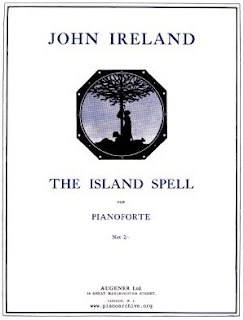
Decorations was published in the summer of 1915, and its issue was noted in several journals at the time. There are three movements: The Island Spell, Moon-glade and The Scarlet Ceremonies. In 1919 all three pieces were published individually. The first number is often played alone.

The Island Spell was completed during the summer of 1911, when Ireland was on holiday at Fauvic in Jersey, however, the composer was unsatisfied with the ending. The revised solution suddenly came to him the following year, whilst back on holiday in the Channel Islands.

I recently came across an unsigned review (Western Daily Express, 4 April 1916, p.5) for a Clifton Chamber Society concert held on Monday 3 April 1916 at the Victoria Rooms, Clifton, Bristol. The entire evening was dedicated to British music and was presented by the Clifton Quintet. For the record, the performers were Herbert Parsons (piano), Maurice Alexander (first violin), Edgar Hawke (second violin), Alfred Best (viola) and Percy Lewis (cello). The concert opened with the remarkable Biscay Quartet (1913) by John Blackwood McEwen. The author notes that it was still in manuscript. This was followed by York Bowen’s Suite in D minor, op.28 for violin and piano (1909). Three piano solos followed: Two Preludes in A major and E major respectively (1906) by Paul Corder, The Island Spell by John Ireland, and R.O. Beachcroft’s Impromptu No.2 in C. The critic noted that “the ‘Spell,’ is a fascinating example, though somewhat peculiar.” The final piece at this recital was the Phantasy in F minor (1910) by James Friskin.

Of interest, R.O. Beachcroft was then music master of Clifton College. The present work, written in 1910, was dedicated to the evening’s pianist, Herbert Parsons.

So, was this the premiere performance of The Island Spell? There is no way of knowing, but it does push back Craggs’s date by nearly three years.

Looking at this concert some 106 years later gives a good impression of British music that was making headway at the time. Sadly, only Ireland’s masterpiece remains securely in the repertoire today. Recordings have been made of all the other works, save the Beachcroft.

Thursday, 16 September 2021

John Ireland: Trio in D for clarinet, cello and piano (1913)

Before listening to John Ireland’s Trio in D for clarinet, cello and piano, I recommend reading the excellent essay by Stephen Fox at MusicWeb International. I have noted before that this is an excellent piece of musical scholarship, that is not technically off-putting. Further contextualisation of this piece can be gained from the liner notes written by Giles Easterbrook for the Prima Facie recording of the work.  This explains that the Trio’s history is complex, its chronology uncertain and Ireland’s motivation ‘debatable.’  

Distilling all this information provides the following overview of the Trio’s genesis, development and reception. The work appears to have been composed during 1912-1913. It was premiered during a Thomas Dunhill chamber concert in the Steinway Hall on 9 June 1914. The soloists were Charles Draper, who was known as the grandfather of English clarinettists, May Mukle (cello) and the composer playing the piano. After a couple of performances, the composer withdrew the Trio. Subsequently, elements of the piece were introduced into a conventional Piano Trio. Alas, this itself was abandoned. Eventually, some of the music was included in Ireland’s Piano Trio No.3 in E major, composed in 1938. This has established itself in the repertoire.

Stephen Fox, the Canadian clarinettist, clarinet maker and musicologist has reconstructed a ‘satisfying work of some beauty, great vigour and a delightful addition to the repertoire’. The above-mentioned essay by Fox explains how this was achieved.

What does this Trio sound like, and how does it fit into John Ireland’s musical aesthetic? I think that listeners who are au fait with the composer’s music will recognise the present work’s pivotal nature. The influence of Johannes Brahms and Charles Villiers Stanford had been respectfully laid aside to be replaced by something that nods to Maurice Ravel and Claude Debussy. On the other hand, Fox makes a valid point in declaring that this Trio could not have been written by anyone other than a British composer. Certainly, there are some hat tips to folksong, if not any actual quotations.

This is a gorgeous work that provides the listener with a beautiful evocation of the landscape heard through the prism of Ireland’s mind. It is hard to believe that there are only two recorded versions of this masterpiece currently available. It seems to me that this pivotal work should be at the forefront of John Ireland’s chamber music repertoire.

An excellent recording of Ireland’s Trio can be heard on the Prima Facie CD label (PFNSCD 009). It is performed by the Tritium Trio: Jernej Albreht clarinet, Joseph Havlat, piano, Lydia Hillerudh, cello. Other works on this disc include John McCabe’s Sonata for clarinet, cello and piano (1969), Kenneth Leighton’s Fantasy on an American Hymn Tune (1975) and Giles Easterbrook’s Trio (2002).

The Naxos recording of John Ireland’s Trio in D for clarinet, cello and piano, has been uploaded to YouTube. It is presented as three videos: Allegro non Troppo, Scherzo-Vivace and Lento con moto. The artists are Robert Plane, clarinet, Sophia Rahman, piano and Alice Neary, cello.


Sunday, 29 November 2020

John Ireland (1879-1962): Adam lay ybounden

Brierley after Holman Hunt

Advent Sunday is here once again. For Christians, this is the first day in a season of preparation leading up to the Nativity on 25 December. The liturgical theme of today is the Judgement to come, its causes, its certainty, and the way of escape. Much of the day’s liturgy reflects on the Coming of Christ, the End of the World and a personal need for divine forgiveness.

It is interesting that the Anglican Church’s Prayer Book Gospel for the Day is Matthew 21.1-13. This text, which is a description of Palm Sunday, provides a picture of Jesus coming in meekness and humility and casting out the works of darkness. 

One of the loveliest carols sometimes heard at this time is John Ireland’s short ‘Adam Lay Ybounden.’ The text was written by an anonymous author. It is included in a manuscript now in the British Library (Sloane 2593, ff.10v -11). It is dated to around 1400.

Theologically, these words are a meditation on the fall of humankind, but with a twist. If Adam had refused the apple offered to him by Eve (as explained in Genesis 3.6) then Mary would never have given birth to Jesus and she would not subsequently to be the Queen of Heaven.  The opening verse reminds the reader that Adam was to have been kept in bonds for 4000 years. I guess that simply means that humanity is subject to sin. The third verse muses on the cosmic consequences of Adam’s action, whilst the last stanza blesses our early ‘father’ for the action he did. For today, stripped of its allegorical language, this carol is a meditation on the sinful nature of humanity which can be read in the news each day, and the Christian’s notion of salvation through the Son of Mary, Jesus Christ.

Adam lay ybounden
Bounden in a bond;
Four thousand winter 
Thought he not too long. 

And all was for an apple, 
An apple that he took, 
As clerkès finden, 
Written in their book. 

Né had the apple taken been 
The apple taken been, 
Né had never our lady 
Abeen heavʼné queen. 

Blessèd be the time 
That apple taken was, 
Therefore wmoun singen 
Deo gracias!

Ireland wrote ‘Adam lay ybounden’ in 1956. The carol was for conceived for unaccompanied mixed chorus – soprano, alto, tenor and bass. It is not known when it was first performed. The score was published by E.H. Freeman & Co. Ltd., in 1956. (University Part Songs and Anthems No,115).  Musically, the composer is looking back to his younger days. Anyone who knows Ireland’s music will be conscious of the self-referencing to his well-known The Holy Boy in this carol. The Holy Boy was originally written for piano in 1913, as the third of four Preludes. It immediately became popular and was subsequently arranged for a wide variety of instrumental and choral forces.  Philip Lancaster (‘The Part Songs of John Ireland’ in ed. Foreman, Lewis, The John Ireland Companion, Boydell Press, 2011, p.296)  suggests that despite ‘Adam lay ybounden’ ‘aping’ The Holy Boy it is ‘a setting that deserves attention, both for its beauty, its simple directness, and in its embodiment of Ireland’s style.’ Certainly, the modal flavour and the shape of the melodies are ‘immediately identifiable’ as being by the composer. Finally, Lancaster notes that ‘Ireland is hugely successful at portraying innocence, imbued with a unique melancholy.’

Fiona Richards, in her masterly study of the composer (The Music of John Ireland, Ashgate 2000, p.62) explained that in the last few years of Ireland’s life he ‘rediscovered his interest in writing for the church.’ This resulted in several new works and some revision of old ones. It does not imply that he resolved personal dilemmas over High and Low Church or his interest in Paganism.

In 1957, John Ireland made a setting of Psalm 23, The Lord is my Shepherd. This was for solo voice. It remains unpublished. Two years later, he wrote a fine Meditation on John Keble’s Rogation Hymn for organ: this was to be his final composition.

Many settings of ‘Adam lay ybounden’ have been made, including examples by Boris Ord (1897-1961), Benjamin Britten (1913-1976) in his A Ceremony of Carols (1942), Peter Warlock (1894-1930) and the present example by John Ireland (1879-1962).

There have been several recordings of John Ireland’s ‘Adam lay ybounden’ over the years. The earliest would seem to be Worcester Cathedral Choir conducted by Donald Hunt. This was released on the superb Abbey label. (LPB 803) in 1979. It was part of an album devoted to Ireland’s choral music.

The most convenient recording appears on the Naxos label. The CD (8.573014) was made by the Lincoln Cathedral Choir conducted by Aric Prentice. This carol is grouped together as ‘Four Unaccompanied Carols, also featuring ‘New Prince, New Pomp’ (1927), ‘The Holy Boy’ (1913, arr.1941) and ‘A New Year Carol’ (1941). This remarkable disc also includes a wide range of Ireland’s other church music. This version of this carol has been uploaded to YouTube.