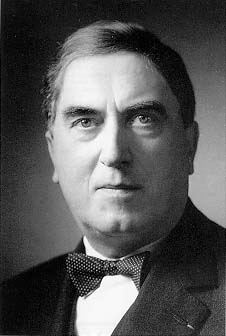
Enthusiasts of Alan Rawsthorne’s
(1905-71) orchestral music can be satisfied that most of this repertoire is
available on at least a single CD. One
piece that seems to have escaped the recording studio is the late Triptych,
completed in 1969. To be sure at least three archive recordings are extant.
The year 1969 had been relatively
quiet for the composer. The Triptych was the only completed composition
listed in Dressler (2004), p.319). On
the academic front, Rawsthorne had been awarded honorary D.Mus. from both Liverpool
University and Queen’s University, Belfast. (McCabe (1999, p.299). Triptych
was the last orchestral work that Rawsthorne wrote. The following year would
see a final flowering of chamber music: The Quintet for clarinet, horn, violin,
cello and piano, and the Oboe Quartet No.2. There remained an unfinished Elegy
for guitar (1971) which was completed by Julian Bream.
The basic information about Triptych
is straightforward. It was also known as the Prelude, Fantasia and Fugue [or Postlude]
and was completed in 1969. It was a BBC commission. The large orchestra
included triple woodwind, harp and tuba. The duration is about 16 minutes.
The premiere was on Sunday 23
February 1969 at the Ashton Hall in Lancaster, with the BBC Northern Symphony
Orchestra, conducted by Norman Del Mar. This concert was part of the BBC Lancaster
Music Festival running for three days. The entire concert was broadcast live on
Radio 3. During the interval, John Amis talked about this new work. Other music heard included Roussel’s Symphony
No.4 and Felix Mendelssohn’s Violin Concerto, with Alfredo Campoli as soloist. No further performances are
listed in John Dressler’s Bio-bibliography (2004, p.71).
Peter Heyworth, reviewing Triptych’s
first performance in The Observer (2 March 1969, p.28) notes that “…in
scale it was a fairly modest affair, scored for conventional orchestra...” On
the other hand, it seemed “to contain more imaginative music than, for
instance, his last Symphony [No.3] (1964) or the cantata Carmen Vitale
(1963).” The progress of the composition is predicated on the opening chords for
“its distinct harmonic flavour” and acts as “a quarry for its melodic
material.” Stylistically, Heyworth
thinks that there are nods towards Debussy’s opera Pelléas and Mélisande
and Sibelius, at least in the opening pages. He considers that the central
Fantasia is “the most assertive and forthright of the three movements, yet…also
the least interesting.” The finale is the most elusive part of the Triptych.
Despite having been billed as a Fugue, only the central section displays much
“contrapuntal movement.” The remainder recalls chords from the opening Prelude
and provides a cyclic form to the work.
Heyworth concluded his review by
insisting that “in no sense is this a major piece and its very inconclusiveness
is likely to limit its appeal.” He felt that “it had an unobtrusiveness that is
all too apt to be shouted down today.” However, the ultimate success of Triptych
is found “behind its bare and un-gesturing style [where] there lurks a distinct
and individual mood of disenchanted romanticism, and behind an apparent
waywardness and disinclination to force ideas into an ‘effective’ mould, there
lies a firmer snse of purpose and direction than one might suppose.” Quite a
positive assessment, I think.
The Musical Times (April
1969, p.408) critic John Manduell wrote that the concert “began with Roussel's
Fourth Symphony, sensitively and sympathetically shaped by Norman del Mar…[and]
the first performance of Rawsthorne's Prelude, Fantasia and Postlude
[Triptych], in which the delicately drawn outer sections enclose a Fantasia (in
sonata form, be it noted) rich in invention and characteristically strong in
logic. Rawsthorne has here richly rewarded the BBC for its policy of
commissioning a new work for each of these Weekends.”
Norman Kay provided an extensive
analysis and assessment of the Triptych in the Tempo journal (Spring,
1969, pp.54-55). He notes that despite the “fairly large orchestra” the
“resources are used sparingly.” There
are “few doublings, and few overt gestures.” The composer utilises much solo writing,
especially in the woodwind, brass and percussion departments of the
orchestra. Formally, the structure is
“economical” with the two slow and sometimes serious outward movements (Prelude
and Postlude) framing the central faster Fantasia. Kay notes many cross
references between movements, especially the first and last. The essay
concludes by the assertion that: “In general, then, the work's main value is in
confirming Rawsthorne's trend towards unsupported line, and an increasing
desire to leave harmonic implications to the listener's imagination, rather
than spell them out in chordal accompaniments. The present work, in fact, may
very well prove to be a transition to a style based on the 'orchestra of
soloists' which would seem to be the perfect vehicle for Rawsthorne's ideas.”
Sadly, the composer’s death in
1971, did not allow this premise to be tested, at least not in a further orchestral
piece.
The study score, a facsimile of
the manuscript of Triptych, was published in 1971 by Oxford University
Press. R.T.B. writing in Tempo (October 1971, p.463f) notes that the
original title, Prelude, Fantasia and Fugue, “describes the nature of the music
well enough; it is interestingly conceived, there are some unusual and
imaginative orchestral textures and the whole work makes a convincing
impression, which is what one would expect from its composer.”
Sebastian Forbes (Poulton, 1986,
p.136) devotes a brief paragraph to Triptych. He explains that the
opening Prelude is a “miniature slow movement”, followed by the middle section
where “energetic outbursts are short-lived, and the result is fragmentary.” As
for the fugue (Postlude) he notes the subject contains all twelve notes of the
chromatic scale, and relates to the opening movement. Unfortunately, the “development
[of the fugue] is unworthy…”
In his monograph on Alan
Rawsthorne, John McCabe (1999, p.274f) reminds the reader that the composer had
third thoughts about the title: Prelude, Fantasia and Fugue, then Prelude,
Fantasia and Postlude and finally Triptych. The implication was that the
composer “was not completely sure of his aims in the writing of the work.”
The finale, apparently, begins as
a fugue, but does not develop as such. One touching aspect of Triptych
was that it concluded on a single C major pizzicato chord. McCabe notes that
this was Rawsthorne’s favourite tonality, and therefore presents “a genuine air
of finality about it, as if he knew it was his farewell to the orchestra, whose
repertoire he had so marvellously enriched during his career.” Yet, for McCabe,
this sentimentality does not justify positive criticism of the music. He thinks
that “the ideas are patchy…and the vigour of the central Allegro is
fitful.” As the realization of this
middle Fantasia is critical to the work’s success, “its failure to maintain a
line or develop material convincingly is most disappointing.” There was some positive elements, with some
“beguiling orchestral colours” near the Triptych’s start.
I have never heard Alan
Rawsthorne’s Triptych. Due to the Covid Pandemic, I was unable to search
out the score or recordings in the music library. From the above assessments, contemporary
critics did not regard it as a great effort. Yet even Beethoven did not produce
masterpieces every time. I note that the German master’s Wellington’s
Victory op.91, which must be his most drivelling composition, has 18 CDs
listed in the current Archiv Catalogue. Surely there must be an
opportunity for a single recording of Triptych. It need not even be a
new production. As noted above, there are several broadcast recordings
available which could surely be mined for a new CD or stream.
Bibliography:
Dressler, John C. Alan Rawsthorne: A Bio-Bibliography (Westport, Connecticut, Praeger Publishers, 2004).
McCabe, John, Alan Rawsthorne: Portrait of a composer (Oxford University Press, 1999).
Poulton, Alan, ed, Alan Rawsthorne, Essays on the Music (Hindhead, Bravura Publications 1986).
Files of The Musical Times, The Observer, Tempo etc.