Saturday, 15 June 2013

Ian Venables: Complete Works for Piano Solo


Ian Venables has justly gained a reputation as being one of the most important composers of vocal music of our time. He has contributed an impressive array of songs with piano and chamber accompaniments. Only recently, his latest offering, The Song of the Severn, Op.43 was heard at Malvern. It would be unfair and wrong to suggest that his music-making was restricted to the muse of song. A few years ago SOMM released a major retrospective of his chamber music, including the important Piano Quintet Op. 27. This was received with critical acclaim.  In addition there is a fine Rhapsody for organ, a few choral works and some pieces for brass ensemble. Up until the present CD release few people have realised that Venables is also an accomplished writer for the piano. This should have been obvious to any listeners who have approached his songs and chamber works (with piano) and have heard the idiomatic and well-conceived writing for this instrument that is a major part of the success of these works.

I began my consideration of this CD with the Three Short Pieces, Op.5 which date from 1986. If any listener is expecting to find intimations or expansions of Venables’ vocal achievement then this is not the place to look. What he has provided are three impressions ‘for children.’ Now I am not sure that these pieces are necessarily for ‘beginners’: I guess they are possibly about Grade 6. The liner notes suggest that the ethos of the work is meant to be evocative of childhood – in other words an adult ‘reflecting’ on their younger days. Other examples of this in the literature are Debussy’s Children’s Corner, Elgar’s Wand of Youth Suite and many of the piano works by Harry Farjeon and Alec Rowley.  I am not too convinced that these pieces have the ‘lightness’ suggested in the notes. I feel that there is a sadness and nostalgia that counterbalances the seeming innocence and playfulness. The ‘Caprice’ is quite a tricky little piece that exploits a rugged rhythmical figure. The form can be defined as a ‘freak, whim, fancy’.  The Dance of the Teddy Bears is much less whimsical than the title may suggest. It feels that this is more of a case of ‘teddies’ that have reached the grand old age of their ‘companions’ and are dancing a stately minuet rather than frolics ‘down in the woods today...’  The final number of this set is the serious, reflective and possibly even 'melancholic' Folk Tune. This is a big powerful piece that clearly reflects the composer’s respect for Ralph Vaughan Williams. It is built on an arch form with a commanding climax. My only concern is that this group of pieces is a little imbalanced.  The emotional disparity between the ‘Caprice’ and the ‘Folk Tune’ is immense. I feel that the latter could (should?) stand alone as a recital piece.

The Portrait of Janis, Op. 9 is a deeply felt and often moving miniature. It was composed in the autumn of 2000 and was first performed by the composer during a visit to California in the same year.  The composer has summed up this work “…the piece is a wistful evocation of mood, a backward glance, remembering a perfectly happy moment spent with special friends”.
Indeed it is very much about time and place, ‘recollected in tranquillity’, with one such friend placed at its centre: Janis.’ For most of the Portrait the composer has moved his centre of attention away from the United States to that of the English landscape. The notes do not tell of the ‘happy moment’ was a recent or far off event. Whatever the historical and personal associations, Venables has created a perfectly poised reflection that balances sadness with tranquillity and a retrospective mood that defies analysis.

I find Oscar Wilde’s story of The Nightingale and the Rose too hard to bear: it is certainly not one I would choose to read for entertainment or pleasure. It is not fair to repeat the tale as some readers may not yet have read it. The tale is a well-written allegory of selflessness, sacrifice and love.  This story has called forth Ian Venables’ only piece of ‘programme’ music to date. The Nightingale was originally written (and performed) as a children’s ballet for the ballerina Marjorie Chater-Hughes, however it was later ‘extensively’ reworked into an ‘impromptu’. As a piece of ‘theatre’ this music charts the course of the story almost line by line. It is a stunningly beautiful composition that has nothing to do with ‘children.’ I can only listen to this work by blanking the story out of my mind: as such, I can cope with the inherent sadness, heartbreak and tragedy. I do wonder if Ian Venables will one day produce a major ballet score to stand beside John McCabe’s Edward II or Joby Talbot’s Alice.

I listened next to the ‘Caprice’ Op.35, which was commissioned by the Gloucester Three Choirs Festival for their 2001 event.  It was premiered by Philip Dyson. This work is much more powerful and profound than its title would suggest. The opening motive seems to pervade much of this music in an almost minimalistic way: yet, this is no pastiche of Philip Glass or the ramblings of Einaudi. There is plenty of variety and seeming development. The ‘Caprice’ is designed in an arch form with a central section that is withdrawn and possibly even disturbing. The musical material is largely timeless. It is not possible to say that this or that composer has influenced the music; however the central section has a kind of Bach-by-way-of-Finzi feel to it. The opening ‘choppy’ theme is reprised, bringing the work to a satisfying close – but not without one or two references to material from the ‘middle eight’ ‘song without words.’

I have never been to Stourhead in Wiltshire, however, listening to this music (and checking out the website) makes we want to ‘go west’ to see this stunning house and its gardens. The Stourhead Follies, Op.4 was inspired by a visit made by the composer in 1984. The liner notes point out that this left a ‘deep impression’ on the composer and resulted in music that reveals the ‘evocative atmosphere of the gardens.’
The key to this work is in the subtitle – ‘Four Romantic Impressions.’ Nevertheless, this is music that can stand alone without the allusions to the topographical markers. This is not ‘impressionistic’ music as such, but a reflection of the composer’s feelings, moods and, I guess, personal memories of the visit.
The opening number is entitled ‘Temple to Apollo’. It does not require a great knowledge of piano music to divine that Rachmaninov and Ravel (favourites from Venables’ youth) are lurking in the shadows here. The composer does not parody these ‘greats’ but uses their pianism to create an intense and vibrant mood that is quite personal.
‘Palladio’s Bridge’ is almost barcarolle-like with its ‘hypnotically lilting rhythmic figures.’ It is another excellent example of Venables’ ability to make a ‘backward glance o’er a travell’d road.’ This is not written in a smiling pastoral mood as such: there are dark things here that do not feature in a carefree summer’s day in the policies of a big country house.
The third ‘impression’ is ‘Pantheon’ which is quite short, but vibrant and largely untroubled in its mood. The liner notes suggest that the insistent rhythms conjur[e] up a mood of Bacchanalian excess and joyful abandon. The harmonies here are drier and colder: the theme is almost nautical, shanty-like in its statement.
‘The Grotto’ makes a fine conclusion to these four impressions. There is a stasis and sadness here that acts as a foil to much that has transpired. It is quite a long number, but the hypnotic nature of the music makes it one of those pieces that grab hold of you and draws you into the mood. It is hauntingly beautiful and, for me, sums up much that Venables has expressed in succeeding years. The Stourhead Follies may not be typical of British Music of the late twentieth century, it may not be representative of Ian Venables’ musical achievement to date, yet this is an engaging and moving work that can stand alongside many pieces composed by Bridge, Ireland and Bax.

The Sonata: In Memoriam D.S.C.H. Op.1 (1975, rev 1980) is a big work. Written when the composer was only twenty years old, it is much more than a student ‘exercise’ or the extravagant explorations of youth. The work was called forth after the death of the Russian composer Dmitry Shostakovich and was subtitled ‘In Memoriam DSCH’. It was given the Op.1 and (not surprisingly) represents the composer’s earliest mature work for pianoforte. I am about the same age as Venables, yet I never latched onto Shostakovich in those years (or since). I was more impressed by Britten and Tippett at that time. However, Venables was immensely inspired by the Russian’s Symphonies, string quartets and the monumental Preludes and Fugues for piano.
The key to this work has been given by the composer – ‘I was trying in this work to create a similar sound world, not to copy it, but to refract it through an Englishman’s imagination.’ To what extent this has been successful must fall to reviewers who are better acquainted with Shostakovich’s music than I am. From the point of view of music-qua-music I believe that this Sonata works extremely well.
The work is written in three movements: the first is effectively in sonata form and makes use of the Russian composer’s characteristic device of D.S.C.H. (D, E flat, C and B natural) as a key element in its formal construction. There is a structural balance between a ‘harrowing intensity’ in some passages and the ultimate serenity of the coda. The middle movement is a short scherzo which is designed to ‘mirror’ Shostakivitch’s sense of humour. This is complex music with a huge variety of pianistic devices that presents considerable demand on the pianist. The final section of this Sonata is a long, intense ‘adagio’ which has been described as a ‘threnody.’ This song of mourning is presented in deeply ‘sombre mood’ with few flashes of light piercing the darkness. The music builds up to a climax that sees the virtual abolition of rhythm or key centre.
Ian Venables’ Sonata: In Memoriam D.S.C.H. is an impressive work by any standards: for it to be the first major offering from his pen makes it even more remarkable. The listener will be moved and ultimately satisfied by the working out of this Sonata. Whether it is possible to predicate Venables’ later music from this fine Op.1 is a matter for further listening and exploration. It is a fact that the sombre, reflective and often ‘valedictory’ mood that infuses much of his music to date is already present in these pages.

Ian Flint has provided the excellent liner notes: I have relied heavily on these for this review as virtually all these works are ‘premiere recordings’ and there are no discussion or analysis available elsewhere (except for Venables’ website).   I was hugely impressed with Graham J. Lloyd’s performance of all this music. He has a sympathy for, and understanding of, Venables’ aesthetic that discloses itself in virtually every bar of the music.
I would commend this CD to all British music enthusiasts. It is the perfect compliment to the increasing number of CDs that showcase Ian Venables’ undoubted mastery of English song and chamber music. Other desideratum must be the three important works for brass ensemble including the Triptych for Brass and Percussion, op.21 and the Three Bridges Suite for Jazz Ensemble Op.18.

Track Listing:
Ian Venables (b.1955)
Caprice, Op. 35 (2001) The Stourhead Follies: Four Romantic Impressions, Op. 4 (1984) Three Short Pieces, Op. 5 (1986) Impromptu: ‘The Nightingale and The Rose’, Op. 8 (1996) Portrait of Janis, Op. 9 (2000) Sonata: In Memoriam D.S.C.H., Op. 1 (1975)
Graham J. Lloyd (piano)
NAXOS 8.573156
With thanks to MusicWeb International where this review was first published.


Wednesday, 12 June 2013

BBC Light Music Festival 1958

I was investigating the first performance of Phyllis Tate’s London Fields suite which was first given at the BBC Light Music Festival of 1958. A review of this work will be the subject of a future posting on this Blog. However the Festival itself makes an interesting study. It was sponsored by the BBC and London County Council. There were a series of Saturday concerts beginning on 31 May of that year and continuing at weekly intervals until 5 July. It is the list of novelties that will interest enthusiasts of both English music in general and light music in particular.
There were some eight commissioned pieces including:-
John Addison’s Conversation Piece for piano and orchestra
Geoffrey Bush’s Concerto for Light Orchestra
Hubert Clifford’s Cowes Suite
Iain Hamilton’s Concerto for Jazz Trumpet and orchestra
Alun Hoddinott’s Four Welsh Dances
Spike Hughes, The Nonsensical Tailor, a scherzo
Phyllis Tate’s London Fields, a Suite
Dennis Wright’s Casino Carnival.
Of these novelties, there are three currently available on CD – the Hamilton, the Hoddonitt and the Tate. In addition, there were works performed at these concerts by Arthur Benjamin, Robert Farnon, Reginald Tisley, Gilbert Vintner and William Walton.
Some day I will go and dig out the programmes for these concerts and see just exactly what was played. However, the piece that would be my desideratum would be Hubert Clifford’s Cowes Suite. The reviewer in The Times suggests that this work was ambitious and used “conventional gambits effectively.”
And lastly, one fact I learnt – Spike Hughes was the son of the Irish composer Herbert Hughes. And Herbert studied with Charles Villiers Stanford. So the reported Irishry of The Nonsensical Tailor may well have filtered down from the irascible G.O.M?

Thursday, 6 June 2013

Alan Rawsthorne: Cortèges for orchestra


It surprises me that Alan Rawsthorne’s Cortèges is even less well known than most of his works. I listened to this work again after many years and was suitably impressed. In spite of some negative criticism in the Musical Times this work is a striking essay that impresses by the skill of its form and the variety of instrumentation. The title was queried by the contemporary MT reviewer “Why in French?” I am not sure- perhaps the composer wanted to emphasise the ‘funereal’ as well as the ‘triumphant’ – which would be less obvious if he had called it ‘Processionals’?  
John McCabe in his essential study of Rawsthorne’s music notes the considerable length of this overture -some fourteen minutes and comments that this piece manages to achieve “a rare balance between polyphony and intellect on the one hand and sheer delightful entertainment on the other…” The piece was dedicated to Constant Lambert, although it was in fact Basil Cameron with the London Symphony Orchestra, who gave the work its first performance at the London Proms on 23 July 1945.
The piece is divided into two main parts – the first is more in the line of a lament and the latter that of celebration – but not untinged with reflection. Paul Conway on MusicWeb International has noted allusions to Mahler in the first half of the work and suggests that Rawsthorne was able to skilfully combine epic material with intimate moments. The second section of this overture literally sparkles: the mood has changed out of all recognition.  The work was described in the Musical Times as being a ‘packet of procession snap-shots, mostly cheerful in our inconsequential English way, but not very original…”  I think this is being disingenuous although I wholeheartedly agree with the ‘snap-shot’ allusion. This is a good overture that was quite definitely a work of its era. This piece is just as appealing as the better known Street Corner Overture (1944) although Cortèges is much more complex and has a broader emotional reach.
Fortunately Rawsthorne enthusiasts are lucky in having two excellent recordings of theFantasy Overture currently available on CD: The BBC Scottish Symphony Orchestra conducted by Lionel Friend on Naxos and on Lyrita with Barry Wordsworth conducting the Royal Philharmonic Orchestra.

Monday, 3 June 2013

John Ireland & Cyril Scott: Overtures to Maurice Maeterlinck’s Plays

One of the most exciting CD releases of 2013 (so far, and for me) is the Dutton Epoch [CDLX7302] recording of Cyril Scott’s early, romantic Piano Concerto in D, Op.10 (1900) the Cello Concerto, Op.19 (1902) and the Overture: Pélleas and Mélisande, Op.3 (1900). However it is something that Lewis Foreman states in the liner notes that caught my eye. After discussing Scott’s Pélleas, he suggests that it is ‘interesting to compare Scott...with John Ireland... [who was also] fascinated by the symbolist plays of Maurice Maeterlinck.’ Ireland wrote an overture for Pélleas. Both Scott and Ireland produced overtures or an orchestral poem inspired by the same author’s Princess Maleine.

Alas, both the Ireland works have disappeared and are known only from references in the Monthly Musical Record July 1, 1915 and Edwin Evans’ masterly overview of Ireland’s early music in the Musical Times, August 1919. There is no way of knowing what this music sounded like. No performances have been traced: no reviews written.  They were most likely destroyed by the composer.  
Maurice Maeterlinck’s play Princess Maleine was issued in an English language edition in 1892 and Pélleas and Mélisande a few years later. His work would have been a major influence on composers, writers and artists at this time. However, the best known interpretation  of the play is the opera Pelleas and Mélisande by Claude Debussy.
In the John Ireland Companion (Boydell Press, 2011) Lewis Foreman offers one possible glimmer of hope in the recovery of Ireland’s Pélleas or Princess Maleine. In the composer’s catalogue there is a work entitled ‘Orchestral Poem in A minor’ which is dated London 26 February 1904.’ Foreman notes that no performance has been documented from Ireland’s lifetime and that the work appears to have gone unnoticed.  He concludes the discussion by stating that ‘whether it is one of the two overtures Midsummer (another missing work from Ireland’s early years) or Pélleas et Mélisande, or more likely Princess Maleine...it is impossible to say.  However, he suggests that the listener could ‘imagine...those opening sections [of the Poem] evoking the princess in her tower, and the middle section her escape and wandering through an oppressive and frightening forest.’
This 'Orchestral Poem' is unlike anything that Ireland was to subsequently produced, however, there is a power and intensity to this post-romantic work that demands our attention. It is quite possible the composer did not wish to destroy his Maleine and chose to revise it. Let us hope that here in the pages of the A minor Poem we may have some trace of this lost work.
Scott’s overture, Princess Maleine was withdrawn after a Proms performance in 1907.  It was revised and later reappeared as the Festival Overture in 1934. His Pélleas Overture has been reconstructed from manuscript by Martin Yates. 

Friday, 31 May 2013

Havergal Brian: Violin Concerto in C major


The key question about Havergal Brian’s Violin Concerto in C major is whether it ought to be regarded as one of the great British concertos or whether it deserves its relative obscurity.
Now, the Brian aficionado will insist that this work is a masterpiece and deserves to be taken up by any number of leading soloists and orchestras. But what is the competition? I am sure that the readers do not need to be read a lecture on the repertoire, however it is worth a few moments just listing the some key British works in this genre.
Few would argue that the leading contenders are Edward Elgar and William Walton. However, it would be unfair to disregard E.J. Moeran and Benjamin Britten. Another name to be reckoned with is Alan Rawsthorne who composed two excellent examples of the genre which have been recorded by Naxos. The little appreciated work by Fred. Delius is actually rather good. And the offerings by Ralph Vaughan Williams, Samuel Coleridge-Taylor and Arthur Somervell should not be ignored. In recent years there is the stunning Violin Concerto by Lionel Sainsbury. Yet, it is the Elgar and the Walton concerti that really count in the concert halls and on record. I have loved these two works since I was a teenager: both of them reach for the stars and touch the moon. And they have one distinct advantage. They are exposed to the public. They are heard at concerts and on the radio: scores are available for perusal by the musically literate. There are essays available to assist with analysis. And finally, biographies and letters of these composers help us find our way through these pages.

What are we to make of Havergal Brian’s Concerto? Firstly, this is not a new work – it has been around for 70 years. However it had to wait until 1969 before receiving its first performance by Ralph Holmes and the New Philharmonia Orchestra. It is currently available on a Naxos disc which is a re-release: it was originally issued on Marco Polo over 15 years ago.  
Secondly, the first performance of this piece (1969) was at a time when tonal music was at an all time low. In fact, it was likely to have been regarded as being passé by most learned critics at that time. A composer like Havergal Brian was not appreciated. The concerto, although receiving fine reviews, would not catch the eye of the cognoscenti. It would be left to the enthusiasts of Brian’s music to carry the torch. In the second decade of the 21st century we are less inclined to write-off a work because it does not conform to the latest ideas on musical composition. So the work has a good chance of being heard, enjoyed and appreciated without being condemned.
And lastly, in spite of the efforts of the Havergal Brian Society, I doubt that his name will ever rank with Walton and Elgar in the musical public’s perception.

However, after a number of hearings, I am convinced that this work will complete the triangle of key violin concertos produced in the 20th century in the United Kingdom. 
But first of all it is helpful to give a brief resume of the genesis of this great concerto. I rely heavily on the excellent programme notes written by Malcolm MacDonald for the Naxos recording. Brian had composed his Fourth Symphony in 1933 and decided to embark on the composition of a large scale work -the Violin Concerto. As a child, Brian had learnt to play the violin, so it was natural that he should turn to this particular form.
The draft score was completed by June 1934 but unfortunately it was lost on a train trip from Brighton to London Victoria – his briefcase was stolen or mislaid. Typically, he set to work straight away to recover lost ground. He did not try to reconstruct the work from memory but effectively created a new work using what themes and progressions he could recall from the original. The ‘new’ work was finished in the summer of 1935 and was initially called Violin Concerto No.2. It was subtitled ‘The Heroic’ which aptly summed up the effort Brian put into creating this masterpiece. Eventually the composer dropped the No.2 and the name and it became known as Violin Concerto in C major.

It is superfluous to describe the musical progress of this work. The programme notes give a detailed analysis of each movement and the listener can peruse this at leisure. Furthermore it is difficult to try to say what the work sounds like. All sorts of allusions spring to mind. And one of my criticisms of the Brian’s music is that it can sometimes be a little too eclectic. One minute we are reminded of Elgar, then the next Schoenberg and perhaps a few bars later Shostakovich. But at the end of the day the end result is typically Havergal Brian.
The work is in three movements – two ‘allegros’ sandwich a ‘passacaglia’. On my first hearing, I felt that the work seemed unbalanced, but with further hearings it fell into place for me. The equilibrium between the soloist and the orchestra, which can ruin many a good concerto, seems just about right.
One of Havergal Brian’s fingerprints is the tensions in his use of musical language. Much of this work is quite obviously tonal – yet, suddenly he pushes towards an atonality that would have made Ligetti proud! Some of his ‘tunes’ are diatonic and nod towards folk-music but others suggest the breakdown of the key signature. Some melodies could be whistled by the proverbial ‘butcher’s boy on his bicycle’ – others would seem to defy analysis. Often Brian’s harmonies are conventional sometimes they are harsh. Yet the balance is always right. He never loses the plot.

The greatness of this Violin Concerto lies in the well-contrived tension between competing elements and styles. There is an overt simplicity about much of this music that harks back to a more pastoral age, yet some of the more complex passages owe more to Berg and Schoenberg than to English folk song. Much of this concerto is intense, probing the very heart of music and perhaps life itself. This is expressly so in the Lento. Sometimes there is a serenity that lulls the listener into a false sense of security. Occasionally the music appears naïve – there is a passage in the last movement that is almost childish. Yet the balance remains; the equilibrium is never lost. The artistic integrity is never misplaced.

The final recommendation for this work is the blatantly obvious fact that Brian has used the great romantic concertos of the past as models. Of course he knew the Elgar and the Dvorak and the Tchaikovsky. He has not copied or even parodied any of these works. What he has done is learnt the lessons of their style and their balance and created a masterpiece in his own right.
Havergal Brian’s Violin Concerto is available on NAXOS 8.557775

Tuesday, 28 May 2013

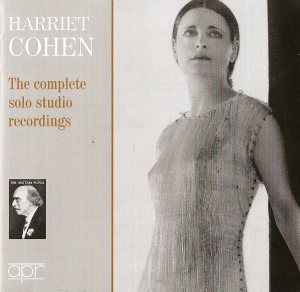
Harriet Cohen: The Complete Studio Recordings

I will not be the first person to have fallen into the trap of regarding Harriet Cohen as being merely a ‘pendant’ of Sir Arnold Bax. To be fair, I first heard of her through my early ‘study’ of Bax back in the nineteen seventies.  The received wisdom suggested that for three decades, she ‘pursued a tempestuous affair with this composer’. When she suddenly discovered that she was not slated to become Lady Bax on the death of his wife, she had an ‘accident’ and cut her wrist whilst carrying a tray of glasses…
Certainly, her colourful personal life has distracted attention away from her achievements in the ‘recital room’ or recording studio. Stephen Siek, in the liner notes, suggests that Harriet ‘as a young woman was beguilingly beautiful, and [that] she rarely hesitated to advance her career through charm and even seduction.’  He mentions her liaisons ‘real or imagined’ with ‘men ranging from H.G. Wells to Ramsey MacDonald.’  Another issue that causes the biographer problems is Harriet’s tendency to fabricate –Siek notes that her autobiography is filled ‘with self-aggrandizing inaccuracies that must be carefully sifted from the truths that it also contains.’
The ‘gossip’ has partially obscured a pianist who was not only great but inspired. Her interpretation of Bach would have been sufficient to have established her reputation for all time. However, as this present collection of recordings proves, her achievement extends in many directions.
Out of interest, W.S. Meadmore quotes a story in the Gramophone Magazine from 1929: ‘When Busoni met Harriet Cohen he looked at her hands and said: "These are the smallest and worst, hands I have ever seen. It would be impossible to play the piano with them. You must give music up." Miss Cohen played to him. He was astonished. He could hardly credit that such hands could make such fine music.’

A few highlights of Harriet’s life and achievements may be of interest to those who have not come across her before.  Harriet Pearl Alice Cohen was born in Brixton, London on 2 December 1895 into a largely musical household. Her father, Joseph, was an amateur cellist and composer and her mother, Kathleen Irene, was an accomplished pianist.  After piano lessons with her mother, Harriet attended the Tobias Matthay Pianoforte School. Other pupils at that time included Myra Hess. In 1908, she gave her first recital – a Chopin Waltz at the Bechstein Hall! Shortly after this, she won an Ada Lewis Scholarship to the Royal Academy of Music where she was one of the star pupils. Harriet won ‘a string of awards’ including the Sterndale Bennett, the Edward Nicholls and the Hine prizes.  She continued her studies with Felix Swinstead and Matthay himself. Whilst at the Academy she was introduced to Arnold Bax and became part of the ‘set’ that adored all things Russian in the wake of Diagalev’s ballet triumphs in London.

One of Harriet Cohen’s achievements was the ‘discovery’ of the significant vein of keyboard music by Tudor and other ‘early music’ composers. This included works by Orlando Gibbons, William Byrd and Henry Purcell.  Another important interest was of Spanish music: she gave the second performance of Manuel da Falla’s Nights in the Gardens of Spain and subsequently performed it many times.
However, her major achievement must be regarded as her exposition of J.S. Bach. The German critic Adolph Weissmann stated that ‘…so deeply has the spirit of the master entered into her that she has few, if any, equals as a Bach player’ and no less a person than Alfred Einstein insisted that ‘she is one of those chosen few who stand among the elect.’  The Times obituary writer notes that Harriet played Bach ‘with great musicianship, precision, buoyancy and an emotional tact which refuses ever to aim at effects outside a true Bach style.’
Over the years, Harriet gave the first performances of a number of important works by contemporary British composers. These included the Piano Concerto by Ralph Vaughan Williams and Bax’s Symphonic Variations. William Walton’s Sinfonia Concertante was introduced by her to France, Spain, Germany and Austria.  European composers including Ernst Bloch and Bela Bartok dedicated works to her. The Soviet composers Kabalevsky and Shostakovich provided her with new pieces: they are represented on these CDs.

Harriet officially retired from public life in 1960. Thereafter she devoted much of her time to the Harriet Cohen International Music Awards and the writing of her autobiography A Bundle of Time. She died on 13 November 1967.

It is not my intention to discuss every number on this superb three CD set – there are 58 tracks each deserving comment and analysis. However, I will mention a few highlights – at least from my perspective.
The lion’s share (32 tracks) of this recording is given over to the music of J.S. Bach. There are three main groupings here. Firstly, there is the important keyboard concerto – No.1 in D minor (BWV1052). This is presented here in two versions – one dating from 1924 and the other from 1946. Both are beautifully stated performances; however the later one is naturally clearer and casts more light on the contrapuntal working out of the piece.  Lewis Foreman has noted that Harriet was ‘celebrated in her day’ for performances of this work.  Once one makes the ‘mental leap’ of hearing this work on the piano as opposed to the clavier, it can be appreciated as a most enjoyable execution. I feel that this music is perfectly poised and ultimately cool in mood.
The ‘pioneering recordings’ of part of Book 1 of Bach’s The Well-Tempered Clavier are critical to Harriet’s career. Apparently, Columbia proposed to issue the entire ‘48’ however, the project never got beyond the first nine. Her playing of these pieces is pretty near perfect. I accept that there have been many fine interpreters of these works – my current favourite is Andreas Schiff. However, Harriet’s commitment to these masterpieces of the keyboard art is impeccable and combines a superb technical approach to the music with a ‘lofty intellectual perception’, which is outstanding. It is only a pity that the set was never completed.
The last element of the Bach recordings is probably less-popular these days – the transcriptions. Perhaps the most famous transcriber of Bach’s music is Busoni; however many other composers turned their hand to this form of arrangement, including Franz Liszt, Max Reger and Sergei Rachmaninov. Harriet also contributed to this genre with a number of pieces including the lovely ‘Beloved Jesus, we are here’ (BWV731) and the stately ‘Sanctify us by thy Goodness’ from Cantata No.22.

It may seem a heresy to many readers when I admit that I am not a huge fan of Mozart’s and Brahms’ piano music.  Naturally, I accept that they are both masters of the keyboard, and concede that it is just the fact that I have not got to grips with their music.  However, I enjoyed the classical and ‘unsentimental’ rendering of the Mozart’s C major Sonata K330. The liner notes rightly admit to the somewhat ‘erratic’ tempos of the first movement – one might call it ‘eccentric.’ However, the slow movement is beautiful and the concluding rondo is perfectly paced.
I am convinced that other reviewers will extoll the virtues of Harriet’s Chopin and Brahms recordings. Certainly, I found her interpretation of the Études attractive, if not revelatory.
The Brahms Ballade in D minor is a ‘big’ work that was inspired by a grisly Scottish ballad tune, ‘Edward’.  Harriet’s performance is expansive and well-balanced. The closing bars of pianissimo are in perfect contrast to the macabre earlier pages.  The Intermezzo in B flat minor is a little lighter in mood, but is still introspective.

I noted above that Harriet took up Falla’s Nights: alas, there is no recording of this work available. However, this collection includes three pieces for solo piano from his pen.  I have always sworn by Alicia de Larrocha for my Spanish piano music; however, Harriet’s performances of ‘Andaluza’, ‘The Fisherman’s Tale’ and ‘The Miller’s Dance’ are beholden to no one. The balance between the fire, the passion and the sultry heat are all ‘present and correct’. These performances are amongst the highlights of a set of CDs full of highlights!

Stephen Siek notes that Harriet’s favourite ‘a cappella’ work was William Byrd’s five-voice mass:  Elizabethan music certainly appealed to her as can be heard in the five short pieces from Orlando Gibbons – ‘Ayre’, ‘Alman’, ‘Toy’, ‘Coranto’ and ‘Mr Sanders his Delight’. I have to admit that I prefer these pieces played on the piano than on the virginal - irrespective of musicological mores. There is a wistful and melancholic beauty about these timeless pieces that defies analysis. I do wish that she had recorded more music from this period. These pieces were taken from Margaret Glyn’s groundbreaking edition of the composer’s works, first published in 1922. Harriet also included Ralph Vaughan Williams heart-breaking Hymn Tune Prelude on [Gibbon’s] Song 13. I feel that this is one of the most moving pieces that RVW composed.

It is naturally good to have everything that Harriet recorded from the pen of Arnold Bax.  The powerful and demanding Paean (Passacaglia) certainly gives the lie to those critics who suggested that her small hands limited her technique. She brings a magic to the ‘Hill Tune’ and to ‘A Mountain Mood’, which is quite simply perfect. Harriet underscores both works’ largely impressionistic nature.  The Morning Song (Maytime in Sussex) which was dedicated to Princess Elizabeth on her 21st birthday is one of Bax’s lighter pieces. Like many of his late works, it has been considered as lacking in inspiration. However, for me it is a delight and manages to portray the idealised landscape, which seemingly inspired it.
One of the pleasures (for me) of the entire set of discs is the highly charged, romantic and very overblown – but gorgeous Cornish Rhapsody from the Gainsborough picture Love Story starring Margaret Lockwood. This performance was used on the film soundtrack.

The liner notes by Stephen Siek are excellent and constitute a major essay on Harriet Cohen’s recording career. It certainly bears careful study both before and after hearing the music. It would have been nice to have had dates for Messrs. Gibbons, Bax, and Bath et al: they were given for many of the other composers. There are some excellent photographs of Harriet of both the studio and the ‘snap’ variety. The CDs themselves are crammed full of music. I guess that they only just managed to fit in all this music on the three CDs.  They are superb values for money -the three discs are available for around £19.

I have never been a great enthusiast for ‘historical recordings.’ For one thing, I never know quite what to expect from the sound quality. Listeners are so used to a pristine reproduction of sound and look askance at any clicks or hiss. The present three CDs certainly have some hiss. Could it have been removed? I guess not. However, I was impressed by the general sound, the pitch seems to be ‘perfect’ and there is little evidence of where the 78 r.p.m. records would have needed to be ‘turned over.’
Yet to possess these three discs I am prepared to forgo my usual reticence to listen to historical recordings. In fact, I would go as far to say that I would give an arm and a leg to hear these tracks – complete with a bit of surface noise.
The reader may well divine that I am still half-in-love with Harriet some 40 years after first discovering her: that may well be true. However, I would challenge any person to listen to her performance of Debussy’ Clair de Lune and not be impressed, challenged and moved.

CD1
J. S. BACH (1685-1750) Keyboard Concerto No 1 in D minor BWV1052 Orchestra /Sir Henry Wood (1924)
J. S. BACH The Well-Tempered Clavier Book I: Preludes & Fugues Nos. 1-9 BWV846 - BWV854 (1928)
BACH/RUMMEL Mortify us by thy grace, from Cantata No 22 (1928)
BACH/COHEN Beloved Jesus, we are here BWV731 (1928)
CD2
J. S. BACH Keyboard Concerto No 1 in D minor BWV1052 Philharmonia Orchestra/ Walter Susskind (1946)
J. S. BACH Prelude & Fugue No 4 BWV849 from WTC Book 1 (1947)
BACH/COHEN Sanctify us by thy goodness; Beloved Jesus, we are here BWV731; Up! Arouse thee! from Cantata No.155 (1935)
BACH/PETRI Fantasia (Praeludium) in C minor BWV921 (1935)
Wolfgang Amadeus MOZART (1756-1791) Piano Sonata No 10 in C major K330 (1932)
Frederic CHOPIN (1810-1849) Nocturne Op 15 No 1; Trois Nouvelles Études Nos. 1 & 3 (1943); Étude Op 25 No 7 (1928)
CD3
Johannes BRAHMS (1833-1897) Ballade in D minor Op 10 No 1; Intermezzo in B flat major Op 76 No 4 (1930)
Claude DEBUSSY (1862-1918) Clair de lune, from the Suite bergamasque; La cathédrale engloutie, No 10 from Préludes Book I (1948)
Manuel DE FALLA (1876-1846) Andaluza, No 4 from Pièces espagnoles; The Fisherman’s Tale, from El Amor Brujo; The Miller’s Dance, from The Three-Cornered Hat (1943)
Dmitri KABALEVSKY (1904-1987) Sonatina in C major Op 13 No 1 (1943)
Dmitri SHOSTAKOVICH (1906-1975) Prelude in E flat minor Op 34 No 14 (1943)
Orlando GIBBONS (1583-1625) Ayre – Alman – Toy – Coranto – Mr Sanders His Delight (1947)
GIBBONS/Ralph VAUGHAN WILLIAMS (1872-1958) Hymn Tune Prelude on Song 13 (1947)
Arnold BAX (1883-1953) Paean (1938); A Hill Tune (1942); A Mountain Mood –Them & Variations (1942) Arnold BAX Morning Song (Maytime in Sussex) Orchestra/ Dr Malcolm Sargent (1947) Arnold BAX ‘The Oliver Theme’ from the film Oliver Twist Philharmonia Orchestra/ Muir Mathieson (1948)
Hubert BATH  (1883-1945) ‘Cornish Rhapsody’ from the film Love Story London Symphony Orchestra/ Hubert Bath (1944)
HARRIET COHEN (1895 -1967)
The Complete Solo Studio Recordings
Harriet Cohen (piano)
APR Recordings APR7304
With thanks to MusicWeb International where this review was first published


Saturday, 25 May 2013

John Blackwood McEwen: Quartet for Strings No.7 in Eb


The Quartet for Strings No.7 in Eb was written in 1916: this was in the middle of the First World War. Therefore, it is hardly surprising that this work was subtitled 'Threnody'. It is a song of lamentation.
This quartet is written in four movements with three of them being slow. The work opens with a very dark and lugubrious Lento. However there are some moments of warmth in this movement. With increasing complexity it builds up to a climax which resolves itself into a restatement of the opening theme. 
This is a satisfying opening movement, showing the composer's genius to the full. The short second movement is full of string effects. The programme notes describe them as ‘late Elgarian arpeggios and motoric figures.’ All too soon we are in the ‘Allegro Molto. There is no doubt that this is the heart of the work. Here we have a stunning display of string writing.  Tunes seem to be passed ‘to and fro’ across this movement. Suddenly a gorgeous phrase is taken up, used and then seemingly cast aside. There is no doubt that this is a masterpiece of string writing. Not until Britten and Tippet do we reach such an understanding of how a string quartet works within British chamber music.
The last movement is a meditation the old Scottish Lament - Flowers of the Forest. This song was composed to remember the fallen at the battle of Flodden in 1513, and is a highly appropriate choice for a work written during the 'War to End all Wars.' Somehow McEwen manages to avoid any sense of the parochial or of pathos or sheer sentimentality. It is a beautiful and perfect ending to a splendid composition.
John Blackwood McEwen’ Quartet for Strings No.7 in Eb can be heard on Chandos CHAN9926.  

Wednesday, 22 May 2013

Myra Hess - The Complete Solo and Concerto Studio Recordings

Myra Hess and I go back a long way. In the mid nineteen-sixties my late father bought a radiogram – complete with multi-stylus feature and auto-changer. I remember that at first he had only two records – one by the great Paul Robeson and the other was the ubiquitous ‘highlights’ from the Huddersfield Choral Society’s recording of Messiah. I had one - Cliff Richard’s Summer Holiday EP - I still have it. A few days after this fine piece of furniture had arrived; a colleague of my father’s turned up at the house with a huge pile of 78 and 33 r.p.m. records. Most of them were dedicated to the crooning of Bing Crosby however one disc was totally out of class – it was Dame Myra Hess playing her transcription of ‘Jesu, joy of man’s desiring’. I confess to having been positively bored by this music and preferred Cliff’s ‘Dancing Shoes’. In fact, the name stuck due to having recently heard a family legend of how the German wartime Rudolf Hess leader had parachuted onto Eaglesham Moor just south of Glasgow close to where an old cousin lived ... I had presumed they were related.

However, years have flown: Myra Hess’ arrangement and recording of JJMD is, to me, one of the most precious things in the world. I have come to love her playing and to appreciate her massive achievement in the musical world. This present CD is a treasure trove for anyone who has fallen in love with this great pianist and I can guarantee that it will give hours of listening pleasure.

I imagine that most readers will have a brief knowledge of Myra’s life and times. However a few biographical notes will be of interest and allow the listener to put this impressive retrospective CD release into context.
Myra Hess was born in North London on 25 February 1890. She began her musical education at the Guildhall School of Music, then located at the John Carpenter Street site. She studied under the pianist Julian Pascal and Robert Orlando Morgan. In 1902 Myra won a scholarship at the Royal Academy of Music. There she studied with Tobias Matthay (Uncle Tobs) and became one of his most distinguished pupils. Other alumni from that era included York Bowen, Clifford Curzon, Moura Lympany and Harriet Cohen. In 1907 she played her debut concert with Beethoven’s Fourth Piano Concerto and Saint-Saëns’ Fourth Piano Concerto under Thomas Beecham at the Queen’s Hall.
Many commentators regard her first major success occurring in the Netherlands in 1912 when she played the Schumann Concerto in A minor with the Concertgebouw Orchestra under Willem Mengelberg.
In January 1922 she made her American debut at the Aeolian Hall in New York. From that time until the outbreak of the Second World War she split her year into three parts – American tour, concerts in Holland and the UK and a two-month working holiday in the country.
Myra’s greatest public achievement was the National Gallery Concerts which commenced on 10 October 1939 and continued until 10 April 1946. Unlike some other composers and performers she turned down a lucrative and ‘safe’ American tour to do this important artistic work.
After struggling with illness, including arthritis and circulatory problems, Myra Hess gave her last public concert on 31 October 1961 at the Royal Festival Hall under the baton of Sir Adrian Boult. She played the Mozart Piano Concerto in A major. For the next four years she led a somewhat reclusive life and died on 25 November 1965.
Myra Hess was awarded a number of honours during her lifetime including a CBE (1936) and a DBE (1941).

What is contained in this five CD set? In fact, it is exactly what it says ‘on the tin’. I did a quick cross-check with the ‘Hess Discography’ prepared by F.F. Clough and G.J. Cuming and presented as an appendix to Denise Lassimonne’s book Myra Hess by her Friends (Hamish Hamilton, London, 1966). What has been issued here is the ‘complete commercial recordings of the solo and concerted piano music’. Chamber music has not been included. Unsurprisingly, there are many non-commercial recordings and BBC transcription discs and tapes of American broadcasts that form part of Myra’s recorded legacy.

There are so many works presented in this five-disc set, that I do not feel I can discuss each one in detail: I intend to give a brief overview of the corpus and consider a number of personal highlights. Myra Hess had a considerable repertoire. However as she matured, she tended to concentrate on the established classical and romantic repertoire. These are extensively represented in the set.

Three names permeate the track-listings – Bach, Brahms and Beethoven. There are three performances of the above mentioned ‘Jesu, joy’. Other examples from Bach’s pen include the Gigue from the French Suite No.5, a Prelude and Fugue in C sharp from Book 1 of the ‘48’ and the ‘Allegro’ from the Toccata in G major BWV916. Any of these pieces will convince the listener that she was an expert at playing this kind of music. I mention the late sonatas of Beethoven in a later paragraph; however I was taken by her charming and ultimately innocent account of ‘Für Elise’. Brahms is represented by a number of his Intermezzi, Waltzes and Capriccios.

Maurice Hinson suggests that Schubert’s Sonata in A major D.664 is one of the ‘technically easy’ examples in the set. It is also one of the most performed. I find Myra’s interpretation of this ‘easy’ work both illuminating and largely untroubled. The middle movement impressed me most. It is one of the few Schubert Sonata movements that I can hack/battle my way through. Her moving performance is a master-class. The finale is pure magic.

In the early days of her career Myra Hess would regularly play works from the turn of the twentieth century. However, as time went on she tended to drop these from her repertoire. Fortunately she recorded a number of them for the American Columbia label. Included here are Debussy’s Poissons d’orfrom Images Book 2, the ubiquitous La fille aux cheveux de lin and Minstrels from the Préudes. How could any pianist fail to want to play Ravel’s gorgeous Pavane pour une infante défunte? Other ‘modern’ numbers include a commanding version of Manuel de Falla’s Ritual Fire Dance which sounds fresh after 84 years. American audiences must have been grateful for the inclusion of Charles Griffes The White Peacock in recital programmes. Interestingly this piece was inspired by William Sharp/Fiona McLeod’s poem – ‘Deep in the heart of a sea of white violets/Slowly, white as a snow-drift, moves the White Peacock.’ It is an impressionistic dream. This audience would also have loved her rendition of Edward MacDowell’s AD MDCXX from the once popular Sea Pieces Op.55. Here she manages to recreate the profoundly rolling sea that the Mayflower encountered as she headed across the Atlantic. It is a pity that there is no recording of one of her other favourites – Walton O’Donnell’s Before the Dawn. Perhaps one day someone will record it in her honour.

I was delighted that a number of British composers appear in the discography. Chief amongst these is the massive Sonata by Howard Ferguson which is a tragic reflection on the death of his piano teacher Harold Samuel. This is one of the misplaced masterpieces of British piano literature. Myra Hess explores the depth of pain and despair with great sympathy and clarity. The short, but compelling Bagatelles are also given here. Interestingly, she performed these works at the National Gallery Concerts, possibly in recognition of Howard Ferguson’s huge contribution to that project.

The short selection of pieces by Purcell arranged by Myra are beautifully stated and well suited to the piano. It would be a hard-hearted person who did not melt to her performance of the Nocturne No.4 in A major by the Irish composer John Field. Two treasures are the Album Leaf Op.22 and Elves Op.17 by Tobias Matthay, which are, I believe, the only available recordings. It is a fitting tribute by his pupil whom he regarded as his ‘prophetess’.

I felt that the Mozart Piano Concerto No.21 in C major K467 has stood the test of time. This recording was made during 1942. It is my favourite of the set of 27 and I was delighted to find that Myra excels herself. She manages to balance a truly dazzling performance with a studied, gentle touch and thoughtful phrasing. The slow movement was taken at a considerably slower pace than that for which this Elvira Madigan music is best known. Maybe this is too slow for some people. It certainly brings a greater emphasis on introspection – more than is normally encountered. Yet this was wartime: she strikes the mood just right. The Hallé Orchestra is conducted by Leslie Heward.

Other works will capture the imagination of listeners. I feel guilty foregoing comment on Schumann’sCarnaval, his Piano Concerto and the great Etudes symphoniques. This latter recording has been criticised as not being Myra at her best. The orchestra join forces for a performance of César Franck’sVariations symphoniques. This was one of Matthay’s warhorses and he apparently encouraged his pupils to ‘take it up’. Hess gives a splendid account of this work exploring the depth of feeling that Franck felt lay ‘under the surface of the melody’ (Hinson).

I will be accused of omitting to tell of triumphant performances of some Mendelssohn favourites, a number of beautiful Scarlatti sonatas, the gorgeous The Maiden and the Nightingale by Enrique Granados and a few pieces by Haydn, Dvorák, Palmgren and Chopin.

The two Beethoven Sonatas are at the heart of Hess’s achievement. Both works were issued in the early nineteen-fifties and therefore benefit from good sound quality. Howard Ferguson has written that the ‘recording which comes closest to capturing [her] beauty of tone, human warmth and deep musical understanding is … the Beethoven Sonata in E major, Op.109’. It is certainly a revelation. Her performances of the last three piano sonatas had earned her the greatest of respect, especially in Holland. Sir Paul Mason has written a moving little anecdote about these works: one evening his wife had asked Myra whether she understood what Beethoven was trying to say in his last works. Myra apparently reflected for a little and then replied, “No, but I think Beethoven would understand what I have been trying to do when I play them.’ Mason concluded by suggesting that he expected Beethoven had told her!

The liner-notes are excellent and provide an essential introductory essay on Myra Hess’s recording career. As noted in my review for the Harriet Cohen set in the same series, it would have been good to have had a few composer dates. It is fine not giving Beethoven, Brahms and Bach’s details but listeners may not have those of Scarlatti, Griffes, Matthay and MacDowell at their fingertips. There are some excellent ‘new’ photographs which I have not seen before. Also included is the well-known picture of her playing the piano complete with fur-coat in an unheated National Gallery.
I have outlined the musical content of these five CDs above. However I am amazed at just how many pieces have been included: there are more than 50 works. All five discs are just under/over 80 minutes of playing time. All this is priced at a ‘mere’ £25 (APR Website Price). The value of this collection cannot be faulted.
I have noted in the past that I am not a great enthusiast for ‘historical recordings’. If I am honest I usually prefer the latest version - assuming artistic integrity. I have never been too sure what to expect from re-mastered 78 r.p.m. discs and early vinyl. Should all the clicks and hiss have been removed? Does the technology exist to do this? Would we want to do it?
The present recordings all contain ‘imperfections’ that would not be tolerated by the fastidious listener of today. However, this is a small price to pay for such a stunning collection of music played by one of the most talented of British pianists.

Finally, Arthur Mendel wrote that he doubted ‘that any of Myra’s records will convey to future generations what we found unique in her’. The reason he gave for this contention was her ability to put the listener in direct contact with the music. She had difficulty in imagining an audience at the other end of a chain of electromechanical links – microphone, amplifier, tape, disc, stylus, amplifier, and loudspeaker. He insisted that Myra had to be challenged by an audience ‘physically present’ and that that the ‘moment she lived for was that in which she felt the triumph of achieving communication to people who at all other moments were by comparison strangers to her.’
 Listening to this music some sixty years after the last track was ‘laid down’ one can sense much of this ‘triumph of communication’ in spite of Arthur Mendel’s reservations. That is because these recordings - plus a few others - are the only record we have of such an inspired pianist.
Track-Listing:
CD 1 The American Columbia Recordings, 1928–1931 [78:51]
J. S. BACH (1685-1750)/Myra HESS
Jesu, joy of man’s desiring [3.18]
J. S. BACH
Gigue from French Suite No 5 in G, BWV816 [3.20]
Prelude & Fugue in C sharp BWV848 from WTC I [3.21]
Allegro from Toccata in G major, BWV916 [1.58]
Giuseppe Domenico SCARLATTI (1685–1757)
Sonata in C minor L352 (Kk11) [1.58]
Sonata in C major L104 (Kk159) [1.40]
Franz SCHUBERT (1797-1828)
Sonata in A major D664, [18:23]
Franz SCHUBERT /Rudolph GANZ (1877-1972)
Ballet music from ‘Rosamunde’ [3.52]
Ludwig Van BEETHOVEN (1770-1827)
Bagatelle in B flat major Op.119 No. 11 [1.59]
Johannes BRAHMS (1833-1897)
Intermezzo in C major Op.119 No. 3 [1.43]
Capriccio in B minor Op.76 No. 2 [3.25]
Robert SCHUMANN (1810-1856)
Vogel als Prophet Op.82 No. 7 [3.35]
Felix MENDELSSOHN (1809-1843)
Song without Words Op.38 No. 6 ‘Duetto’ [2.43]
Song without Words Op. 67 No. 4 ‘Spinning Song’ [1.46]
Selim PALMGREN (1878-1951)
'Cradle song' from Preludes Op. 17 No. 9 [3.24]
Maurice RAVEL (1875-1937)
Pavane pour une infante défunte [5.52]
Claude DEBUSSY (1862-1918)
Poissons d’or Images, Book 2 No. 3 [3.49]
La fille aux cheveux de lin Préludes I No. 8 [2.21]
Minstrels Préludes I No. 12 [2.07]
Charles GRIFFES (1884-1920)
The White Peacock Op.7 No.1 [4.34]
Manuel de FALLA (1876-1946)
Ritual fire dance from ‘El amor brujo’ [3.42]

CD 2 The English Columbia Recordings, 1933 [80.43]
John FIELD (1782-1837)
Nocturne No 4 in A major [3.39]
Frederic CHOPIN (1810-1849)
Nocturne in F sharp major Op. 15 No 2 [3.34]
Edward MACDOWELL (1860-1908)
AD MDCXX Op. 55 No 3 [2.51]
Antonin DVORÁK (1841-1904)
Slavonic Dance Op. 46 No 1 (duet with Hamilton Harty) [3.28]
The HMV 78-rpm recordings, 1937–1949
Henry PURCELL (1659-1695) /Myra HESS
Saraband; Minuet; Air [4.43]
Giuseppe Domenico SCARLATTI
Sonata in G major L387 (Kk14) [2.53]
J.S. BACH/Myra HESS
Jesu, joy of man’s desiring [3.31]
Adagio from BWV564 [4.29]
J.S. BACH
Prelude in D major BWV936 [2.29]
Franz Joseph HAYDN (1732-1809)
Sonata in D major Hob XVI: 37 I Allegro con brio [4.25]
Wolfgang Amadeus MOZART (1756-1791)
Piano Concerto No. 21 in C major K467 - Hallé Orchestra/Leslie Heward [28:53]
Johannes BRAHMS
Capriccio in B minor Op. 76 No. 2 [3.28]
Intermezzo in A flat major Op. 76 No. 3 [3.16]
Intermezzo in E flat major Op. 117 No. 1 [4.56]
Intermezzo in C major Op. 119 No. 3 [1.42]
Capriccio in D minor Op. 116 No. 7 [2.25]

CD 3 The HMV 78-rpm recordings, 1937–1949 (continued) [79:39]
Robert SCHUMANN
Carnaval Op. 9 25 [26:45]
Piano Concerto in A minor Op 54 - Orchestra [not identified]/Walter Goehr [31:48]
Cesar FRANCK (1822-1890)
Variations symphoniques - City Of Birmingham Orchestra/Basil Cameron [15.30]
Tobias MATTHAY (1858-1945)
Album Leaf Op.22 [3.27]
Elves Op.17 [2.08]

CD 4 The HMV 78-rpm recordings, 1937–1949 (continued) [78.07]
Howard FERGUSON (1908-1999)
Five Bagatelles Op.9 [7.19]
Piano Sonata in F minor Op.8 [21:48]
The HMV LPs 1952–1957
Ludwig Van BEETHOVEN
Piano Sonata in E major Op. 109 [21:33] 
Piano Sonata in A flat major Op. 110 [20:00] 
Klavierstück in A minor ‘Für Elise’ WoO55 [3.15]
Bagatelle in E flat major Op.126 No 3 [3.05]
Felix MENDELSSOHN
Song without Words in A major Op. 102 No 5 [1.06]

CD 5 The HMV LPs, 1952–1957 (continued) [79.30]
Robert SCHUMANN
Piano Concerto in A minor Op.54 - Philharmonia Orchestra/Rudolf Schwarz [32:41]
Études symphoniques Op 13 [26:53]
Giuseppe Domenico SCARLATTI
Sonata in C minor L352 (Kk11) [3.24]
Sonata in G major L387 (Kk14) [2.47]
Enrique GRANADOS (1867-1916)
'The Maiden and the Nightingale' from Goyescas [6.38]
Johannes BRAHMS
Waltz in A flat Op. 39 No. 15 [1.33]
Intermezzo in C major Op. 119 No. 3 [1.48]
J. S. BACH/Myra HESS
Jesu, joy of man’s desiring [3.42]
Recorded between 1928-1957
APR RECORDINGS 7504 
With thanks to Music Web International where this review was first published.

Sunday, 19 May 2013

Charles Williams: Rhythm on Rails.


Charles Williams contributed a number of works celebrating railways. I think of the score to the film Night Train to Munich (1940), the miniature orchestral piece Model Railway and the present Rhythm on Rails.  However, any listener imagining that this present piece has its genesis in a consideration of the Royal Scot speeding between London Euston and Glasgow Central, the Cornish Riviera travelling between Paddington and Penzance or the Talisman connecting Edinburgh with London Kings Cross, will be mistaken. This railway is ‘all-American’. My minds eye sees a heavy goods train crossing the Rockies rather than an express passenger train on British Rail.  It is Casey Jones that has his hand on the regulator.
The musical picture opens gently with steam locomotive sounds which more or less keep up for the duration. There is a little scrurrying tune that features as one of the ‘counter-melodies of the piece. Eventually this builds up to a bold theme delivered on the brass instruments. This has an intimation of a steam whistle. However there is another theme introduced which is a sweeping, romantic tune that acts as a foil to the ‘rhythm of the rails.’ Towards the half-way point the composer introduces a hard, bluesy whistle sound into the musical texture. This is a sinister wailing noise and suggests that the train is insisting everything gets out of its road. The music quickly moves to the coda and ends with a ‘sforzando’ chord, but not before the whistle is heard again – this time it is a little shunter and not a giant freight locomotive.
The work was composed circa 1956 and was likely to have been a contribution to the massive Chappell library of ‘mood music.’
There have been many recordings made of this piece over the year, including some by the composer. However the Hyperion British Light Music Classics., Volume 4, CDA67400 is possibly the best of the currently available versions.
It is often stated that Rhythm on Rails was used as the theme music to Morning Music on the BBC Home Service. However, although this tune was often heard, it was not actually the theme tune. 

Thursday, 16 May 2013

Some New Piano Pieces, 1929 style

One of the minor pleasures, but ultimately of frustration, is noting piano works mentioned in old musical journals. In the present instance, the February 1929 issue of The Dominant devotes a column to recently published piano music with special emphasis on what was useful for ‘educational’ purposes.  It is one of the unfortunate facts of programme makers and recitalists at present (2013) that they tend to avoid this ‘genre’. Presumably this is because they are deemed ‘too easy’ and do not show off the technical achievements of the maestro. A lot of fine music has been lost to concertgoers because of this conceit. For example, the music of Alec Rowley, Felix Swinstead, Harry Farjeon and Thomas Dunhill has disappeared from view. I guess that the assumption is that these composers wrote nothing but ‘educational’ music: pieces that are only of interest to Grade Fivers. Certainly, all of them wrote virtuosic music that deserves the occasional airing.
The present article outlines some dozen or so pieces that lie between what is now Grade 1 and Grade 7. I have not a clue what any of them sound like, save to say that they fascinate me. I guess that if I am honest it is the typically picturesque titles that impress me: as a youngster I would rather have played a piece of music called ‘Pirates Ahoy!’ than a Minuet in G.
Some of these pieces are studies –such as Eva Pain’s Three Rotation Studies – which we are assured are much better than the title suggests. There is apparently some subtle pedalling to engage with.  I wonder what T.A. White’s The Maze and Puck’s Dance sound like – seemingly exactly as their titles suggest.  I have heard of the composer C. Edgar Moy; however his Riverside Days are new to me. They are charming summer pictures expounding short verses by Rodney Bennett (father of the better known composer).  Another pedagogue is Dr. Kitson – famed for his text books on counterpoint and harmony. Seemingly his Two-Part Invention is a ‘tip-toe dance between the two hands’. Who was Sybil Fountain?  Certainly her Sea Horses have evocative titles such as ‘Flying Fish’ and ‘Coral’.  Two descriptive sets of pieces include Norman Peterkin’s Summer Eves, and Barnham Johnson’s Hard-Handed Men which explore the characteristics of six delightful characters from A Midsummer’s Night Dream, including Quince, Bottom, a Carpenter and a Weaver.
The better kent composer, Robin Milford has contributed a ‘senior piece’ with his slow paced Sir Nicholas’ Caper.  E. Markham Lee had issued an impressive sounding suite called Cliff and Tide-Rip, which is ‘entirely free of the ‘written for children’ feeling that spoils so much ‘educational’ music’. Two Pieces were offered by Roy Agnew –one gay, one smooth. Gordon Slater, who is probably best remembered in the organ loft, has published three pieces under the title Bluejacket – ‘Hornpipe’, ‘Sea Croon’ and ‘The Blue Peter’.  One piece that especially caught my eye was F.H. Shera’s Bridge End which seemingly has ‘enormous variations of tone, and pace, all logical and interesting to make.’
Somewhere in my collection of piano music, I know that I have a piece or two by Welton Hickin; however I cannot put my finger on them at the moment. In 1929 his contribution was Three Miniature Dances. At a higher grade level, Norman Peterkin’s Two Tunes for piano (one drowsy, one lively) and Thomas Wood’s Three Plain Tunes deserve mention.
Nancy Gifford concludes her brief review in The Dominant by noting that ‘what is good of all this output of new music ...is first and foremost [that] the pieces are not likely to be met with in examination lists.’ She concludes that they are ‘fresh, wholesome, connected with out of door life, or with literature, and are perfectly free from mawkish sentiment.’  
I guess that I may find one or two of these numbers in second hand music bookshops or charity shops. However, I imagine that most of them I will never play or hear. And I guess that this is a pity...
...hopefully some reader may have a scan of the above mentioned Cliff and Tide-Rip by E. Markham Lee.

Monday, 13 May 2013

British Composers: Proms 1930

It is always instructive to examine reviews of music from the past. There are two key issues here. Firstly, what was the contemporary estimation of a piece of music – especially if it was a first performance and secondly what has been the subsequent success or failure of the music in question. The author of this review from The Musical Mirror has singled out a few pieces of British music which were given at the 1930 Promenade Concerts held at the Queen’s Hall between 9 August and 4 October 1930.

On September 4 the evening opened with Lord Berners’ brilliant and exhilarating Fugue in C minor for Orchestra. Dame Ethel Smyth conduced two of her own compositions, Two Interlinked French Melodies for orchestra and the first concert performance of an Anacreontic Ode for baritone and orchestra, a skilful and picturesque setting of a drinking song, the spirit of which was not entirely caught by Mr. Herbert Heyner. Miss Beatrice Harrison spoilt her performance of Elgar’s Violoncello Concerto in E minor with a cloying and sentimental attitude. Notwithstanding Elgar’s Enigma Variations, the piece de résistance was Constant Lambert’s The Rio Grande, which received a fine performance under the baton of the composer.
On September 11 Alan Bush conducted his Symphonic Impression Op.8, which was written a few years ago, while the composer was studying composition under John Ireland. This work is imbued with his master’s seriousness of outlook, together with a marked individuality and imaginative qualities.  On the other hand, one feels that the thematic material lacks spontaneity, and there are moments when the handling of the orchestra is inclined to be weak and immature.
Mr V. Hely-Hutchinson and Mr. Ernest Lush gave a brilliant performance of Arthur Bliss’ Concerto for Two Pianofortes, a clear cut and vigorous work, written with the usual facile cleverness that characterizes nine-tenths of the music of contemporary composers.
But what pigmies they all appear besides a composer of Elgar’s stature, a fact which duly impressed us on hearing Sir Henry Wood’s fine reading of Elgar’s Symphony No.1 in A flat, in which we have the highest flights of poetical imagination combined with an unsurpassed mastery of technique.
Delius was represented by the exquisite A Song Before Sunrise and the Dance Rhapsody No.1.
The programme on September 18 was interesting in that we were able to compare two distinct generations – William Wallace and Elgar on the the once hand and Arthur Bliss and Holst on the other.  It was purely a matter of artist versus artisans. The former were represented by William Wallace’s shamefully neglected symphonic poem, Villon, a work of genuine inspiration and fine workmanship, and Elgar’s symphonic poem Falstaff, which for beauty and content, consummate technical mastery, and ingenious musical characterisation towered above Bliss’ uninspired Serenade for baritone and orchestra and Holst’s clever but cold Concerto for two violins.  Not even the luscious and full-blooded playing of Miss Jelly d’Aranyi and Mme. Adila Fachiri could make this music thaw.
The Musical Mirror October 1930

Friday, 10 May 2013

Charles Williams: ‘Marianne’


Charles Williams (1893-1978) wrote a huge corpus of music for the concert platform and for the film industry. However, most of the latter is un-credited.  He is best known for the romantic tune The Dream of Olwen which was used in the 1948 film While I Live.  Equally successful was the Devil’s Galop which was the theme music to the successful radio show Dick Barton, Special Agent.  Other well-known tunes are the theme music to the long-running BBC Light Programme “Friday Night is Music Night”. For many years he was the conductor of the Queen’s Hall Light Orchestra.
Marianne is a delicious little concert valse written in an easy going, but typically romantic style.  
After a sad  introduction which is followed immediately by a wistful tune for woodwind supported by strings, the main waltz tune sweeps into the picture. However the opening clarinet theme never quite leaves the scene and we are left with the distinct impression that Marianne is at one and the same time a ‘tom boy’ and a ‘deb.’  Like so much light music the listener is impressed by the formal integrity of this short work, the balance of the themes and the surprisingly subtle orchestration.
It is difficult to date the work; there is no record on COPAC. However the recording of this piece preserved on Guild’s Golden Age of Light Music was made in 1943. This was likely mood music that may have been composed in the nineteen thirties. Certainly Marianne has all the flair of thirties fashion.
‘Marianne’ can be heard on Guild Light Music GLCD 5107